Alternatives
Canva presentation alternatives for teams
Looking for Canva alternatives means you are choosing by constraint, not by trophy. Stay when the design suite already handles brand visuals and light decks well. Leave when serious decision decks need stronger outline discipline than template browsing. Gamma fits outline-first business decks with present-link delivery; it is not always the right replacement. Scores and tradeoffs use the public rubric on the method page and are dated August 2026. We build Gamma and still tell you when to stay or pick another lane. Document dated bake-off notes so the next quarterly review starts from evidence rather than vendor nostalgia. Read stay and leave sections before you cancel seats, alternatives pages are decision tools, not churn scripts.
Evaluation axes:/method. Pairwise detail:Gamma vs Canva.
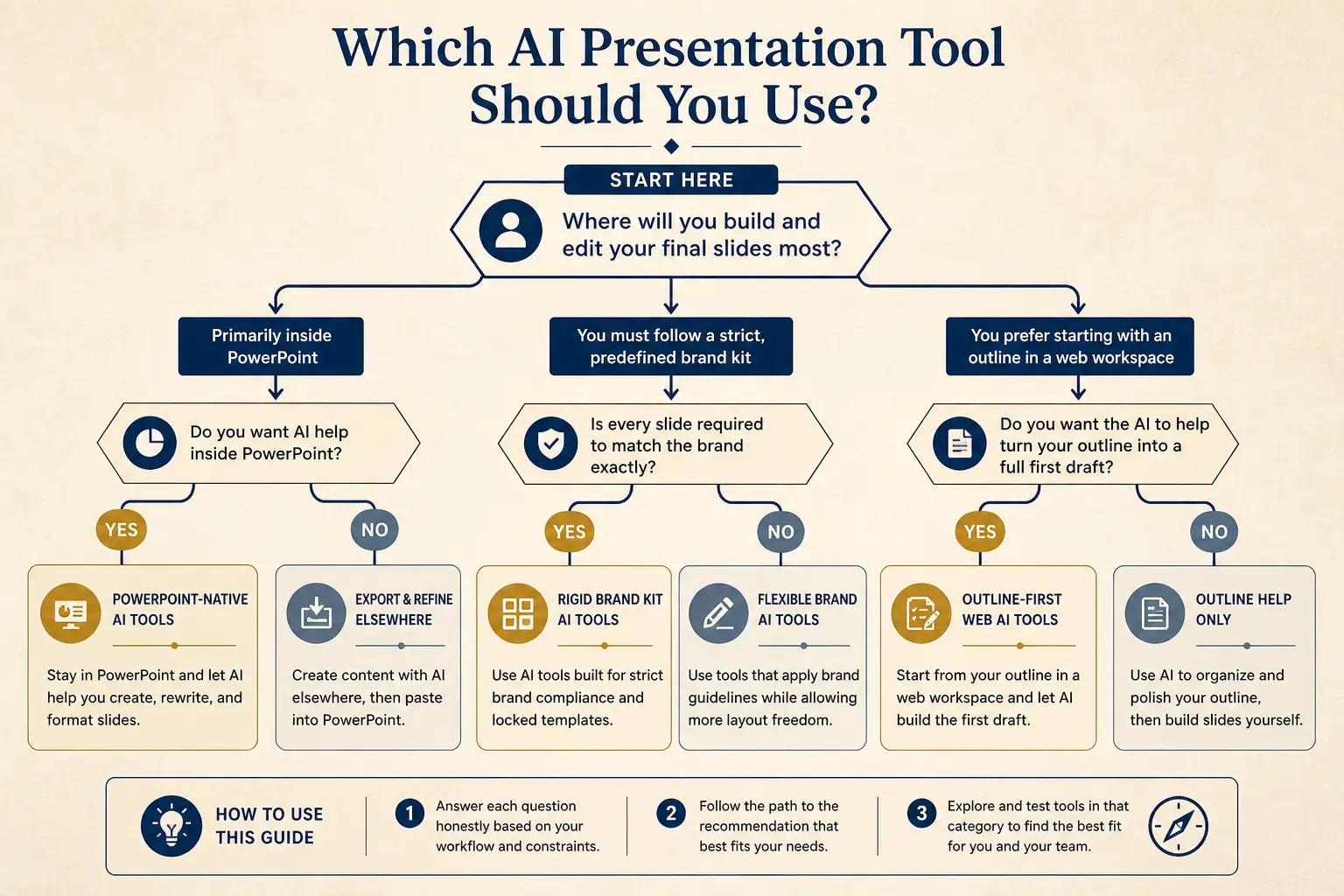
Which tool for which job
Need native PowerPoint editing every day?
Yes → Plus AI / Copilot · No → continue
Need rigid brand kits across a large team?
Yes → Beautiful.ai / enterprise kits · No → continue
Need outline-first AI drafting + present link?
Yes → Gamma
Migration decision framework
Original framework, the Migration Gate. Gate 1: Is the product still fit for your job after verifying current status and pricing as of Aug 2026? Gate 2: Is your pain brand kits, file gravity, analytics, or narrative surgery? Gate 3: Can you dual-run for one quarter by job class? Gate 4: Only then pick a primary alternative and migrate one deck type. Skipping to Gate 4 creates regret migrations. Pair this page with Gamma vs Canva for pairwise scores. Document dated bake-off notes so the next quarterly review starts from evidence rather than vendor nostalgia. If you cannot name which gate failed last time you switched tools, you are guessing again.
Evaluation rubric axes
Outline preview
- Hook, set up 10-slide exec review: goal, progress, risks,
- Evidence, proof, metrics, or examples
- Ask, decision or follow-up
Preview only, Gamma expands this into editable slides.
Stay with Canva if…
Stay with Canva when the design suite already handles brand visuals and light decks well and switching would create more risk than it removes. Staying is a valid outcome of an alternatives page. Procurement should not treat alternatives as a mandate to churn if the current tool still matches the binding constraint for the decks that matter most this year. Document dated bake-off notes so the next quarterly review starts from evidence rather than vendor nostalgia. Write the stay decision down with a date so a future teammate does not reopen the same debate without new evidence.
- Your team already lives in Canva for social, one-pagers, and light internal decks.
- Brand kits in Canva cover the visual jobs you actually ship every week.
- Presentations are occasional, not your core fundraising or enterprise sales motion.
- Switching would fragment a design suite that is working for non-deck creative work.
Stay decision hygiene: name the constraint that still wins, name the owner who can reopen the decision, and set a review date. Without a review date, stay decisions calcify into dogma even after the product changes underneath you.
Leave Canva if…
Leave Canva when serious decision decks need stronger outline discipline than template browsing and a bake-off on Structure and Editability fails under a forced reorder. Leave when stakeholders need a deliverable path, present link or PPTX, that you cannot reliably hit today. Leave when Honesty fails: marketing no longer matches what your seat can do in product. Document dated bake-off notes so the next quarterly review starts from evidence rather than vendor nostalgia. Time-box the leave decision to one job class first; expanding after a win beats a company-wide cutover.
- Investor or enterprise sales decks need claim spines Canva templates do not force.
- You rewrite narratives weekly and the design canvas slows section surgery badly.
- Stakeholders want present-link workflows with clearer outline control than a design board.
- Your failure mode is weak asks and mushy structure, not weak cover-slide visuals.
When Gamma is the fit
Gamma is the fit when you need outline-first drafting for pitches, sales follow-ups, and exec reviews; when present link covers most rooms; and when you accept planned export cleanup. Gamma is also the fit when you want dated, method-based comparisons rather than another undated listicle about Canva replacements. Document dated bake-off notes so the next quarterly review starts from evidence rather than vendor nostalgia. Run the interactive on this page before you buy, the output should point to a concrete Gamma workflow or tell you to stay.
- Narrative decision decks are the job, pitch, sales follow-up, product review.
- Outline-first editing matters more than template marketplace breadth for your outcomes.
- You can keep Canva for design suite work and use Gamma for serious decision decks.
- You want rubric-based comparisons with dated tradeoffs rather than template aesthetics alone.
When Gamma is not the fit
Gamma is not the fit when the design suite already handles brand visuals and light decks well remains the binding constraint and Canva, or a specialist in that lane, already solves it. Gamma is not the fit when daily native PowerPoint editing by legal is mandatory with zero appetite for export cleanup. Pick the lane winner; do not force Gamma into a kit or file-gravity job it will lose. Document dated bake-off notes so the next quarterly review starts from evidence rather than vendor nostalgia. Forcing Gamma into a not-fit lane creates shadow Canva or PowerPoint usage within a month and poisons the evaluation.
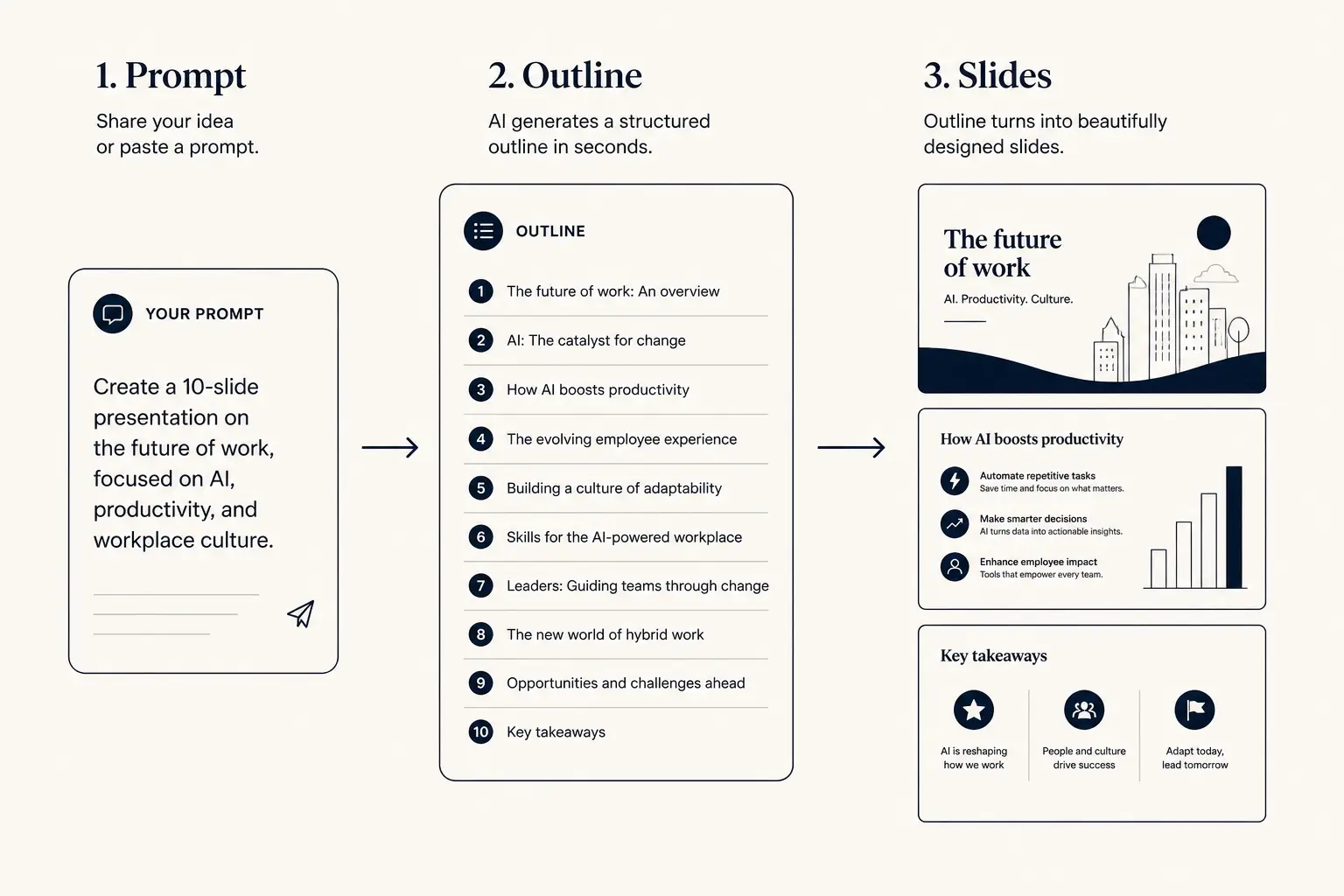
Prompt → outline → slides
1. Prompt
Audience, goal, length, proof you already have.
2. Outline
- • Opening claim
- • Proof beats
- • Ask / next step
3. Slides
Alternative shortlist
Shortlist alternatives by job class, not by blog ranking. The table below maps common replacements after Canva. Re-score each option with the same brief and forced edit. As of Aug 2026, verify pricing and features on vendor sites before you buy seats or cancel Canva. Include adjacent stack costs in total cost of ownership. Document dated bake-off notes so the next quarterly review starts from evidence rather than vendor nostalgia. Invite one skeptic from brand, legal, or sales into the bake-off so constraints surface before contracts are signed.
| Option | Best when | Watch-out |
|---|---|---|
| Gamma | Narrative business decks | Not a full design suite |
| Stay on Canva | Design suite + light decks | Weak forced structure |
| Beautiful.ai | Rigid brand kits | Less open-ended rewriting |
| Pitch | Sales team analytics | Different than design suite |
| PowerPoint + AI | File-native enterprise | Blank-canvas risk remains |
Worked migration scenario
Worked scenario A: a product team uses Canva for weekly reviews but fights the tool when risks must jump ahead of options. They rebuild one review in Gamma from claim titles, keep Canva for jobs it still wins, and measure time-to-decision for four weeks. Dual-run wins if both constraints remain real and measurable. Document dated bake-off notes so the next quarterly review starts from evidence rather than vendor nostalgia. Capture minutes-to-decision and number of forced edits survived, vanity screenshots do not convince finance.
Worked scenario B: a founder leaves Canva because the job is fundraising narrative. They inventory metrics and customer proof, lock a seed arc, generate in Gamma, and only then decide whether a PPTX-native tool is needed for a stubborn partner. Scenario C: they discover the pain was missing proof, not the tool, and pause migration until the evidence inventory exists. Document dated bake-off notes so the next quarterly review starts from evidence rather than vendor nostalgia. If scenario C is your reality, fix proof inventory before you spend another week comparing logos and pricing pages.
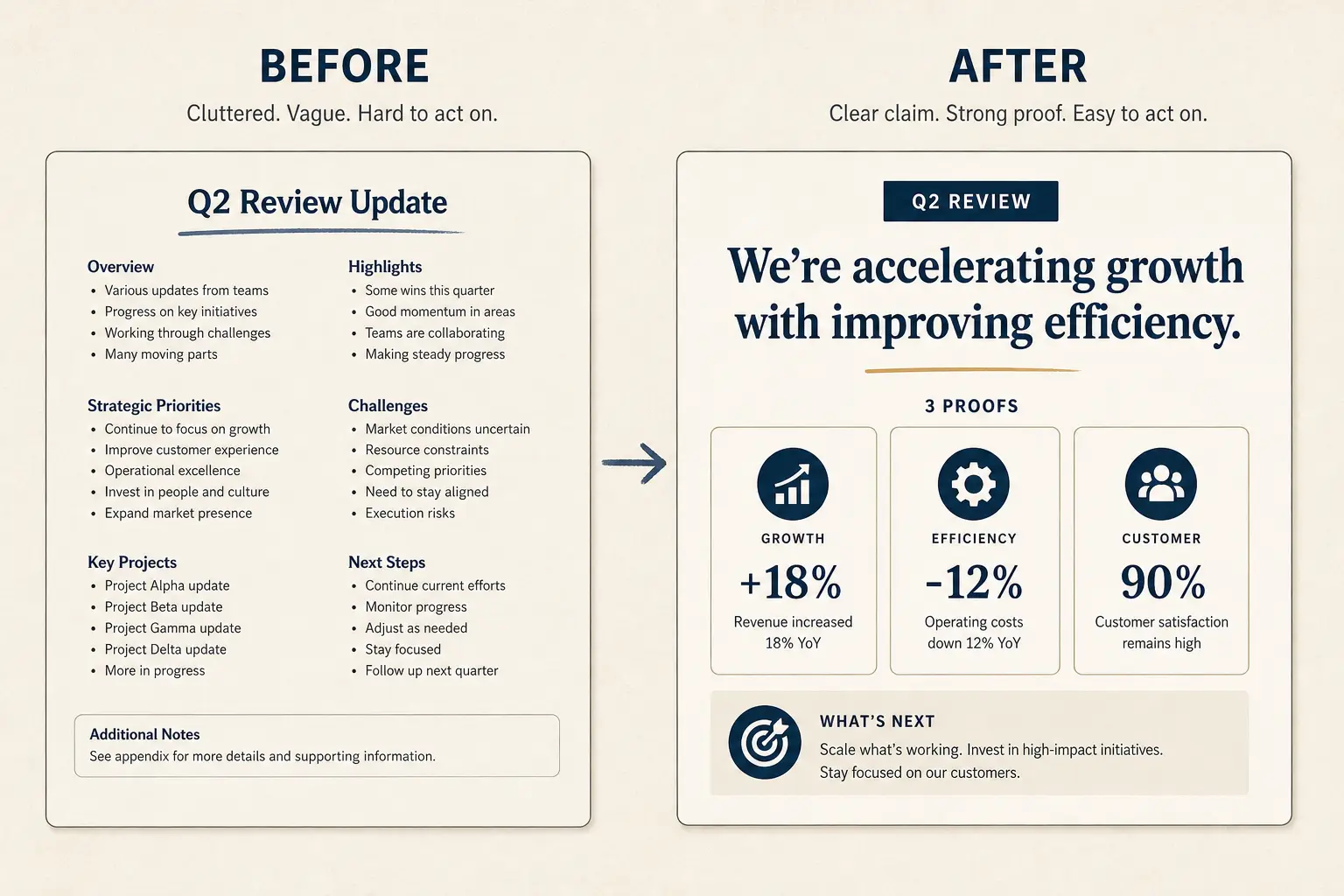
Weak slide → strong slide
Before
- • Overview
- • Features
- • Next steps???
After
- • Cost of status quo
- • Wedge in one claim
- • Proof + decision ask
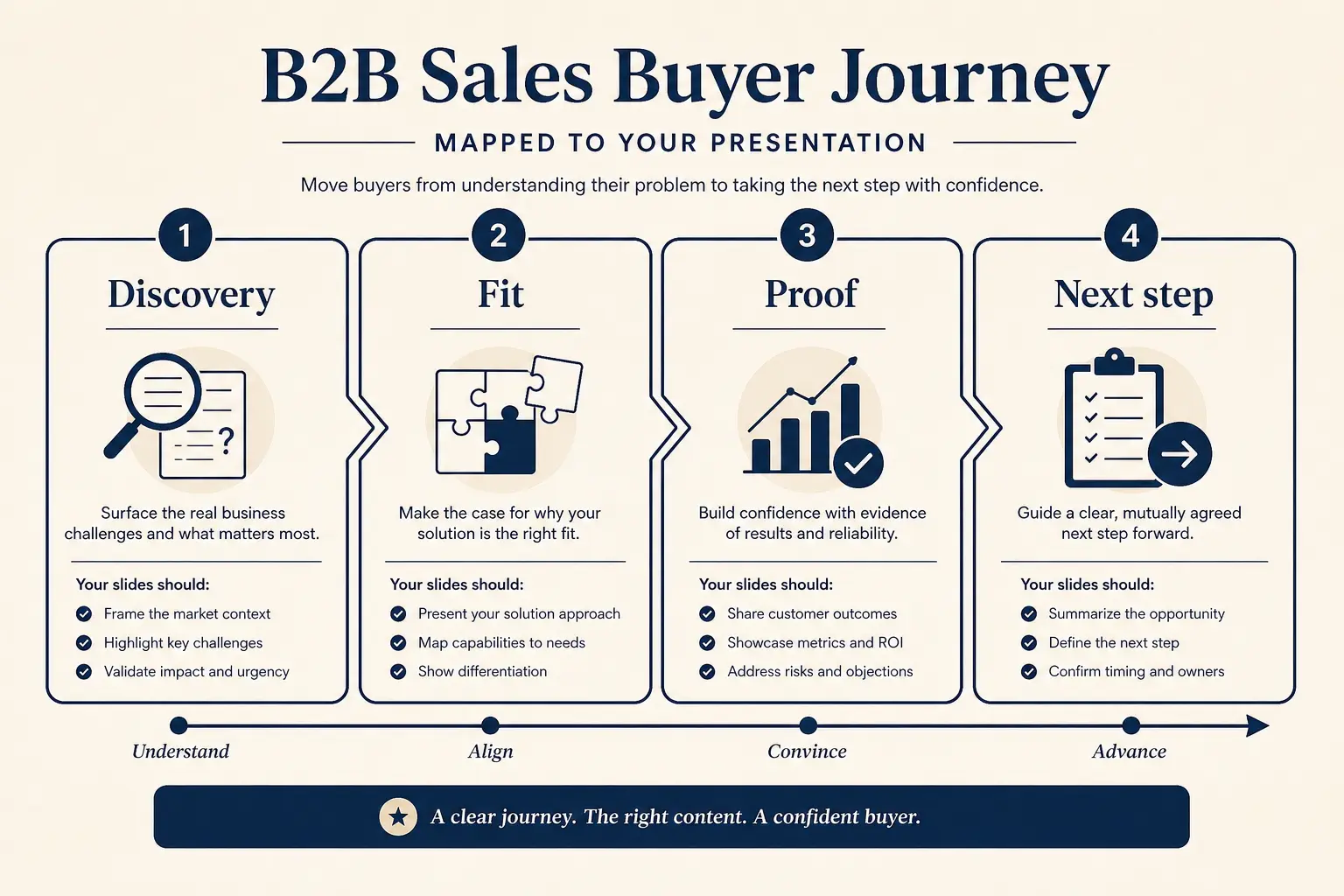
Buyer journey → slide map
Discovery
Pain + stakes
Fit
Why you win
Proof
ROI / risk
Next step
Clear ask
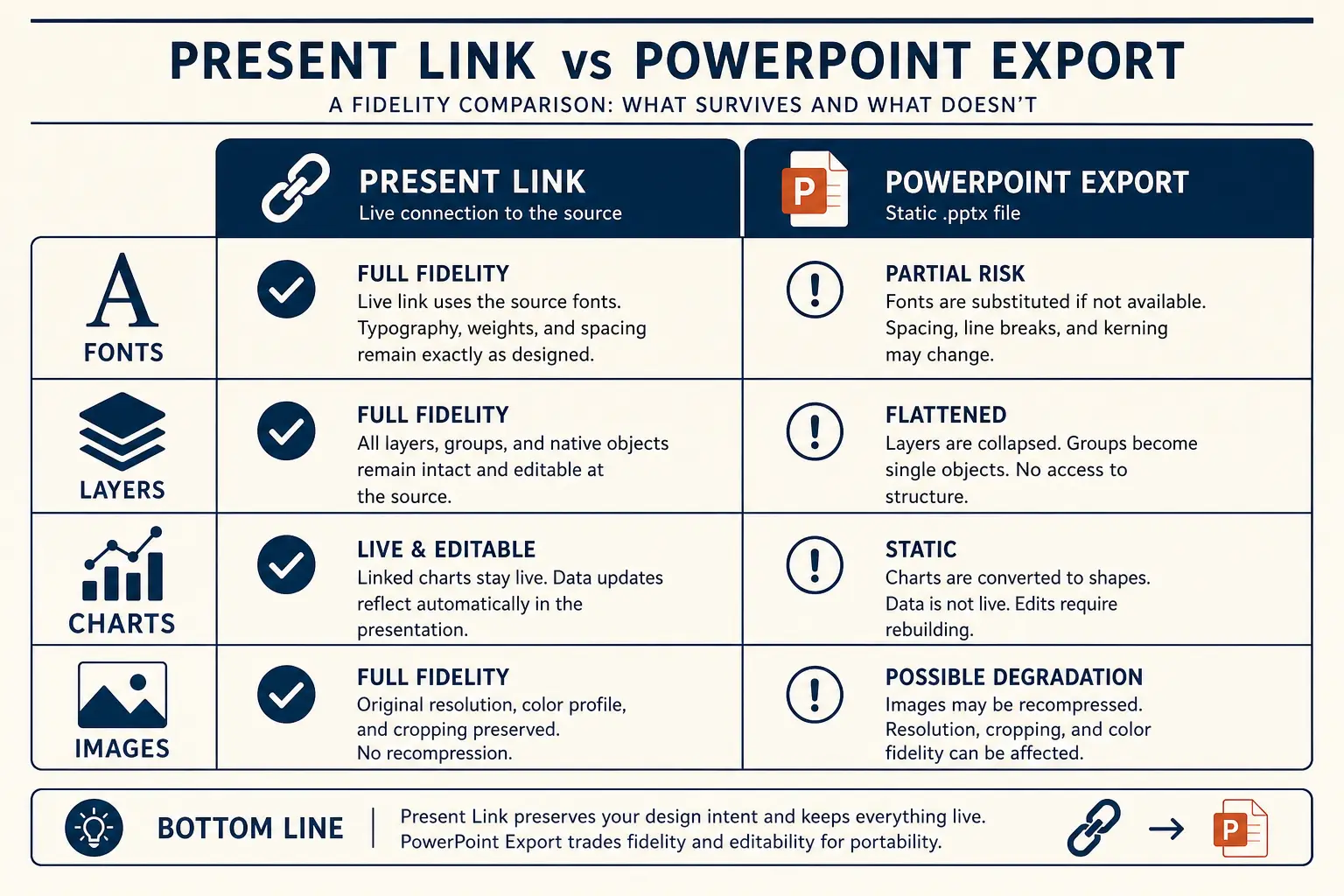
Present link vs PPTX fidelity
Present link
- • Live latest edits
- • Best for your room
- • Analytics-friendly
Export PPTX / PDF
- • Offline / procurement
- • Brand review in PPT
- • Expect cleanup passes
Time-to-usable-deck
Blank PPT path
Outline in docs → design fight → rebuild → 3–8 hours
Outline-first AI path
Prompt → edit outline → generate → polish → minutes to first usable draft
Failure modes and what to cut
Failure modes when shopping Canva alternatives: cloning aesthetics instead of migrating arguments; canceling seats before one job class succeeds; ignoring export requirements; trusting undated pricing; and picking the wrong lane winner for the wrong failure mode. Cut big-bang cutovers that touch every template in a single weekend without a rollback plan. Document dated bake-off notes so the next quarterly review starts from evidence rather than vendor nostalgia. The migration anti-pattern is aesthetic cloning: recreating old templates without fixing the ask, proof, or section order. Re-read the method page whenever a vendor launches a major AI feature so your scores stay comparable across quarters.
- Cut replacing Canva entirely if non-deck design work still depends on the suite.
- Cut judging Gamma by cover-slide aesthetics alone without a forced narrative edit.
- Cut migrating without separating light decks from decision decks by job class.
- Cut undated Magic Studio claims, verify in-product as of Aug 2026 before you buy.
Pricing note (August 2026)
Pricing note dated August 2026, verify on vendor sites for Canva and every alternative you shortlist. Seat definitions, AI credits, and export gates change. Screenshot pages for procurement. Include adjacent stack costs when the alternative lives inside Microsoft, Google, or a design suite. Ignore aggregator dollar amounts from older posts. Document dated bake-off notes so the next quarterly review starts from evidence rather than vendor nostalgia. Ask vendors whether AI credits, brand kits, and export sit on the same tier you are buying, SKU splits hide true cost.
Concrete next step
Concrete next step: pick one live deck that represents your pain with Canva. Export or copy its text. In Gamma, rebuild claim titles only, generate, force a section reorder, rewrite one metric, and present. If it fails your constraint, pick the lane winner from the table instead of forcing Gamma. Save the outline and scores with dates beside the decision. Document dated bake-off notes so the next quarterly review starts from evidence rather than vendor nostalgia. Put the winning outline in your wiki with the scorecard; next quarter starts from that artifact, not from memory. Re-read the method page whenever a vendor launches a major AI feature so your scores stay comparable across quarters. If the candidate tool wins, schedule the second job-class migration only after two successful live meetings, not after one friendly internal dry run.
Frequently asked questions
Move one serious deck off Canva
Rebuild a pitch or sales deck in Gamma from claim titles, keep Canva for the design suite jobs it already wins.