Learn · Pitch
Pitch decks that raise meetings
A pitch deck is a meeting opener, not a business plan with transitions. Investors decide in minutes whether the story is coherent enough for a deeper conversation. Your job is to make the narrative recognizable: problem, solution, why now, market, product, traction, model, team, and ask, in an order that matches your stage.
This hub covers structure, stage differences, and AI workflows that keep you from shipping slide soup. For the product path, see the AI pitch deck generator. For annotated shapes, see examples. For ongoing investor communication, see fundraising.
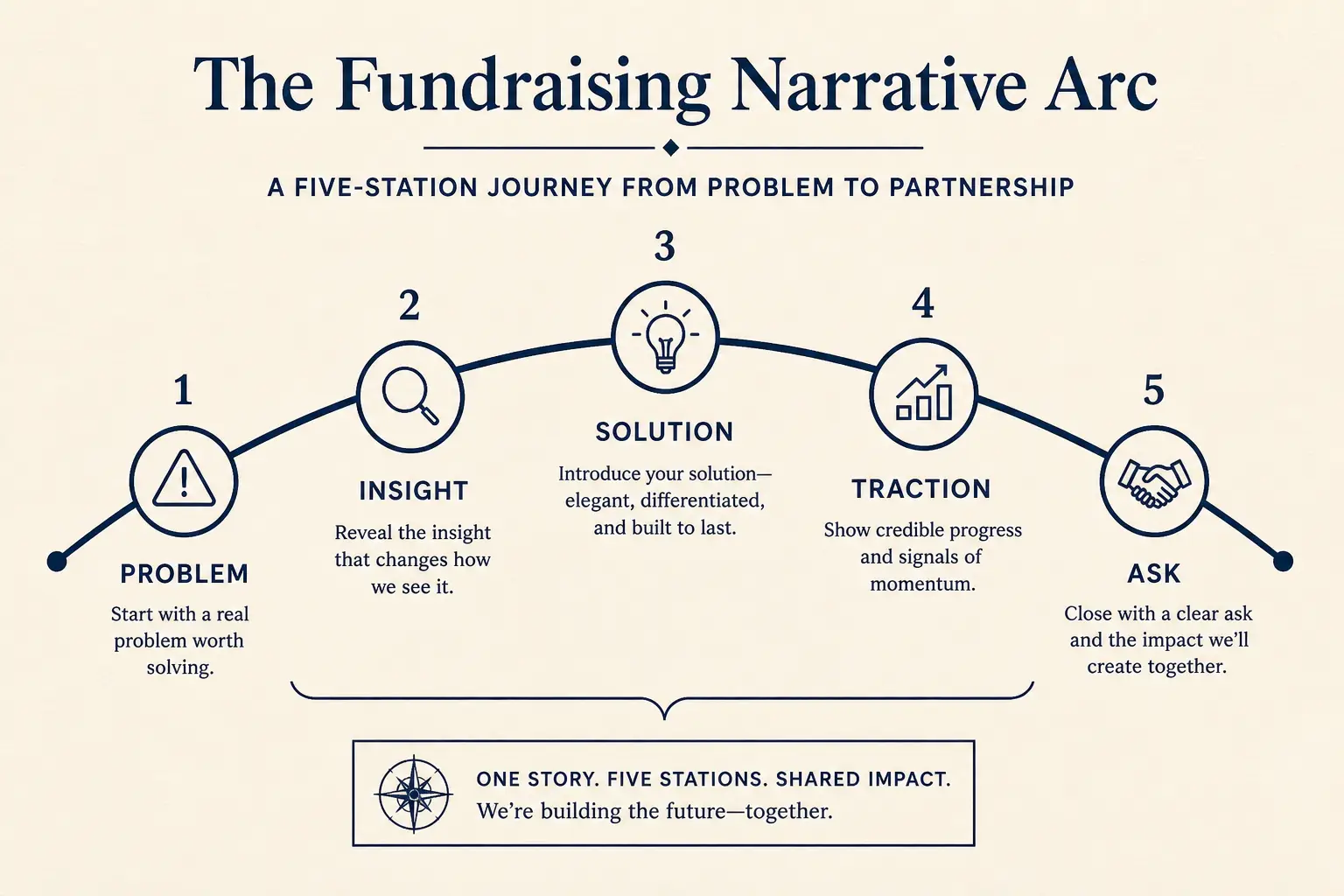
Fundraising narrative arc
Tension early. Proof before the ask. Titles should skim as a story.
What “good” looks like
A strong pitch deck answers four questions without forcing the investor to dig: What painful problem exists? Why is your solution the right wedge now? What evidence says this is working? What do you want next, and why will capital accelerate it?
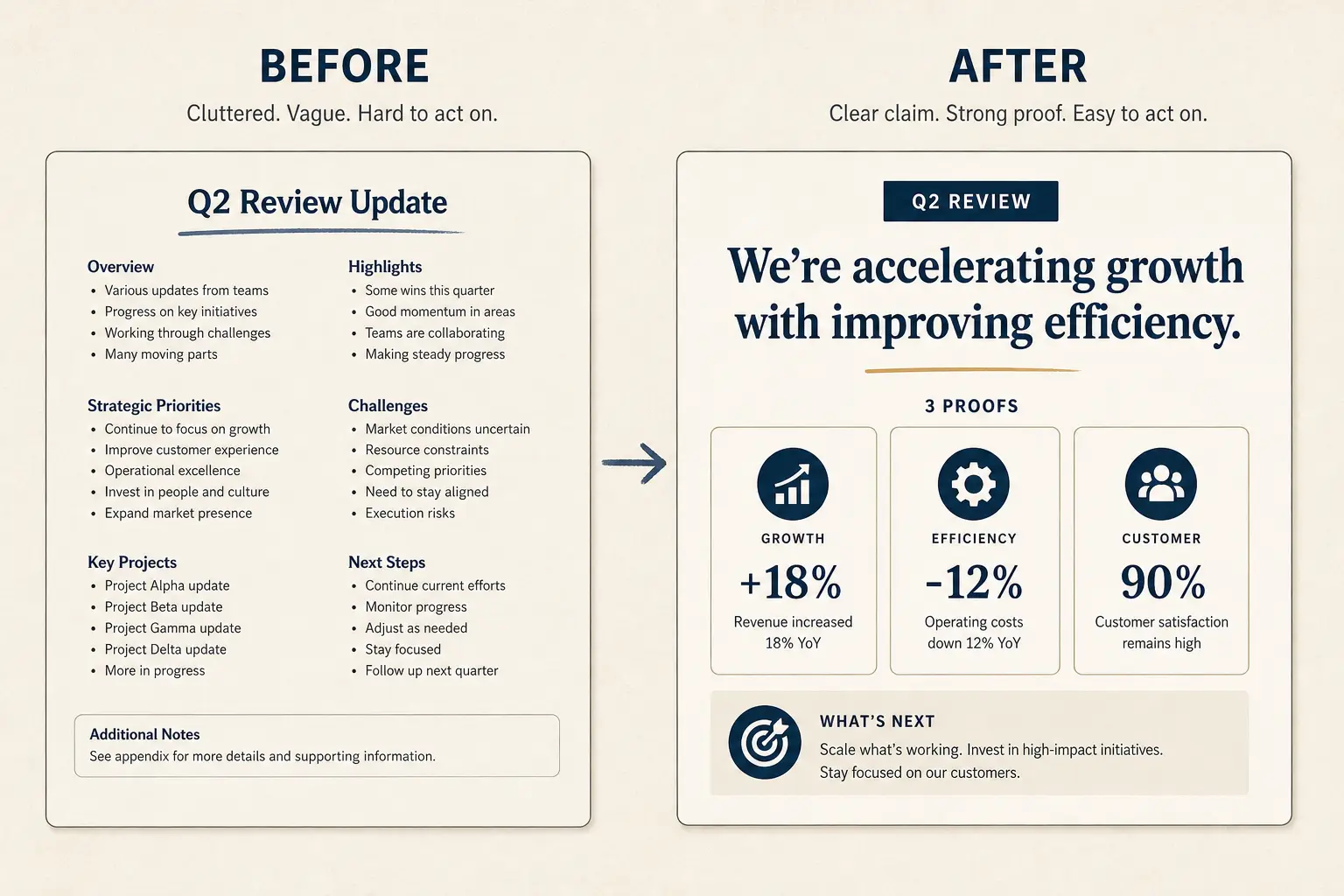
Design should disappear into hierarchy. One claim per slide. Metrics that can survive a follow-up. No vanity charts. Traction belongs before the ask; the market slide should not be a Wikipedia dump of TAM. Read only the titles in order, if they do not tell a coherent story, fix titles before colors.
Anatomy of a claim slide
Claim headline (one idea)
Supporting line that states the so-what for this audience.
Source / footnote
Stage changes the deck
- Pre-seed / seed, Insight, wedge, early signal, and team credibility matter more than perfect financial models.
- Series A, Repeatable motion, cohort evidence, and a clear plan for the capital raise take the lead.
- Later, Efficiency, path to leadership, and risk management join the narrative.
Reusing a Series A template for a seed raise usually produces empty slides. Cut until every slide earns its minutes. The seed vs Series A guide is the deep dive; the rule of thumb is: earlier stages sell insight and wedge, later stages sell machine and plan.
Framework: the four-slide rewrite
If you only have an hour before a meeting, rewrite these four: problem (who hurts, why now), traction (definition, time window, three facts), wedge (why you win the beachhead), and ask (amount, use, milestones). Everything else is supporting cast. AI can propose the rest after those four are honest.
Using AI without sounding generic
AI is excellent at proposing a first structure and terrible at inventing your insight. Feed it the real problem statement, the wedge, three traction facts, and the ask. Then edit the outline before you polish layouts. If a slide could belong to any startup in your category, rewrite it. Prefer outline-first tools when you still need narrative work.
Concrete prompt pattern: audience (seed investors in X), constraint (10 slides), must-include facts (three metrics with dates), tone (direct, no hype adjectives), and the ask. Then force a second pass: “Delete anything not unique to us.” Score tools on the evaluation rubric , Editability matters as much as Design when you reorder traction.
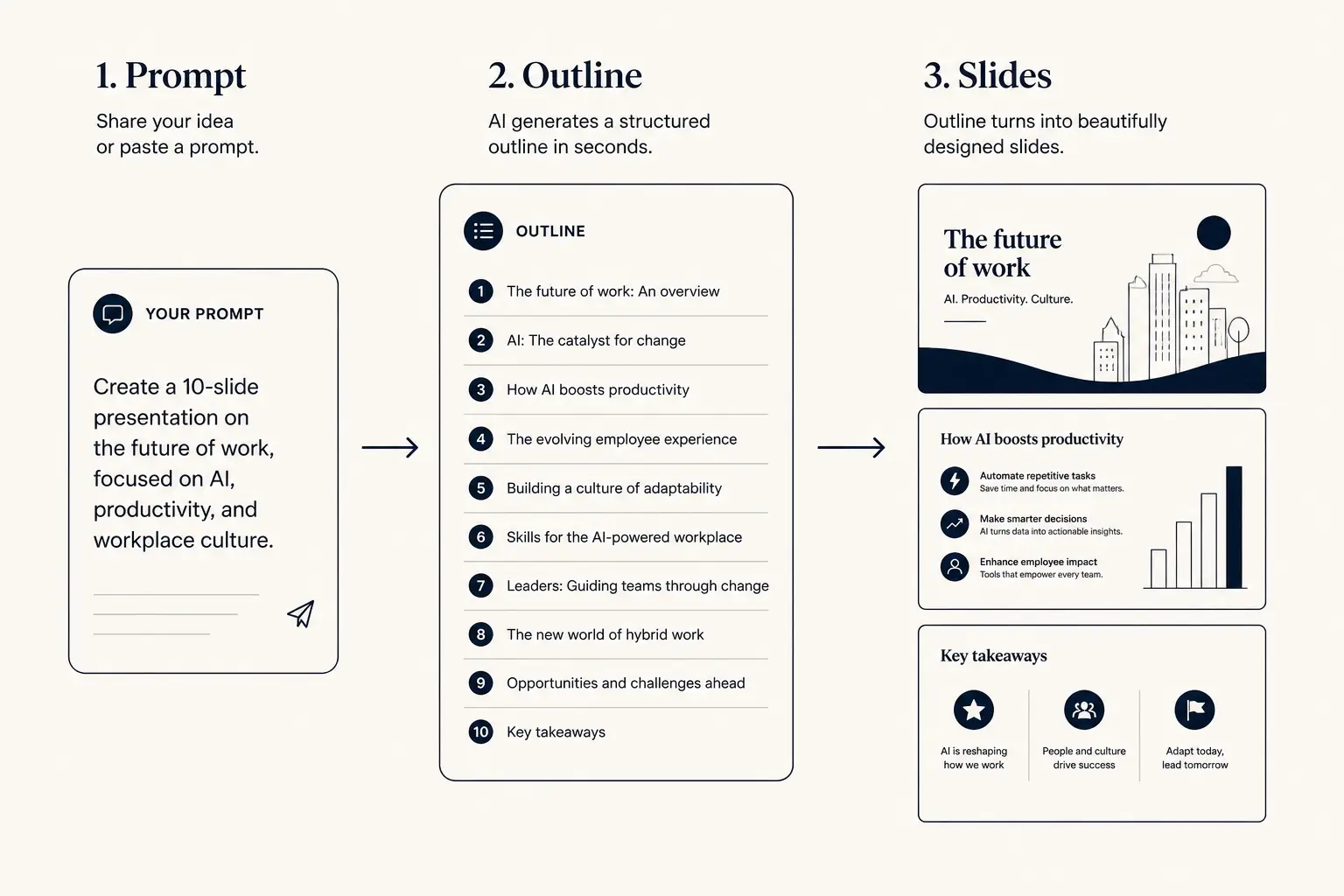
Prompt → outline → slides
1. Prompt
Audience, goal, length, proof you already have.
2. Outline
- • Opening claim
- • Proof beats
- • Ask / next step
3. Slides
Worked example: 10-slide seed in one afternoon
Brief: B2B workflow tool, $2.5M ask, three metrics (week-4 retention 42%, 18 design partners, $12k MRR). Draft in Gamma with a 10-slide cap. Kill the competitive insult matrix. Rewrite TAM as SOM beachhead. Put traction before product. Ask slide: amount, 40% product, 40% GTM, 20% ops, milestones for 18 months. Present from a link; export PPTX only if requested.
Time split that works: 20 minutes facts, 25 outline, 30 slides, 15 ask rehearsal. If the outline still feels generic after 25 minutes, do not polish, your insight is not on the page yet.
Time-to-usable-deck
Blank PPT path
Outline in docs → design fight → rebuild → 3–8 hours
Outline-first AI path
Prompt → edit outline → generate → polish → minutes to first usable draft
Common failure modes
- Starting with product features before the problem is felt
- TAM slides that do not explain obtainable market
- Traction that cannot be questioned (no time window, no definition)
- Ask slide buried or missing use of funds
- Appendix material shoved into the core narrative
- Competitive slides that insult rivals instead of clarifying the wedge
When AI drafts your first version, hunt these failures explicitly. Models love symmetrical competitive matrices and round TAM numbers. Replace both with specifics you can defend in the room.
Not for you if…
You need a 40-slide data room as the meeting artifact, use a short deck plus a data room instead (data room vs deck). You are writing a board pack, that is a different artifact. You want AI to invent traction, stop; that fails Honesty and diligence.
Frameworks, worked rules, and cuts
Pitch decks raise meetings when titles skim as a coherent story before anyone reads body copy. Partners decide in minutes whether the narrative is coherent enough for diligence. Your operating constraint is not prettier templates. It is stage-fit proof density and an ask that stands alone when the deck is forwarded without you in the room.
Original framework for this hub: the Four-Slide Rewrite. If you only have an hour, rewrite problem, traction, wedge, and ask. Problem names who hurts and why now. Traction carries definition, time window, and three facts. Wedge explains why you win the beachhead. Ask carries amount, use of funds, and milestones. Everything else is supporting cast until those four survive scrutiny.
Worked example with specifics: a B2B workflow seed raise targeting two-point-five million dollars, week-four retention at forty-two percent, eighteen design partners, and twelve thousand dollars MRR. Outline pass kills a competitive insult matrix and rewrites TAM as a twenty-four-month SOM beachhead. Traction moves before product. Present from a link; export PPTX only if an associate requests a leave-behind with an expected cleanup pass.
Failure modes to cut immediately include feature-first openings, Wikipedia TAM theater, traction without definitions, buried asks, appendix material shoved into the core narrative, and competitive slides that insult rivals instead of clarifying the wedge. AI drafts love symmetrical matrices and round market numbers. Replace both with specifics you can defend under questioning.
Not for you if you need a forty-slide data room as the meeting artifact, if you are writing a fiduciary board pack, or if you want AI to invent traction. Use a short deck plus a data room for diligence. Use the fundraising hub for updates and board cadence. Use the pitch generator only after facts are real and dated.
Stage changes the deck hard. Pre-seed overweight insight and early signal. Seed adds motion and retention. Series A demands repeatable GTM and unit economics. Reusing a Series A template for seed usually produces empty slides that waste minutes. Cut until every slide earns its place in a ten to fourteen slide narrative budget.
Concrete next step in Gamma: paste audience, ten-slide constraint, three dated metrics, and the ask. Generate outline only. Force traction earlier. Delete anything not unique to you. Then generate slides and rehearse the ask out loud. If the ask cannot stand alone, the deck is not ready regardless of visual polish.
Interlink discipline matters. Pair this hub with annotated examples, seed versus Series A differences, the investor ask slide guide, and the public evaluation rubric when you compare AI pitch tools. Job-based winners beat overall trophies. Design cannot outvote a missing wedge or an undefined traction metric.
TAM, SAM, SOM slides earn their place only when they explain beachhead sequencing. A giant market number without a twenty-four-month wedge invites skepticism. Prefer bottom-up math from accounts you can name over top-down industry reports pasted for theater.
Ten-minute pitch budgets usually need fewer slides and denser rehearsal, not denser slides. Cut product tours before you cut traction. Park deep architecture behind a verbal offer to dive later. The leave-behind can carry appendix density the live room should not.
When AI drafts a competitive matrix, rewrite it as wedge clarity: who you win against for which job, and why switching cost favors you now. Insult rows waste trust. If you lack competitive proof, say what you will learn in the next ninety days instead of inventing logos.
Forward-test the deck: send titles only to a skeptical friend and ask whether they would take the meeting. If titles do not skim as a story, stop generating layouts. Title-only failure is a Structure problem; no amount of Design scoring will fix it before the outline is honest.
Draft a pitch outline in Gamma
Start from problem, wedge, traction, and ask, then edit slides before the meeting.