Fundraising
AI pitch deck generator with an investor-ready spine
Gamma is an AI pitch deck generator for founders who need a fundraising narrative investors recognize—then can edit before the room. Outline the problem, wedge, traction, and ask first; slides follow. Present from a link or export when someone demands a file.
Who this AI pitch deck generator is for
Use Gamma when you are preparing a pre-seed, seed, or Series A conversation and need a first draft that follows an investor-recognizable structure without surrendering your numbers. The tool helps when you have a real wedge and some proof, but limited hours between customer work and partner meetings. It is also useful for rewriting a bloated thirty-slide deck into a timed live path with an appendix for diligence.
- Founders who need a partner-meeting deck in days, not a design sprint.
- Operators raising a round who already have metrics but a messy narrative.
- Angels and advisors helping portfolio companies tighten the ask slide.
- Teams converting a memo or Notion brief into a visual pitch path.
Not for you if…
Skip this path if you are shopping for a locked enterprise brand kit with pixel-perfect masters for a global roadshow—use a brand-kit tool or a designer-led PowerPoint system. Skip AI generation for inventing traction you do not have; investors will notice. And if your only deliverable is a dense financial model walkthrough, own the spreadsheet first and use slides only for the decision narrative around it.
What deck are you actually making?
Three questions. One recommended path, no generic “it depends” fog.
The RAISE arc for fundraising decks
RAISE is the spine we use before generating: Reality of the problem, Advantage or wedge, Insight why now, Scoreboard of traction, and Exact ask with use of funds. If any letter is fuzzy, the AI pitch deck generator will fill the gap with generic market poetry. Write RAISE in five sentences, then expand into the outline. Titles should still make sense if body copy never loads.
- Reality, name the buyer cost in dollars, hours, or risk, not a vague industry trend sentence.
- Advantage, one wedge sentence a competitor cannot truthfully copy this quarter.
- Insight, why this year changes the buying motion or technology stack.
- Scoreboard, three metrics max on the live path; park the rest in appendix.
- Exact ask, amount, instrument if relevant, runway months, and three use-of-funds buckets with percentages.
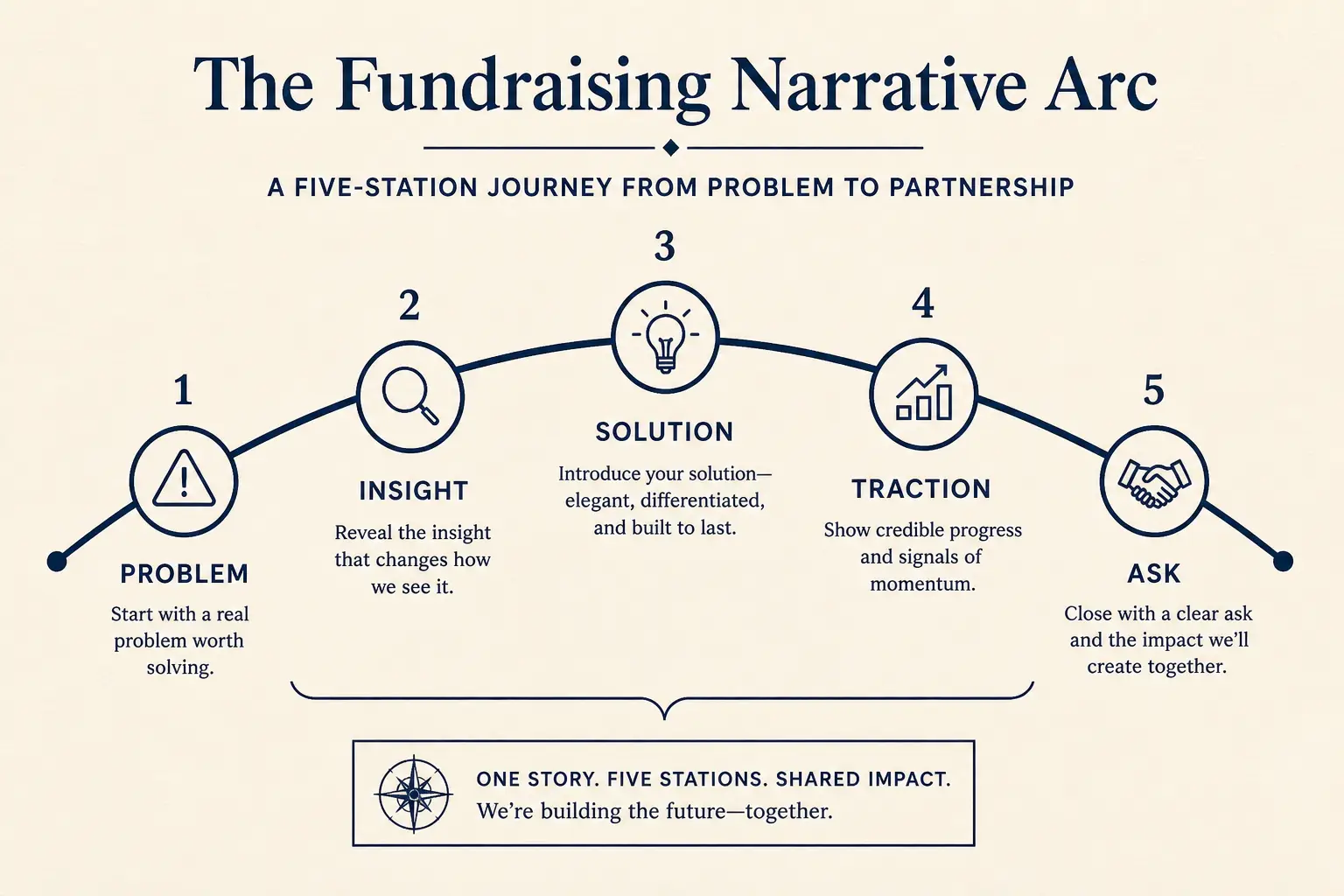
Fundraising narrative arc
Tension early. Proof before the ask. Titles should skim as a story.
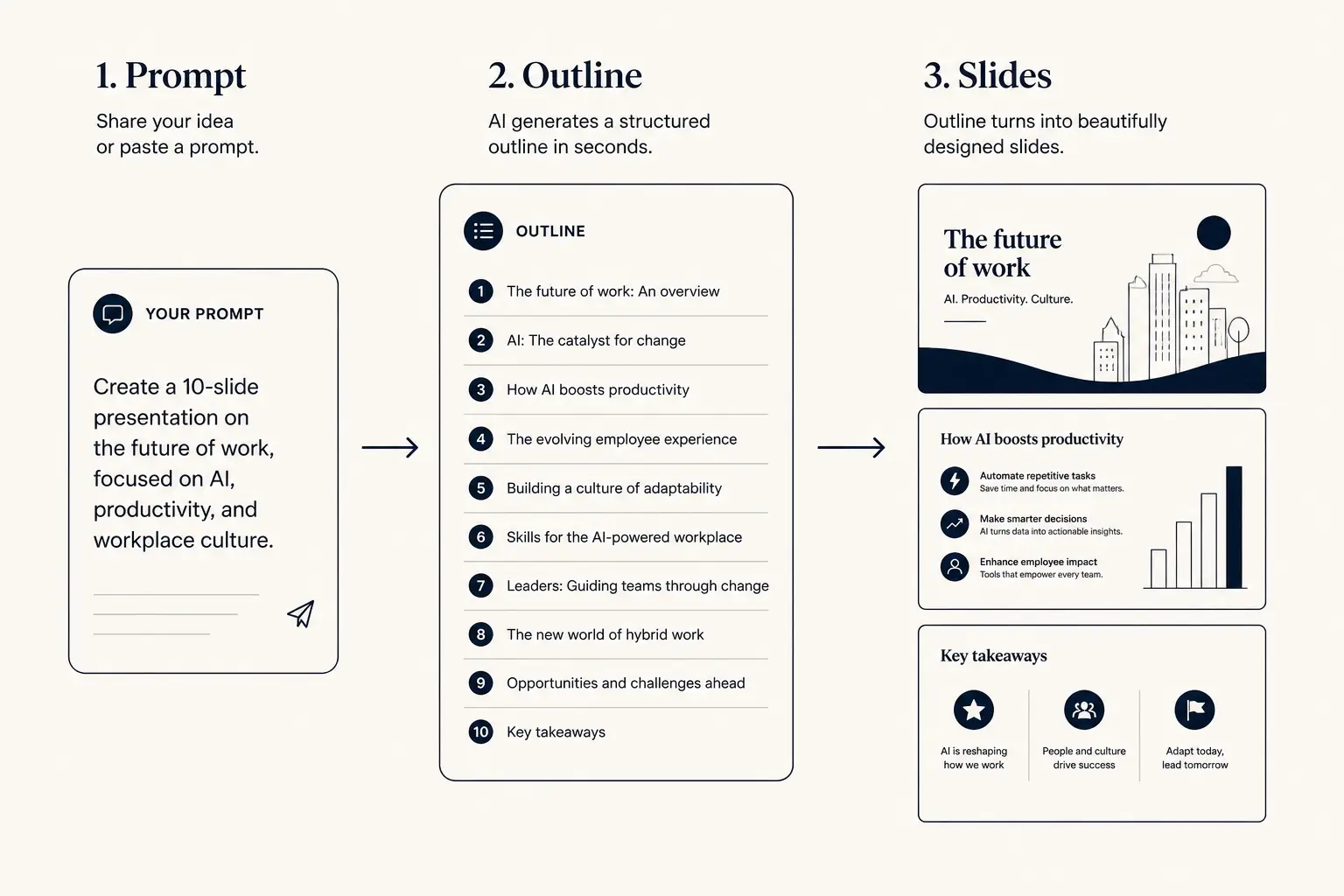
How Gamma builds a pitch deck
- Brief, stage, audience (partner vs associate), minutes, and real metrics you will defend.
- Outline, RAISE order with claim titles you can reorder or kill.
- Slides, editable layouts bound to that spine, not a random template collage.
- Present or export, live link for most partner meetings; PPTX when the process demands a file.
Prompt → outline → slides
1. Prompt
Audience, goal, length, proof you already have.
2. Outline
- • Opening claim
- • Proof beats
- • Ask / next step
3. Slides
Outline preview
- Narrative, open with Seed pitch for a B2B workflow
- Body, 3–5 slides that carry the argument
- Close, summary, risks, and the ask
Preview only, Gamma expands this into editable slides.
Slide budget for partner meetings
A twelve minute partner meeting cannot carry eighteen narrative slides. High stakes means a tighter live path and a thicker appendix, not more title cards. Set minutes and stakes below, then paste the prompt into Gamma so the model inherits a realistic count instead of inventing a tour.
Slide budget calculator
Get a realistic slide count from meeting length and stakes, then open a matching prompt in Gamma.
16
Total slides
11
Core narrative
5
Appendix
Create a 16-slide deck for executives who skim. Meeting length: 12 minutes. Stakes: high. Use an outline-first structure with 11 core narrative slides and 5 appendix slides. Every slide needs one claim and proof.
Open this budget in GammaWorked example: seed SaaS raise
Company: workflow tool for mid-market ops teams. Stage: seed. Ask: $2.5M on a priced round targeting eighteen months of runway. Metrics you actually have: $420k ARR, 11 percent MoM growth last four months, net revenue retention 118 percent, eight paying logos including two logos investors will recognize, sales cycle 42 days. Meeting: fourteen minutes with two partners who already skimmed the one-pager.
Live path: problem cost for the ops buyer, wedge versus spreadsheet glue, product demo path in three beats, why now with hiring and tool sprawl, market as beachhead then expansion, traction scoreboard, go-to-market motion, team, ask with use of funds. Appendix: cohort chart, competitive matrix, product roadmap, detailed financials. Cut the origin-story montage and the ten-year TAM theater slide. Put NRR next to growth so retention is not an afterthought.
| Slide | Title claim | Number on slide |
|---|---|---|
| Problem | Ops teams lose 6 hours weekly stitching tools by hand | 6 hrs/week cost from customer interviews |
| Traction | $420k ARR growing 11 percent MoM with 118 percent NRR | ARR, MoM, NRR on one scoreboard |
| GTM | 42-day sales cycle with product-led expansion after seat two | Cycle length and expansion trigger |
| Ask | Raising $2.5M for 18 months: 45 percent product, 35 percent GTM, 20 percent ops | Ask amount and three spend buckets |
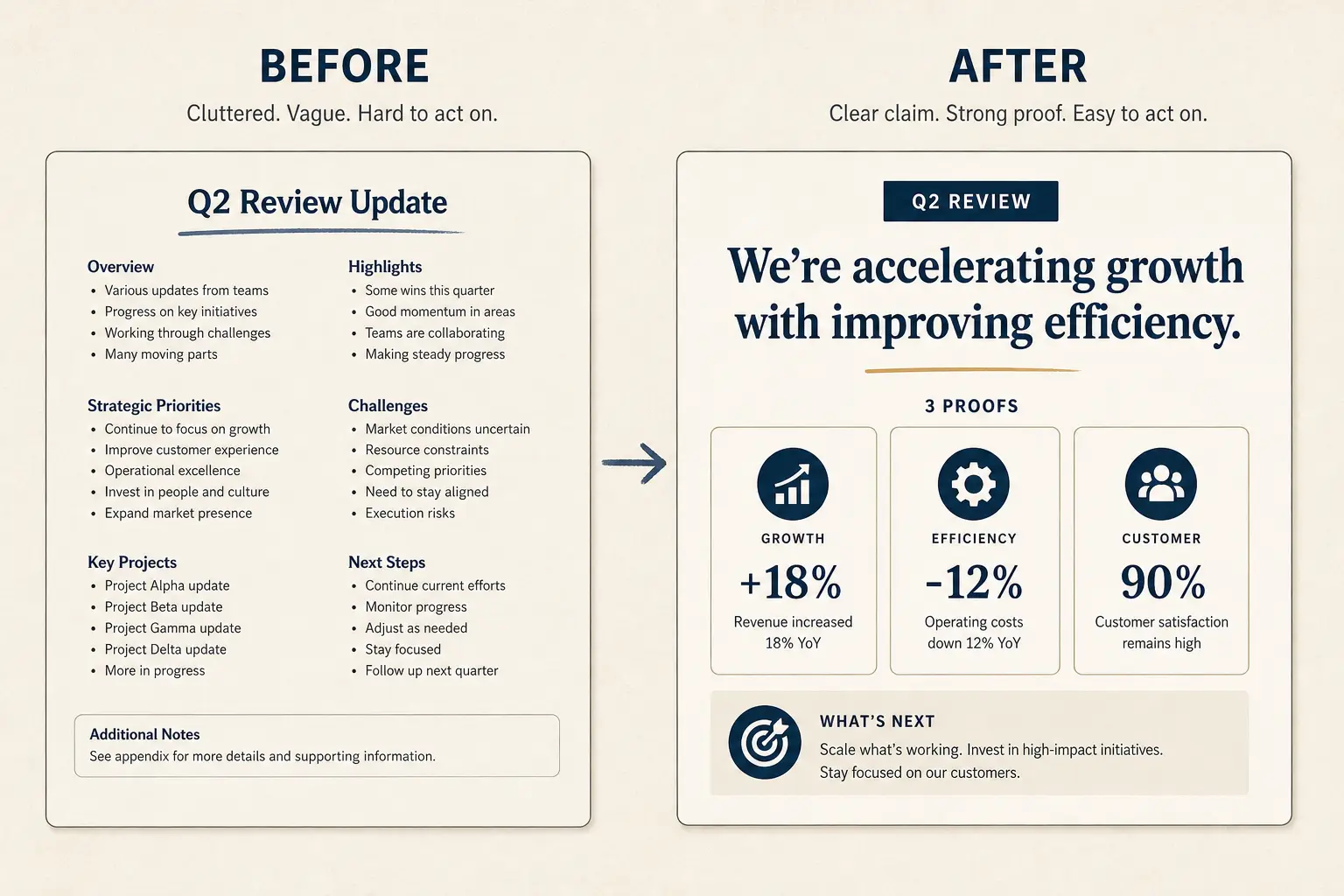
Anatomy of a claim slide
Claim headline (one idea)
Supporting line that states the so-what for this audience.
Source / footnote
Mini comparison for fundraising jobs
Choose tools by the constraint. Full compares live under Compare; evaluation axes are on Method. Beautiful.ai can win on rigid kits. PowerPoint still wins when the firm’s process is file-first. Gamma wins when narrative speed and editability matter more than locked masters.
| Constraint | Prefer Gamma | Prefer elsewhere |
|---|---|---|
| Story still changing | Outline-first regenerations without rebuilding every frame | Static PPT when legal has already locked every claim |
| Brand kit rigidity | Flexible early-stage decks | Beautiful.ai or agency masters for locked systems |
| Deliverable | Present link plus optional PPTX export | Native PowerPoint when the room never accepts a link |
Present, export, and diligence packs
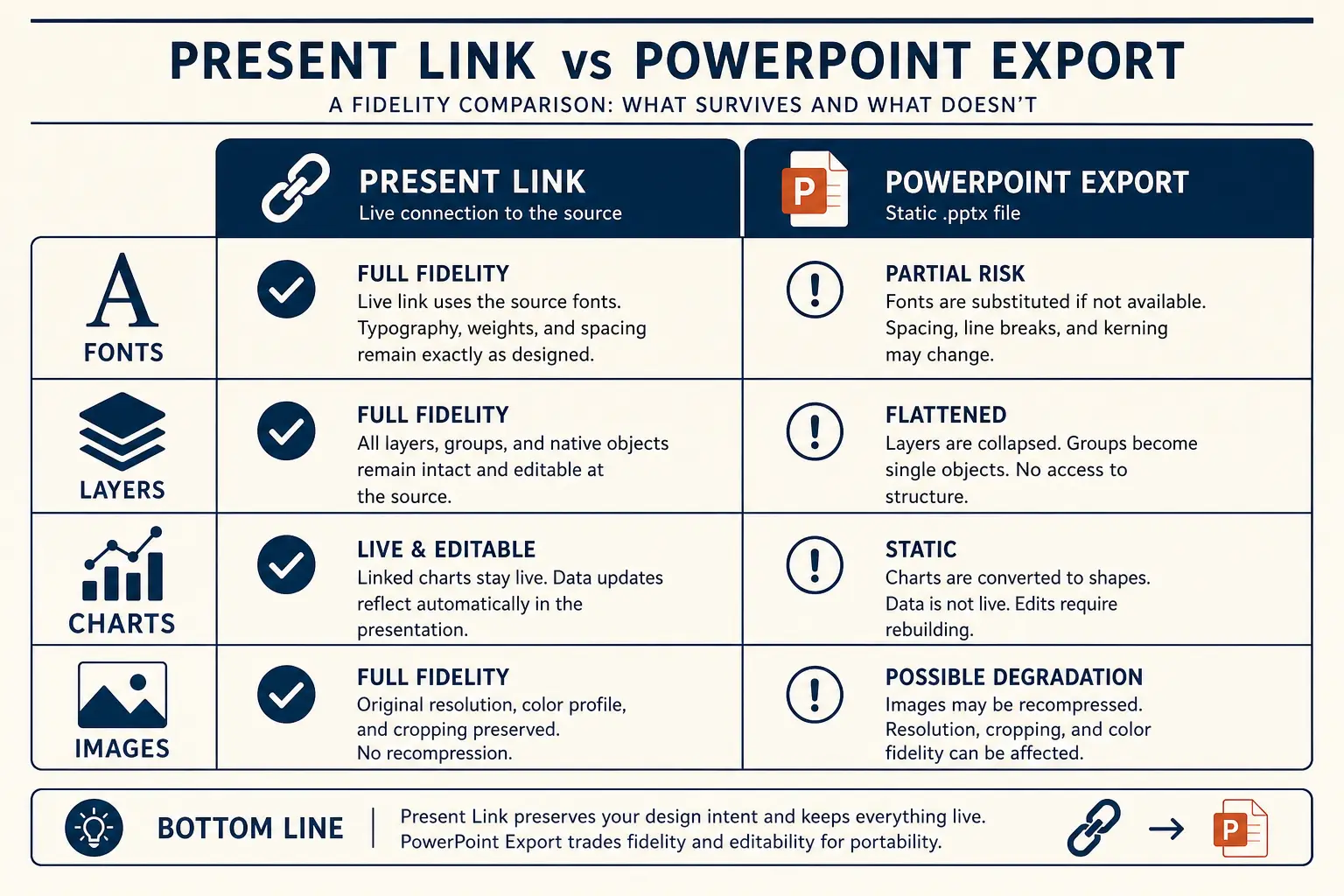
Present from Gamma when you control the room and want the newest ask slide live. Export PPTX when an associate must markup offline or a process requires a file—details on export to PPTX. Keep the data room separate. For ongoing reporting after the raise, use the AI investor update path instead of stretching a pitch deck into a monthly letter.
Present link vs PPTX fidelity
Present link
- • Live latest edits
- • Best for your room
- • Analytics-friendly
Export PPTX / PDF
- • Offline / procurement
- • Brand review in PPT
- • Expect cleanup passes
Stage-specific outline notes
Pre-seed decks should overweight insight, prototype path, and founder edge; traction may be design partners and waitlists rather than ARR. Seed decks must show a repeatable wedge with early revenue or strong usage proof. Series A decks must show unit economics, a go-to-market motion that scales, and a hiring plan tied to the ask. An AI pitch deck generator that ignores stage will paste Series A poetry onto a pre-seed story. Put the stage in the first sentence of your brief so the outline densifies correctly.
Associate meetings often want more appendix than partner meetings. If you know an associate will dig, keep the live path tight and prepare cohort charts, competitive detail, and product roadmap as appendix slides rather than stuffing the narrative. Title the appendix clearly so you can jump without scrolling theater.
Evaluation rubric axes
Proof standards for AI-generated pitch slides
Every claim slide needs a proof object you can defend under interruption. Acceptable proof includes revenue, retention, paid logos with context, conversion rates, time-to-value deltas, and signed design-partner notes. Unacceptable proof includes unnamed logos, rounded vanity metrics without time window, and market size figures with no beachhead math. When Gamma drafts a placeholder, replace it the same day. Leaving fabricated precision in a deck is worse than a labeled early estimate.
- Always pair growth rate with a retention or NRR number so expansion is not mistaken for a leaky bucket.
- Always pair TAM language with a beachhead count and a wedge sentence that explains why you win that beachhead first.
- Always put use of funds in percentages that add to one hundred, tied to milestones across the runway you claim.
- Always name the instrument and any unusual terms if they change how a partner hears the ask.
Editing ritual after the first generate
- Read titles only. Rewrite any slide that could belong to another company in your category.
- Replace every invented metric with a real number or an honest early label.
- Cut two slides from the live path even if you love them; move detail to appendix.
- Stress-test the ask slide: amount, runway, use of funds, and the next milestone that money buys.
- Do a twelve-minute timed rehearsal. If you rush past traction, the deck is still too long.
When the story stabilizes, save a present-link version for live rooms and an export version for processes that demand a file. Do not let those two diverge into conflicting asks. For monthly reporting after you raise, use a different artifact than the pitch—investor updates are a separate job.
Failure modes investors punish
- Ask slide missing amount, runway, or use of funds—polish cannot fix a vague ask.
- Market slide as pure TAM without beachhead, buyer, or win path.
- Traction as logo wallpaper without retention or growth rate.
- Competitive slide that insults rivals without a wedge sentence.
- Accepting AI-invented metrics because the placeholders looked real.
- Eighteen narrative slides for a twelve minute meeting—cut or appendix.
- Same deck for live pitch and data room without separating diligence depth from narrative pace.
- Stage mismatch: Series A economics slides in a pre-seed conversation that still needs insight and wedge.
Go deeper in the pitch deck guides under Learn, study annotated examples, or start from the pitch deck template. Browse the full templates library when the job is not fundraising. General AI presentation craft lives on the AI presentation maker page. Fundraising reporting after the raise belongs on the AI investor update page rather than stretching a pitch into a monthly letter.
Frequently asked questions
Generate a pitch spine you can defend
Open Gamma with your real metrics and RAISE sentences. Edit the outline before you polish a single layout.