Learn · Workflows
Presentation review checklist, a team ritual before the room
Team deck reviews fail when feedback is taste (“make it pop”) and arrives too late to change structure. A working ritual reviews against the decision, evidence, and artifact, early enough that cuts are still allowed. This guide gives a checklist, roles, and timing for sales, product, and leadership decks so review improves outcomes instead of rearranging pixels.
Parent guide: workflows hub. Method notes: how we evaluate decks. Product entry: AI presentation maker.
The ritual at a glance
Cadence: outline review (structure) → evidence review (facts) → artifact review (link/PDF/PPTX) → short polish pass → rehearsal note. Roles: narrative owner, fact owner, room owner. Artifact: checklist in the calendar invite.
Title-only skim opens every structure review. Cuts are a required agenda item, not optional if time remains.
If your review cannot change structure, it is a typography committee. Schedule earlier.
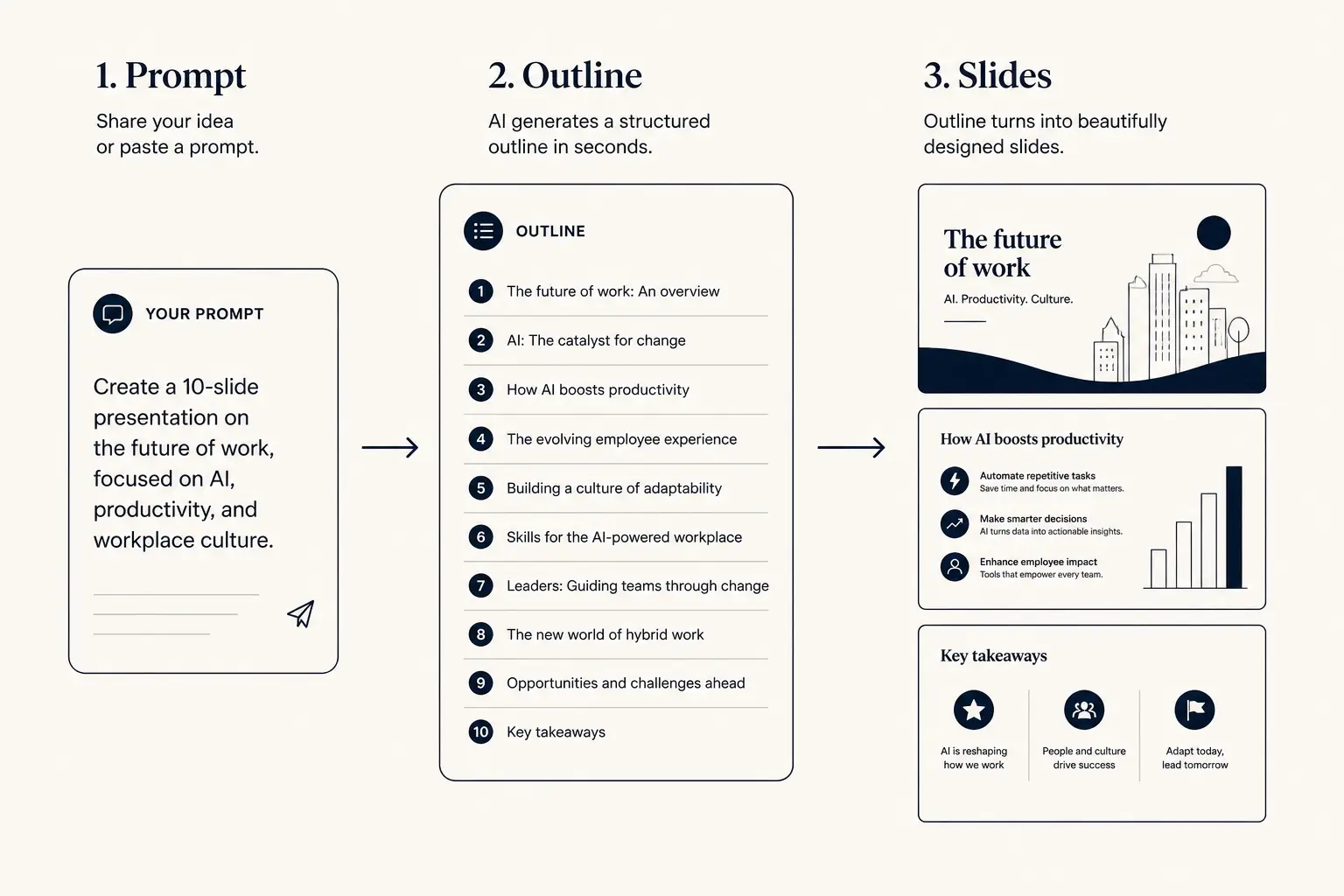
Fundraising narrative arc
Tension early. Proof before the ask. Titles should skim as a story.
Who this is for
Sales teams shipping pursuit decks, product teams before exec reviews, founders before board/investor meetings, agencies before client presentations. Not for: drive-by commenters with no accountability, or reviews that exist only to perform diligence theater.
Small teams can collapse roles but not skip the checklist. Large orgs need explicit decision rights in the room.
Ritual beats heroics. Heroic late nights are usually failed scheduling.
Time-to-usable-deck
Blank PPT path
Outline in docs → design fight → rebuild → 3–8 hours
Outline-first AI path
Prompt → edit outline → generate → polish → minutes to first usable draft
Worked example: Series B product review
Situation: PM ships a roadmap review for Tuesday execs. Last quarter, review was a fifty-minute taste debate on colors. This quarter they run the ritual Monday: title skim fails because ask is unclear; they rewrite the decision slide; evidence owner corrects a churn definition; artifact is present link with PDF freeze for absent CFO.
Meeting time drops to twenty-eight minutes. Execs decide to slip Bet C, the actual job. No one says “make it pop.”
The checklist did not make the deck pretty. It made the decision possible.
Evaluation rubric axes
Outline preview
- Narrative, open with Create a 25-minute deck review agenda
- Body, 3–5 slides that carry the argument
- Close, summary, risks, and the ask
Preview only, Gamma expands this into editable slides.
The checklist (use verbatim)
1) What decision do we need today? 2) Can a skeptic skim titles in ninety seconds? 3) Are metrics defined? 4) What evidence is missing? 5) What 20% can we cut? 6) What risks must be named? 7) What artifact ships? 8) Who owns follow-ups and by when? 9) Did we rehearse once? 10) What would make this meeting fail?
Put answers in speaker notes or a review doc. Red items block external send.
Checklists are boring. Boring is how teams scale quality.
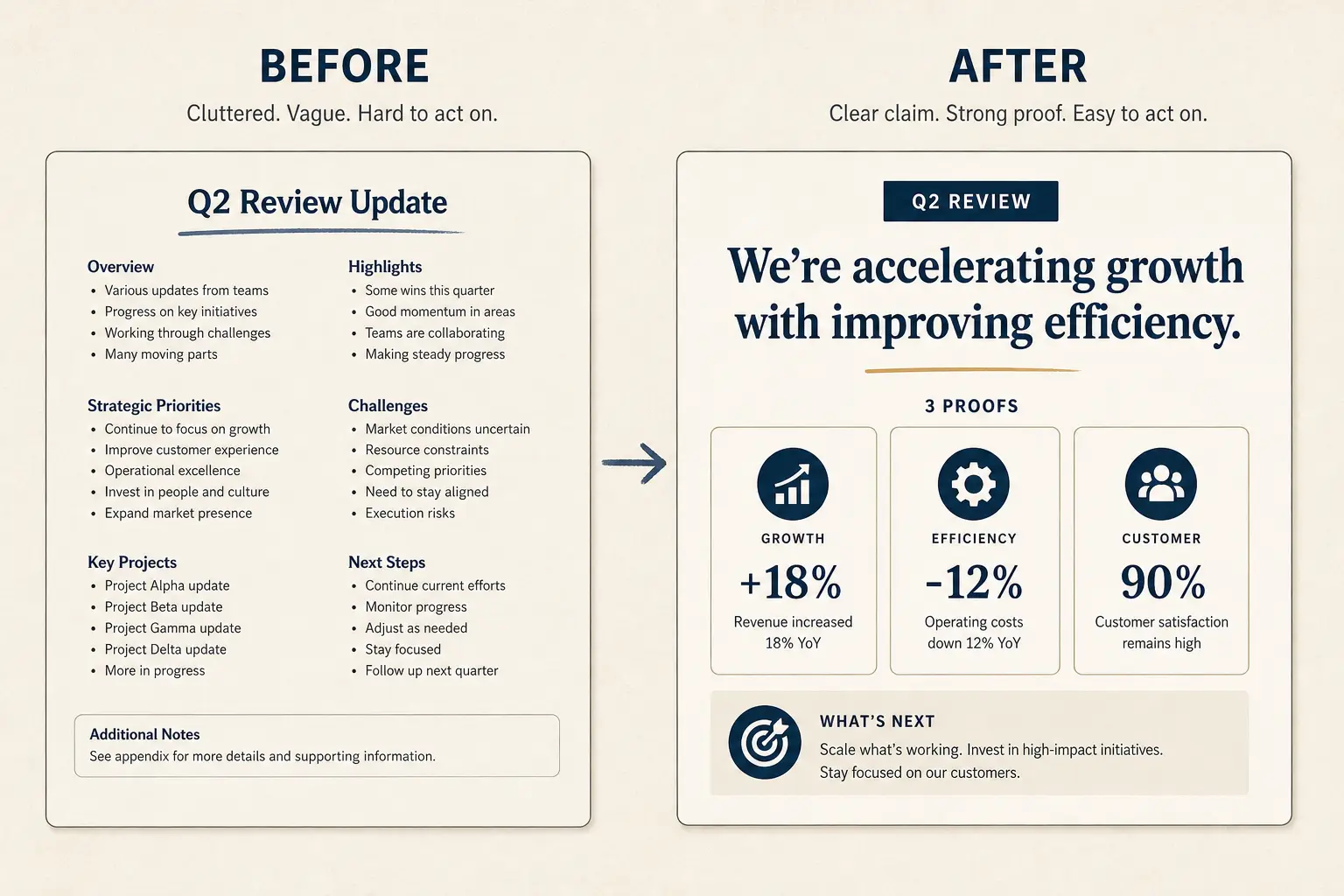
Prompt → outline → slides
1. Prompt
Audience, goal, length, proof you already have.
2. Outline
- • Opening claim
- • Proof beats
- • Ask / next step
3. Slides
Converting taste into decisions
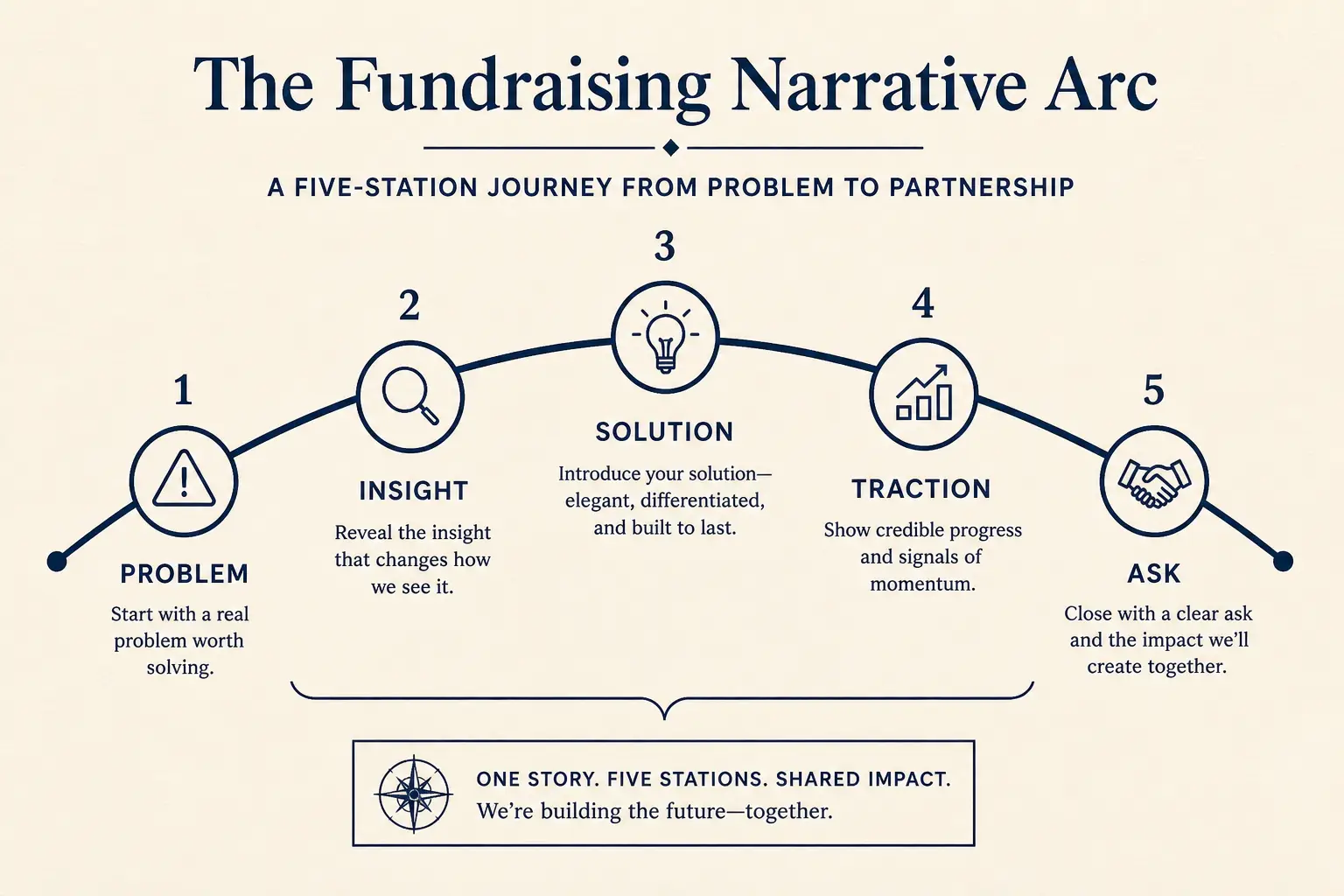
“Make it pop” becomes “The ask is visually equal to a footnote, increase hierarchy so the decision is unmistakable.” “Too much whitespace” becomes “Merge slides three and four; the room does not need a bumper.” If a comment has no decision impact, park it.
Use the before/after tool on weak titles during review. Facilitators should rewrite comments live to teach the norm.
Culture changes when leaders refuse to act on empty taste notes.
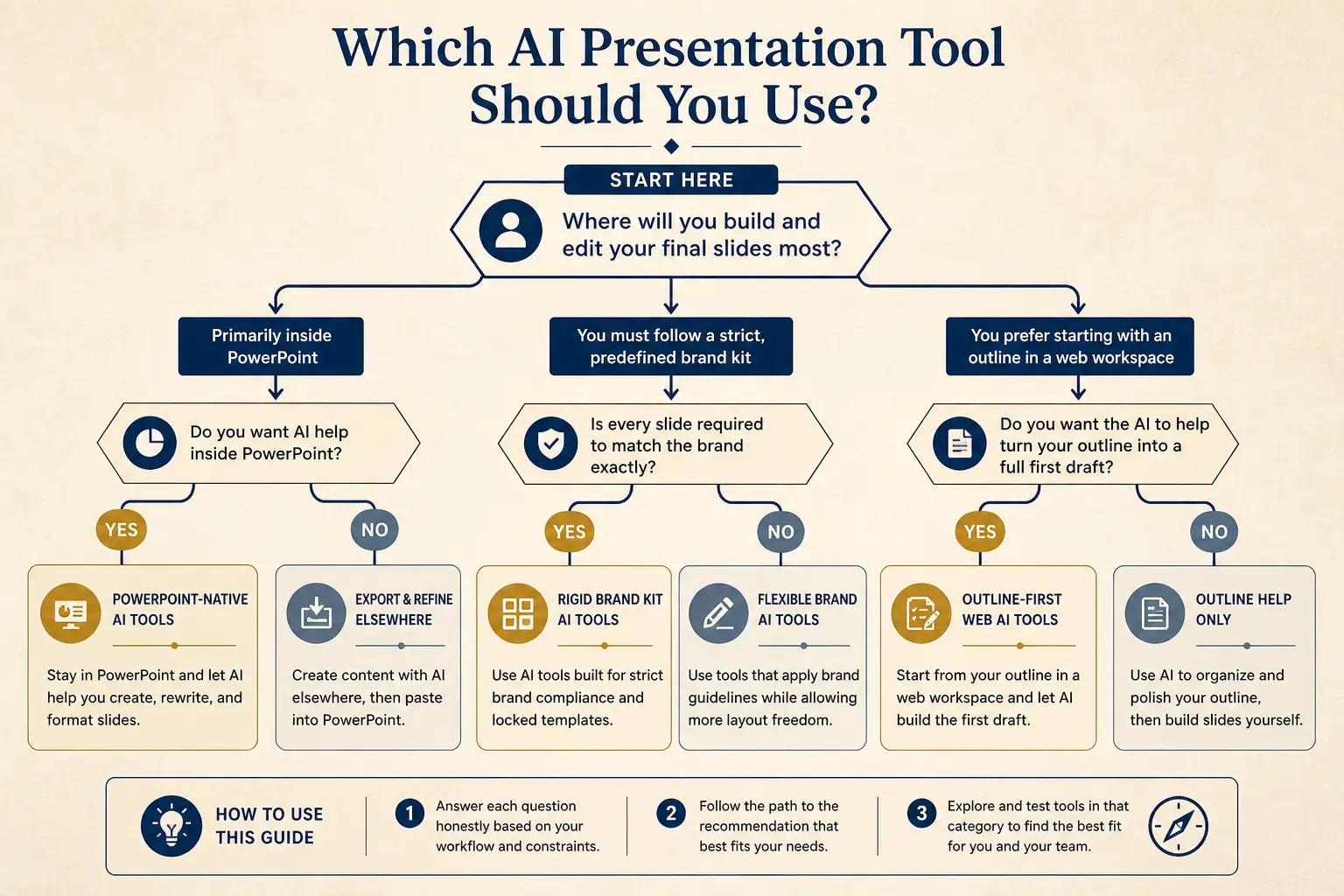
Which tool for which job
Need native PowerPoint editing every day?
Yes → Plus AI / Copilot · No → continue
Need rigid brand kits across a large team?
Yes → Beautiful.ai / enterprise kits · No → continue
Need outline-first AI drafting + present link?
Yes → Gamma
Weak bullets → claim/proof/ask
Paste a bad slide. Get a rewrite pattern you can drop into Gamma, not vibes, a structure.
- Claim: Make it pop (make the cost of inaction obvious)
- Proof: Add more polish (add a number, name, or constraint)
- Proof: Too much white space? (add a number, name, or constraint)
- Proof: Can we add a vision slide? (add a number, name, or constraint)
- Ask: Looks fine (one decision, one owner, one date)
Timing and calendar design
Schedule structure review when at least one rebuild day remains. Final polish review can be day-of for typos only. Invite sparingly. Send titles ahead for async skim when time zones hurt.
Forty-eight hours before external send is a common structure gate. Same-morning only works for low-stakes internal decks.
A calendar without gates is a wish. Put the ritual on the calendar.
Anatomy of a claim slide
Claim headline (one idea)
Supporting line that states the so-what for this audience.
Source / footnote
Slide budget calculator
Get a realistic slide count from meeting length and stakes, then open a matching prompt in Gamma.
14
Total slides
10
Core narrative
4
Appendix
Create a 14-slide deck for executives who skim. Meeting length: 12 minutes. Stakes: medium. Use an outline-first structure with 10 core narrative slides and 4 appendix slides. Every slide needs one claim and proof.
Open this budget in GammaFailure modes
Failure: review after export when PPTX cleanup already burned the team. Failure: twenty attendees. Failure: no fact owner for metrics. Failure: skipping cuts. Failure: debating theme while the ask is blank.
End reviews with explicit ship/no-ship. Record decisions in the notes-to-slides inventory format.
If review does not change a go/no-go, it was socialization, not quality control.
Async and remote rituals
Async checklist in comments works if each item has an owner and deadline. Video review works if you start with title skim on a shared outline, not with slide 1 logo admiration.
Record the session for absentees. Do not recreate the meeting in a comment thread without synthesis.
Remote teams need sharper rituals than co-located teams, ambiguity multiplies over Slack.
Artifact gate inside the ritual
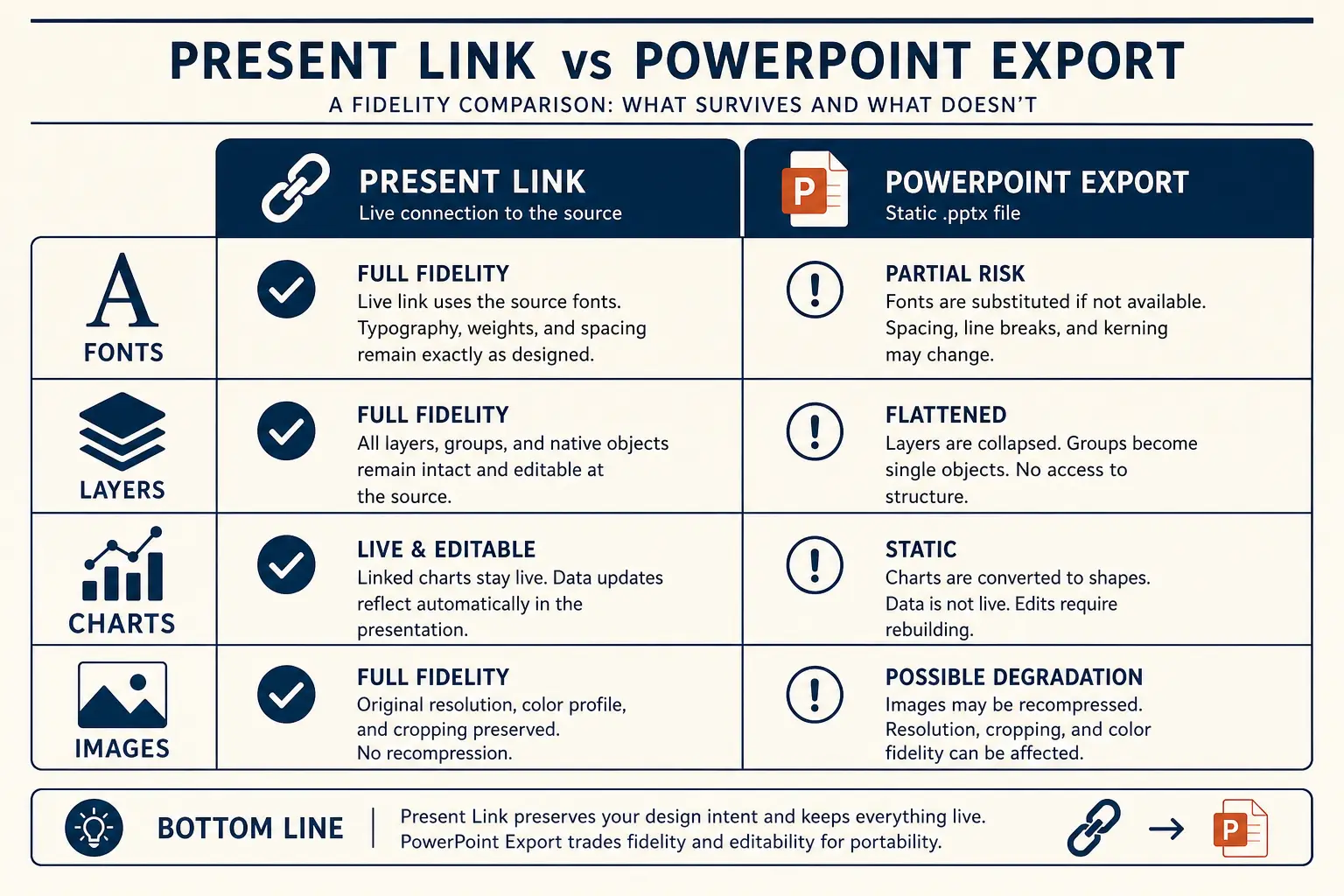
Every review includes artifact confirmation: link, PDF, PPTX, or twins. If PPTX, assign cleanup owner. If link, test permissions. If PDF, freeze naming.
See present-link vs PPTX. See export cleanup spoke.
Artifact surprises after “approval” are ritual failures.
Gamma handoff
Run title skim in Gamma’s outline. Apply cuts. Assign evidence fixes. Confirm artifact. Generate or regenerate sections only after structure passes. Rehearse once.
Return to the workflows hub for pipeline adjacency. Use Method when reviews need shared evaluation language across tools.
Great reviews make rooms decisive. Taste committees make rooms late.
Operating rules for team-deck-review-ritual
Treat Presentation review checklist, a team ritual before the room as a constrained operating problem, not a theme exercise. The constraint set on this page, audience, proof rules, artifact choice, and cut list, is what makes the guidance non-generic relative to workflows hub.
Write the decision or learning outcome in one sentence before you touch Gamma. Paste only proof you can defend in Q&A; blanks beat fiction. Name the artifact (present link, PDF, or PPTX) in the outline header so design stays honest. Schedule one title-only skim with a second person when stakes are external. If a section cannot map to the framework on this page, cut it rather than decorating it.
The scenario details earlier on this URL earn the long-tail ranking; these rules keep execution from drifting back to generic AI output under deadline pressure.
Edit loops that save time on team-deck-review-ritual
Most time waste happens after generation: endless theme tweaks while titles still fail a ninety-second skim. Invert the loop for Presentation review checklist, a team ritual before the room: skim titles, fix claims, fill proof blanks, then adjust visual density for the chosen artifact.
Loop A (10 minutes): title-only skim and cuts. Loop B (15 minutes): proof fill and definition footnotes. Loop C (10–40 minutes): artifact readiness, including PPTX cleanup if required. Loop D (one pass): timed rehearsal or peer read for async leave-behinds. Stop when the decision or learning outcome is unmistakable to a skeptical reader.
If Loop C dominates every week, you are designing for the wrong artifact or carrying too much decorative hierarchy. Simplify the master instead of heroically cleaning exports forever.
Vocabulary lock for team-deck-review-ritual
Generic AI slides drift into vendor vocabulary. Lock the words your audience already uses, course rubric language, buyer phrases from discovery, investor metric definitions, or committee method terms, and paste that glossary into the prompt as a constraint.
Build a ten-term glossary for this scenario before generating. Ban three fluffy phrases that always appear in weak drafts for this job. Require metric definitions on-slide when a skeptic could misread a chart. Prefer audience-native verbs over interchangeable corporate verbs. Keep the glossary next to the prompt template so updates are mechanical.
Vocabulary locks are how long-tail pages stay specific. Without them, every deck collapses into the same interchangeable AI tone.
Ship bar for team-deck-review-ritual
Ship only when a skeptical reviewer can answer: what is the ask or learning outcome, what proof supports it, what did we cut, and which artifact is canonical. If any answer is fuzzy, you are not done, regardless of how polished the theme looks.
Ask or outcome is on a slide, not only in speaker notes. Proof inventory matches on-slide claims one-to-one. Failure-mode cuts from this page have been applied once. Permissions or file open tests completed for the delivery path. Owners and dates exist for follow-ups when the job is operational.
This bar is stricter than “looks fine.” Clear answers under skepticism are how Presentation review checklist, a team ritual before the room work actually lands.
Gamma habit for team-deck-review-ritual
In Gamma, keep the durable habit outline-first: paste a scenario-specific prompt from this page, lock titles, generate, regenerate weak sections with diff prompts, then present or export on purpose. Do not restart from a blank vibe prompt when a long-tail spec already exists for Presentation review checklist, a team ritual before the room.
Keep a team library of A-tier prompts keyed to jobs like this URL. Store proof inventories next to decks so updates are mechanical. Prefer section regen over full rerolls when one metric changes. Link workflows hub from your internal wiki so people escalate to systems when they outgrow this scenario. Re-read Method when tool debates appear, architecture arguments need shared axes.
Day-to-day excellence is boring repetition of good constraints. This page supplies the constraints for one job; Gamma supplies the editable structure to execute them quickly.
Field notes 1 for team-deck-review-ritual
When teams apply Presentation review checklist, a team ritual before the room in the wild, the same friction shows up: rushed prompts, missing proof inventories, late artifact switches, and reviews that argue about taste instead of decisions. Field note 1 is a corrective habit, small enough to run weekly, strict enough to prevent cleanup debt.
Habit: freeze a proof inventory before any generate click, even when the calendar is cruel. Habit: run a ninety-second title skim with someone who was not in the working session. Habit: write the artifact choice in the outline header and refuse layout work that contradicts it. Habit: cut twenty percent after first rehearsal or first async read, on purpose. Habit: log one failure mode from this page that you actually hit, and patch the team template. Habit: prefer section regen with updated proof over full rerolls that reshuffle a working spine.
These habits are not motivational posters. They are the difference between AI that compresses work and AI that creates a second shift of cleanup. Attach them to workflows hub rituals so they survive personnel changes.
Field notes 2 for team-deck-review-ritual
When teams apply Presentation review checklist, a team ritual before the room in the wild, the same friction shows up: rushed prompts, missing proof inventories, late artifact switches, and reviews that argue about taste instead of decisions. Field note 2 is a corrective habit, small enough to run weekly, strict enough to prevent cleanup debt.
Habit: freeze a proof inventory before any generate click, even when the calendar is cruel. Habit: run a ninety-second title skim with someone who was not in the working session. Habit: write the artifact choice in the outline header and refuse layout work that contradicts it. Habit: cut twenty percent after first rehearsal or first async read, on purpose. Habit: log one failure mode from this page that you actually hit, and patch the team template. Habit: prefer section regen with updated proof over full rerolls that reshuffle a working spine.
These habits are not motivational posters. They are the difference between AI that compresses work and AI that creates a second shift of cleanup. Attach them to workflows hub rituals so they survive personnel changes.
Field notes 3 for team-deck-review-ritual
When teams apply Presentation review checklist, a team ritual before the room in the wild, the same friction shows up: rushed prompts, missing proof inventories, late artifact switches, and reviews that argue about taste instead of decisions. Field note 3 is a corrective habit, small enough to run weekly, strict enough to prevent cleanup debt.
Habit: freeze a proof inventory before any generate click, even when the calendar is cruel. Habit: run a ninety-second title skim with someone who was not in the working session. Habit: write the artifact choice in the outline header and refuse layout work that contradicts it. Habit: cut twenty percent after first rehearsal or first async read, on purpose. Habit: log one failure mode from this page that you actually hit, and patch the team template. Habit: prefer section regen with updated proof over full rerolls that reshuffle a working spine.
These habits are not motivational posters. They are the difference between AI that compresses work and AI that creates a second shift of cleanup. Attach them to workflows hub rituals so they survive personnel changes.
Field notes 4 for team-deck-review-ritual
When teams apply Presentation review checklist, a team ritual before the room in the wild, the same friction shows up: rushed prompts, missing proof inventories, late artifact switches, and reviews that argue about taste instead of decisions. Field note 4 is a corrective habit, small enough to run weekly, strict enough to prevent cleanup debt.
Habit: freeze a proof inventory before any generate click, even when the calendar is cruel. Habit: run a ninety-second title skim with someone who was not in the working session. Habit: write the artifact choice in the outline header and refuse layout work that contradicts it. Habit: cut twenty percent after first rehearsal or first async read, on purpose. Habit: log one failure mode from this page that you actually hit, and patch the team template. Habit: prefer section regen with updated proof over full rerolls that reshuffle a working spine.
These habits are not motivational posters. They are the difference between AI that compresses work and AI that creates a second shift of cleanup. Attach them to workflows hub rituals so they survive personnel changes.
Field notes 5 for team-deck-review-ritual
When teams apply Presentation review checklist, a team ritual before the room in the wild, the same friction shows up: rushed prompts, missing proof inventories, late artifact switches, and reviews that argue about taste instead of decisions. Field note 5 is a corrective habit, small enough to run weekly, strict enough to prevent cleanup debt.
Habit: freeze a proof inventory before any generate click, even when the calendar is cruel. Habit: run a ninety-second title skim with someone who was not in the working session. Habit: write the artifact choice in the outline header and refuse layout work that contradicts it. Habit: cut twenty percent after first rehearsal or first async read, on purpose. Habit: log one failure mode from this page that you actually hit, and patch the team template. Habit: prefer section regen with updated proof over full rerolls that reshuffle a working spine.
These habits are not motivational posters. They are the difference between AI that compresses work and AI that creates a second shift of cleanup. Attach them to workflows hub rituals so they survive personnel changes.
Field notes 6 for team-deck-review-ritual
When teams apply Presentation review checklist, a team ritual before the room in the wild, the same friction shows up: rushed prompts, missing proof inventories, late artifact switches, and reviews that argue about taste instead of decisions. Field note 6 is a corrective habit, small enough to run weekly, strict enough to prevent cleanup debt.
Habit: freeze a proof inventory before any generate click, even when the calendar is cruel. Habit: run a ninety-second title skim with someone who was not in the working session. Habit: write the artifact choice in the outline header and refuse layout work that contradicts it. Habit: cut twenty percent after first rehearsal or first async read, on purpose. Habit: log one failure mode from this page that you actually hit, and patch the team template. Habit: prefer section regen with updated proof over full rerolls that reshuffle a working spine.
These habits are not motivational posters. They are the difference between AI that compresses work and AI that creates a second shift of cleanup. Attach them to workflows hub rituals so they survive personnel changes.
Frequently asked questions
Run a decision-focused review
Review against the ask and evidence in Gamma, not against vague taste notes.