Compare
Gamma vs Beautiful.ai: which to choose
Gamma vs Beautiful.ai is a brand-kits versus outline-first drafting decision. Choose Beautiful.ai if you need rigid Smart Slide guardrails and design-system compliance across a team that freestyles poorly. Choose Gamma if you need a narrative spine you can rewrite before layouts harden, then present from a link or export when a file is required. Scores use the public rubric on the method page; we build Gamma and still mark where Beautiful.ai wins.
Full scoring definitions: /method. Migration path: Beautiful.ai alternatives.
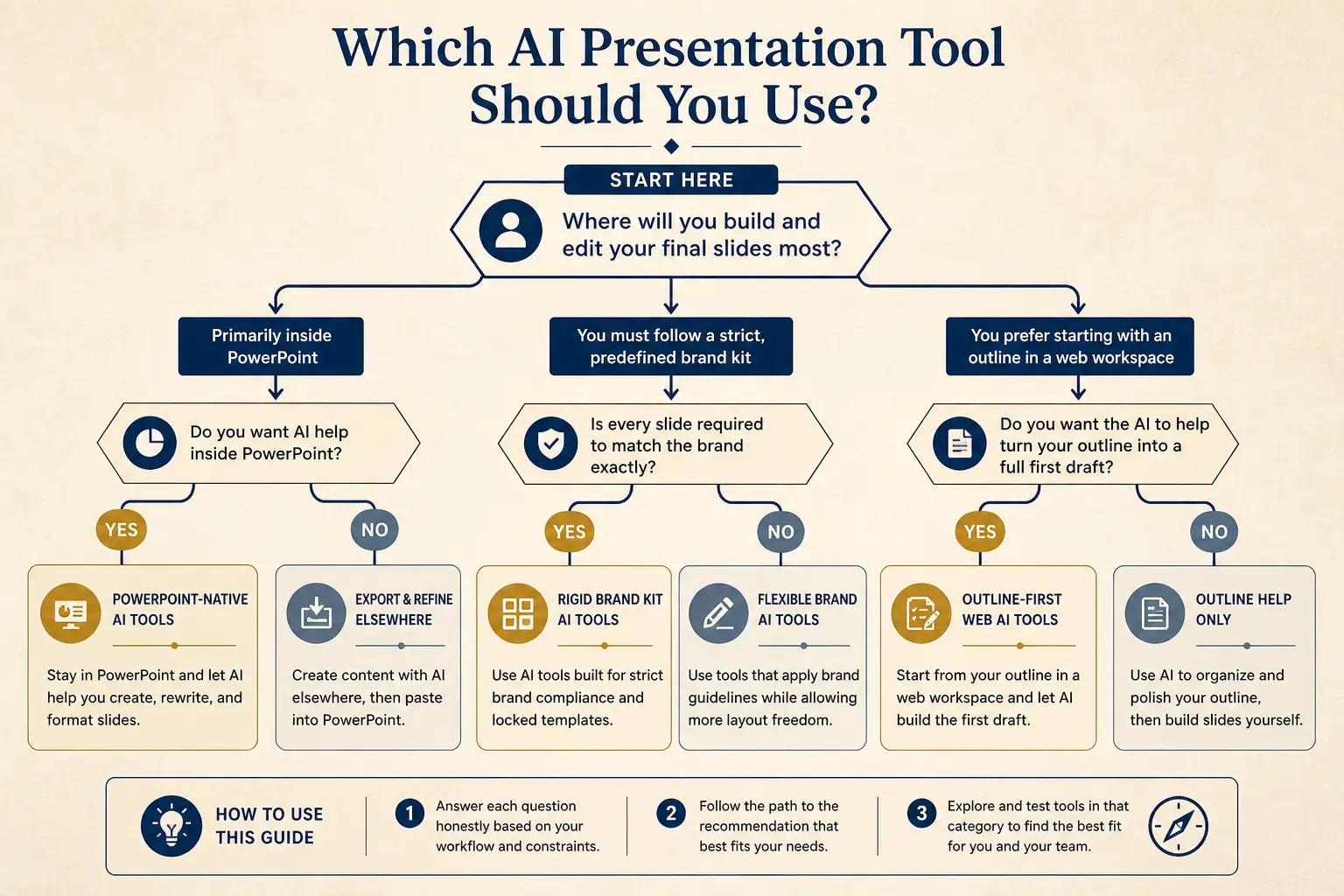
Which tool for which job
Need native PowerPoint editing every day?
Yes → Plus AI / Copilot · No → continue
Need rigid brand kits across a large team?
Yes → Beautiful.ai / enterprise kits · No → continue
Need outline-first AI drafting + present link?
Yes → Gamma
How we tested this matchup
Job brief for this page: a ten-slide product review with a ship or no-ship ask, then a forced reorder that moves risks ahead of options and a metric rewrite on the traction slide. We score the artifact a VP of Product could present tomorrow. Axes are one through five with equal weight unless the room forces a disclosed reweight, for example board packets that must be PPTX. Full definitions live on the method page so you can re-run the protocol yourself.
Beautiful.ai’s brand-kit and Smart Slide strengths are documented on their AI presentations product page. We use that positioning when we award Design and brand-compliance points, and when we say Gamma loses if a rigid kit veto is the binding constraint. For attention and density judgment calls on either tool, we also lean on Nielsen Norman Group’s research on minimizing cognitive load: prettier slides still fail if extraneous clutter burns working memory before the decision lands.
The Constraint Ladder
Original framework for this matchup, the Constraint Ladder. Climb in order: (1) Does brand ops veto freestyle layouts? If yes, Beautiful.ai or another kit tool. (2) Must stakeholders edit the same PPTX daily? If yes, Plus AI or Copilot inside PowerPoint. (3) Does the story rewrite weekly under deadline? If yes, Gamma outline-first. (4) Else pick the tool your team already knows and score Honesty by whether marketing matches the seat. Stopping at step one without asking step three is how kit tools get forced onto messy product reviews every quarter.
Evaluation rubric axes
Score a tool on Gamma’s rubric
1 = fails the job · 5 = excellent. Compare fairly, then read the method page for definitions.
Average: 3.0 / 5
Read scoring definitionsRubric scorecard
Scores below are editorial judgments from the product-review brief as of August 2026. We build Gamma; Beautiful.ai still wins Design for kit-locked work and often Export when you stayed inside Smart Slides.
| Axis | Gamma | Beautiful.ai | Note |
|---|---|---|---|
| Structure | 5 | 3 | Gamma title spine tracks the decision; kit decks feel template-shaped |
| Design quality | 4 | 5 | Smart Slides keep density consistent across contributors |
| Editability | 5 | 3 | Outline surgery versus kit constraints under forced reorder |
| Export fidelity | 3 | 4 | Both need cleanup for board PPTX; kit exports often cleaner |
| Honesty | 5 | 4 | Public method plus dated tradeoffs; verify AI claims in-product |
Choose Beautiful.ai if…
Choose Beautiful.ai when marketing or brand ops owns masters and freestyle layouts create review risk. Choose it when Smart Slide guardrails matter more than open-ended restructuring. Choose it when the story is already approved and the job is consistent visual execution across fifty contributors. Choose it when your team already standardized on Beautiful.ai libraries and switching cost exceeds drafting pain. In those cases Gamma can still draft narrative elsewhere, but Beautiful.ai remains the system of record.
- Marketing or brand ops owns masters and freestyle layouts create risk for customer-facing decks.
- You want Smart Slide guardrails more than open-ended restructuring of the argument the night before.
- The story is already approved; the job is consistent visual execution across a large contributor set.
- Your team already standardized on Beautiful.ai libraries and switching cost exceeds drafting pain for decision decks.
Choose Gamma if…
Choose Gamma when the argument is still moving and you need outline-first drafts you can reject without discarding the deck. Choose it when you rewrite titles and section order the night before the meeting. Choose it when a present link is acceptable for most internal or partner rooms. Choose it when you care about a published evaluation method more than kit lock-in. Fundraising, messy product reviews, and sales follow-ups that change after discovery usually land here.
- The argument is still moving and you need outline-first drafts that survive reject-and-rewrite loops.
- You rewrite titles and section order under time pressure before the meeting starts.
- Present link is acceptable for most internal, partner, or investor rooms you actually run.
- You care about a published evaluation method more than kit lock-in as the primary buying criterion.
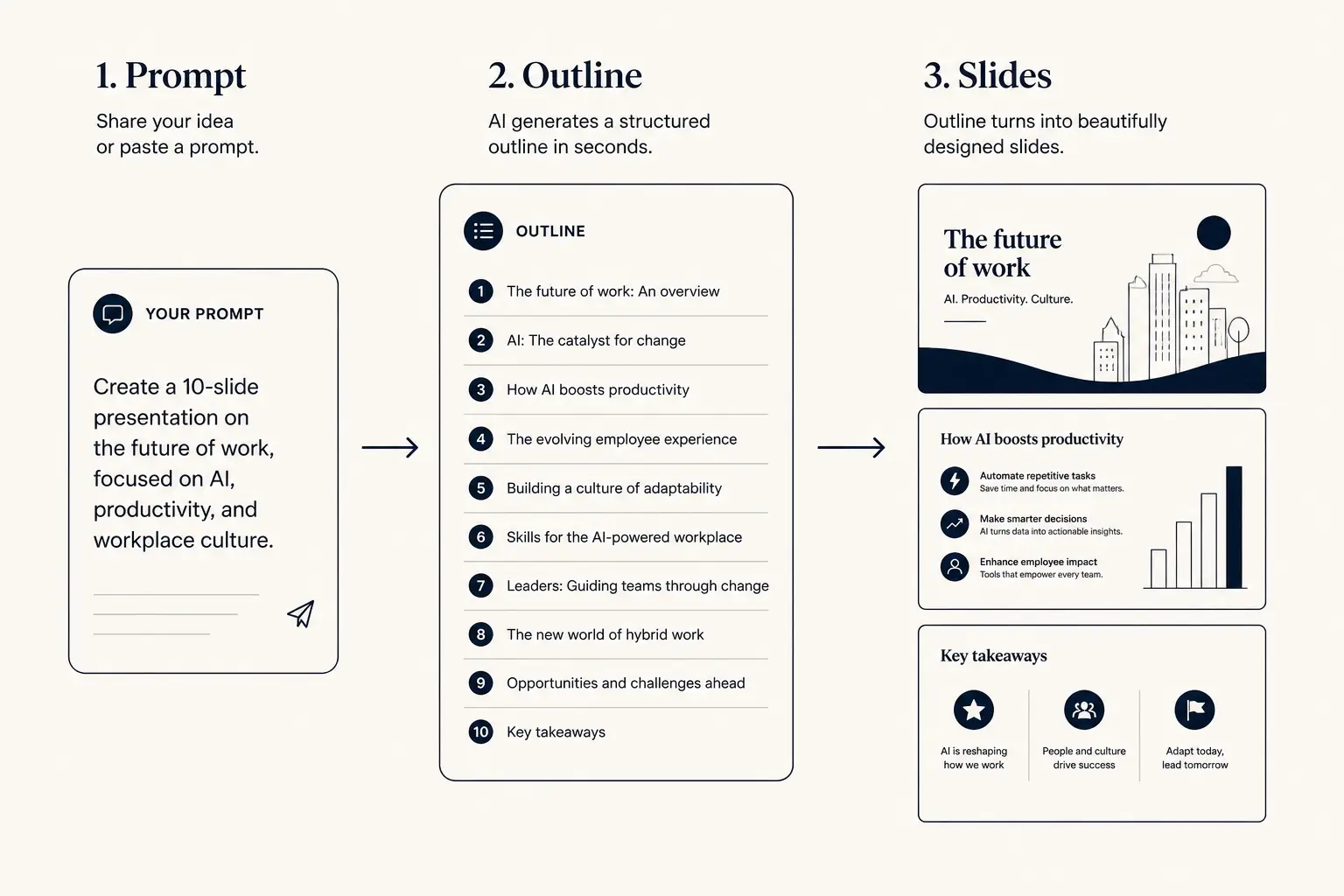
Prompt → outline → slides
1. Prompt
Audience, goal, length, proof you already have.
2. Outline
- • Opening claim
- • Proof beats
- • Ask / next step
3. Slides
Structure
Beautiful.ai produces clean sectioned decks that often feel template-shaped: solid for status updates, thinner for novel arguments that break the kit. Gamma pushes a narrative spine first, claims, proof, ask, then binds layouts to that spine. On fundraising and decision reviews, that difference shows up in the title-only read: can someone skim titles and retell the decision? On brand-locked all-hands with fixed section rules, Beautiful.ai structure is good enough because the organization already decided the arc. Score Structure for the job you actually run, not for a generic “professional looking” vibe.
Design quality
Beautiful.ai earns Design five for kit-locked work: spacing and hierarchy stay consistent when you stay on Smart Slides. Gamma’s Design four means strong defaults with more freedom, and more responsibility, to keep density honest. If your failure mode is someone shipped an ugly slide to customers, Beautiful.ai is the safer sandbox. If your failure mode is pretty slides that do not decide, design is not the axis to optimize first. Do not let a Design five paper over a Structure three.
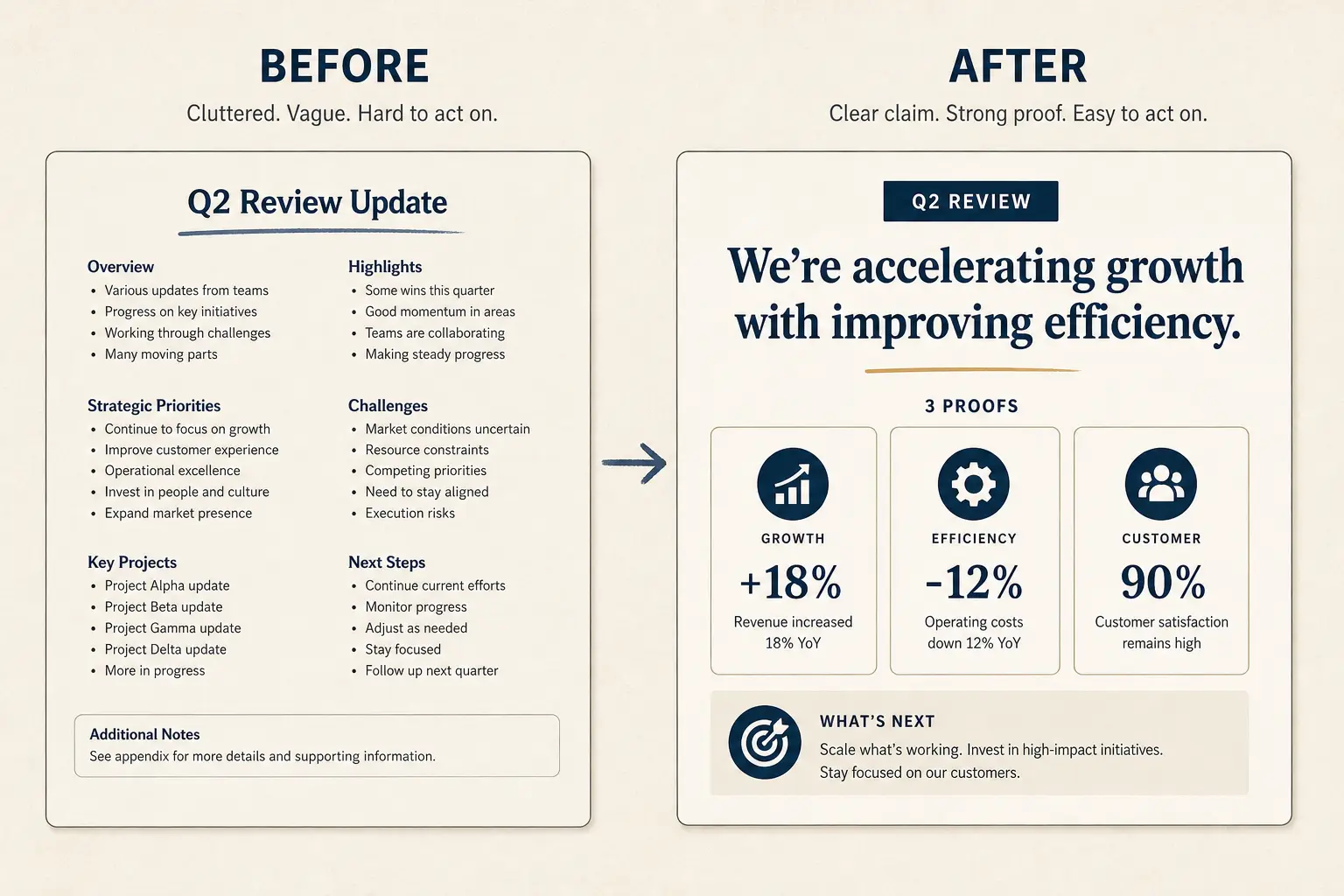
Weak slide → strong slide
Before
- • Overview
- • Features
- • Next steps???
After
- • Cost of status quo
- • Wedge in one claim
- • Proof + decision ask
Editability
Editability is the decisive axis for most operators. Gamma treats outline and slides as one loop: reorder, split, rewrite, regenerate a weak section without discarding the deck. Beautiful.ai editing is comfortable inside the kit and awkward when the narrative needs to break the template. Neither tool should require a full restart for a metric swap, if it does, score Editability a two and walk away. The forced edit in our protocol exists specifically to surface this difference under time pressure.
Time-to-usable-deck
Blank PPT path
Outline in docs → design fight → rebuild → 3–8 hours
Outline-first AI path
Prompt → edit outline → generate → polish → minutes to first usable draft
Export fidelity
As of Aug 2026, verify on vendor sites for current export formats and plan gates. Gamma: strong present-link path; paid plans unlock PDF, PPTX, and PNG with expected cleanup for heavy board packets. Beautiful.ai typically fares well for designed exports when you stayed inside Smart Slides. If native PowerPoint is the system of record every day, neither web tool beats staying in PowerPoint with Plus AI or Copilot. Score the artifact the room requires, not a marketing checklist of formats.
Deep dive on present link versus file handoff: export to PPTX. Plans and export gates: billing.
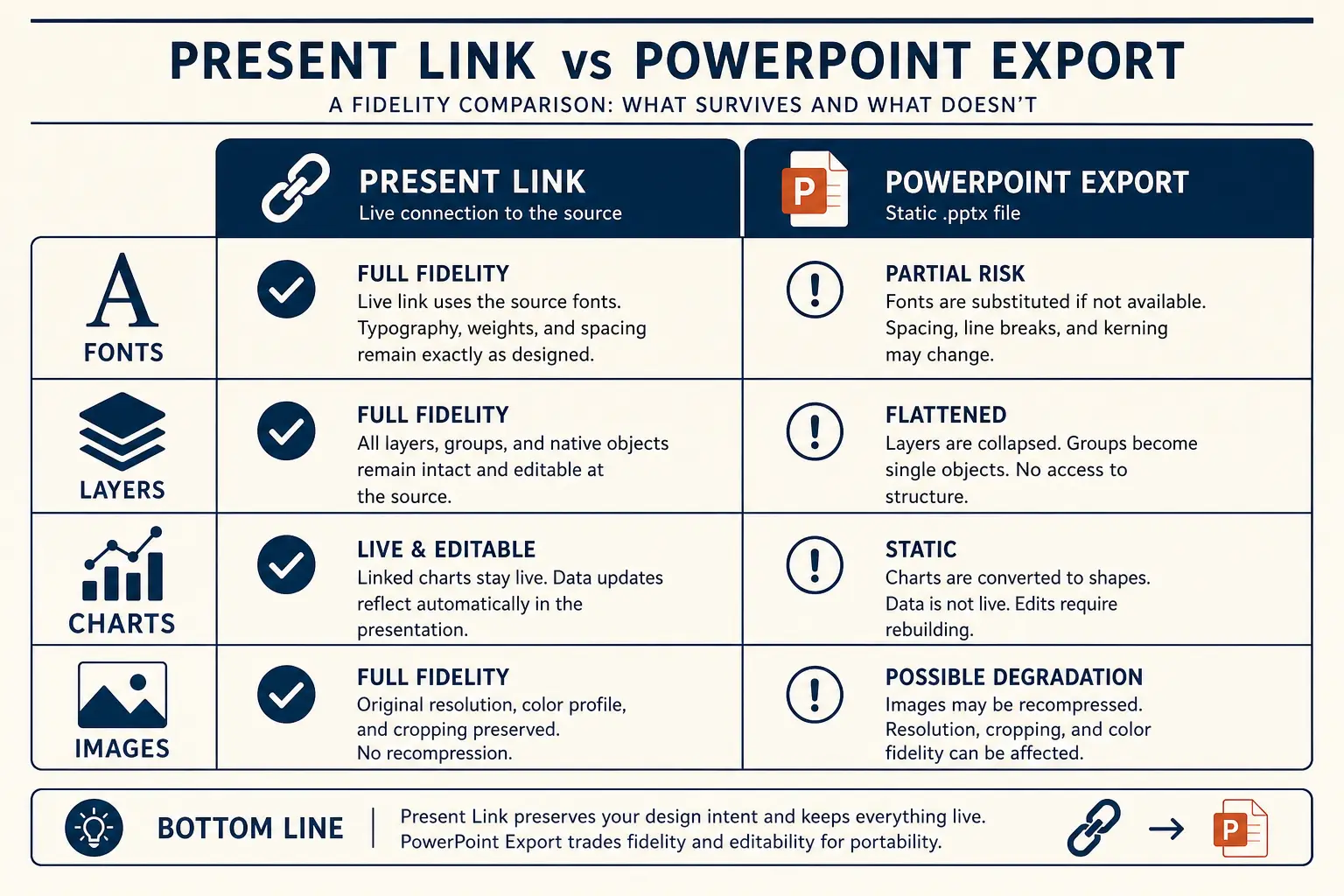
Present link vs PPTX fidelity
Present link
- • Live latest edits
- • Best for your room
- • Analytics-friendly
Export PPTX / PDF
- • Offline / procurement
- • Brand review in PPT
- • Expect cleanup passes
Honesty and transparency
We publish the rubric, date the page, and state when Beautiful.ai wins Design and often Export for kit work. That is the Honesty bar we hold ourselves to. Beautiful.ai’s marketing is generally clear about design-system strengths; still verify AI feature claims in-product against what your seat can actually do. Undated competitor digs, invented pricing, and fake testimonials are disqualifying on this axis for any vendor, including us if we slip.
Workflow comparison
| Step | Gamma | Beautiful.ai |
|---|---|---|
| Start | Brief to editable outline with claim titles | Template or Smart Slide kit selection |
| Revise story | Outline plus slide loop under forced reorder | Edit within slide rules and kit density |
| Brand control | Themes and defaults; not rigid masters | Core strength via Smart Slide guardrails |
| Deliver | Present link or export with cleanup budget | Export or share from the kit library |
Worked scenario: brand all-hands versus ship review
Scenario A, global brand all-hands with locked typography, icon set, and section templates. Beautiful.ai or a similar kit tool reduces off-brand risk across many contributors. Gamma can still draft the narrative, but brand ops will pull the final into the kit. Choose Beautiful.ai as system of record when compliance reviews the file, not the argument. Scenario B, product ship review tomorrow with messy metrics and a story that changed twice this week. Gamma’s outline loop is the faster path. Beautiful.ai will look cleaner sooner and fight you harder when risks must jump ahead of options. Dual-running is rational: kit decks in Beautiful.ai, decision decks in Gamma.
Slide density spectrum
Sparse
Live stage
1 claim, huge type
Balanced
Default
Claim + 3 proofs
Dense
Leave-behind
Detail for async read
Failure modes and what to cut
Common failure modes when comparing these two tools: scoring Design before Structure so pretty nonsense still fails rooms; treating Smart Slide friction as a personal failing instead of a product tradeoff; assuming export equality without opening the PPTX on a clean machine; migrating every deck at once instead of splitting kit decks from decision decks; copying undated pricing from roundups; and buying seats before running the same brief and forced edit in both tools. Procurement tip: demand the same brief, the same forced edit, and a dated feature list from each vendor.
- Cut the idea that one tool must own every deck type in the company — dual-running by job class is normal.
- Cut aesthetic bake-offs that never include a forced narrative edit under a real deadline.
- Cut undated pricing tables from third-party roundups before procurement signs anything.
- Cut full-fleet migrations; move decision decks first, keep kit decks where brand ops already wins.
Pricing note (August 2026)
Pricing note dated August 2026, verify on vendor sites before you buy. Beautiful.ai and Gamma both use freemium or trial entry with paid upgrades for teams, brand controls, collaboration, or export. Seat math should include who edits versus who only views, whether export sits behind a plan gate, and whether brand kits require a higher tier. Ignore dollar figures you find in undated blog posts; open each vendor’s pricing page the day you purchase and screenshot what you saw.
Related decisions
Migrating off Beautiful.ai? Read Beautiful.ai alternatives. Broader shortlist: best AI presentation makers. Product fit for Gamma: AI presentation maker. Annotated decks: examples.
Not for you if…
Gamma is not for you if every customer-facing deck must pass a brand kit review before it can leave the building and you have no appetite for a second drafting home. Beautiful.ai is not for you if your weekly pain is rewriting the argument under deadline inside rigid Smart Slides. Neither tool is for you if the real requirement is daily native PowerPoint editing by legal and finance in the same file, that job belongs to Plus AI, Copilot, or staying in PowerPoint. Naming the not-for cases early prevents expensive seat sprawl.
One-seat decision matrix
Decision matrix for teams that can afford only one primary seat: if brand ops can veto layouts, Beautiful.ai wins. If product and fundraising rewrite arcs weekly, Gamma wins. If procurement demands native PPTX with zero cleanup, neither wins alone, export from Gamma or stay in PowerPoint. If sales wants analytics on who opened the deck, evaluate Pitch as a third lane rather than forcing that job onto a brand kit or an outline tool. One seat for every job is a procurement fantasy; one primary seat per job class is operationally sane.
Anatomy of a claim slide
Claim headline (one idea)
Supporting line that states the so-what for this audience.
Source / footnote
Concrete next step in Gamma
Concrete next step: paste your next product review or pitch brief into Gamma, lock claim titles on the outline, generate slides, then reorder risks ahead of options and rewrite one metric. Present from the link. In parallel, rebuild the same brief inside Beautiful.ai Smart Slides if you have a seat. Keep the tool that survives the forced edit for that job class. For kit-locked work, keep Beautiful.ai. For outline surgery, keep Gamma. Read the method page so scores mean the same thing next quarter.
Frequently asked questions
Stress-test outline-first drafting
Run your Beautiful.ai brief in Gamma: generate, reorder a section, present, then keep the tool that survives the edit.