Compare
Gamma vs Pitch.com for sales decks
Gamma vs Pitch is a choice between an outline-first AI presentation workspace and collaborative presentation platform with sales analytics. Team collaboration, sales rooms, and engagement analytics favor Pitch. Outline-first AI drafting speed for changing narratives favor Gamma. We build Gamma and still write choose-them sections when constraints point the other way. Scores use the public five-axis rubric on the method page and are dated August 2026 so procurement can re-run the same brief on current builds. Read the choose-them sections before the scorecard so you do not optimize for a trophy that ignores your binding constraint.
Scoring method:/method. Compare hub:all comparisons.
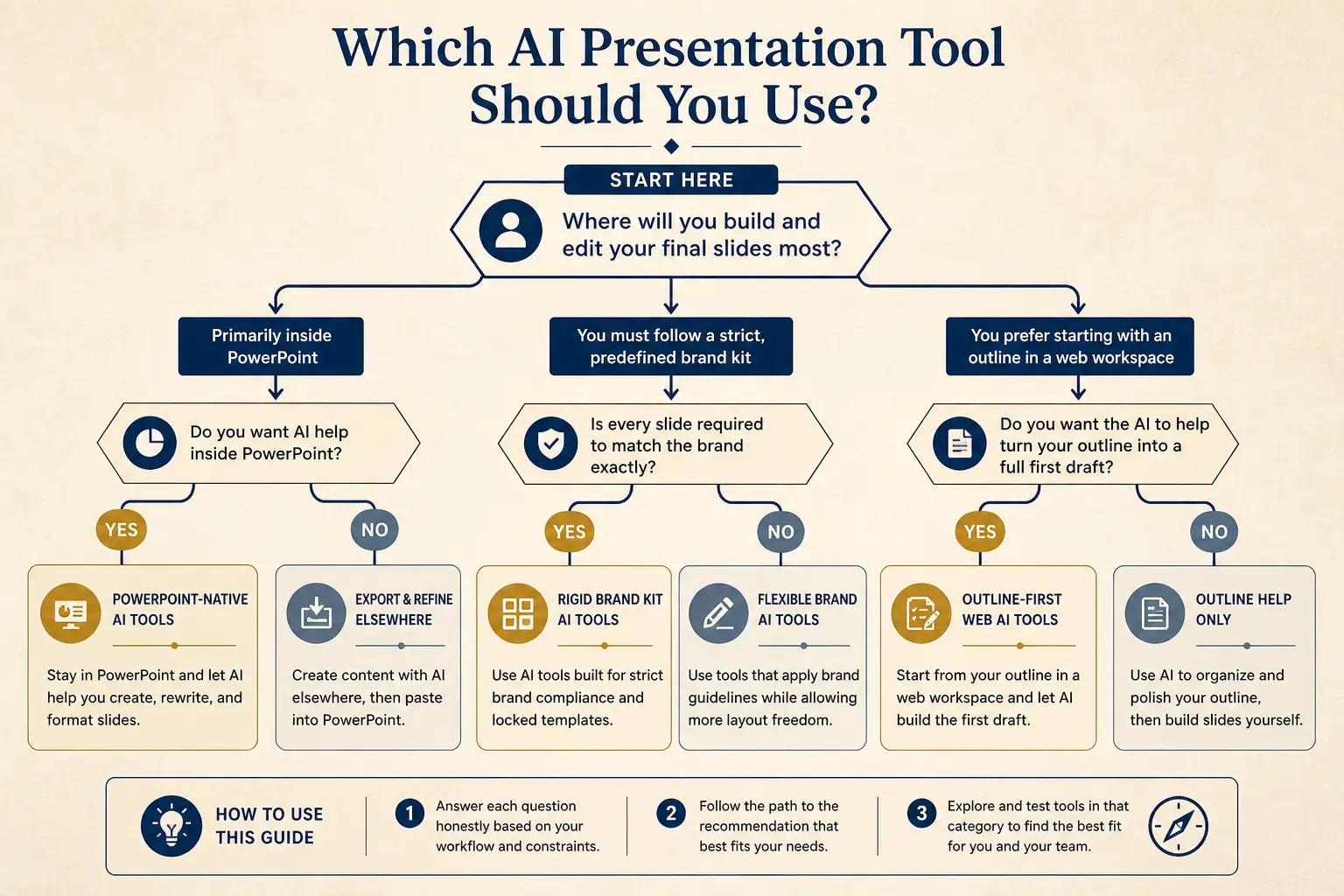
Which tool for which job
Need native PowerPoint editing every day?
Yes → Plus AI / Copilot · No → continue
Need rigid brand kits across a large team?
Yes → Beautiful.ai / enterprise kits · No → continue
Need outline-first AI drafting + present link?
Yes → Gamma
How we tested
Job brief: a ten-to-twelve slide decision deck (product review or fundraising arc) with a clear ask, then a forced reorder of a critical section and a metric rewrite. We score Structure, Design, Editability, Export, and Honesty one through five on the artifact the room needs, present link, PDF, or PPTX. Pitch is tested in its natural habitat; Gamma is tested outline-first. Full definitions live on the method page. If your room requires a different artifact than our brief, reweight Export explicitly and write that reweight at the top of your notes.
The Sales Room Versus Draft Spine Test
Original framework, The Sales Room Versus Draft Spine Test. Pitch optimizes multiplayer decks and knowing whether a buyer opened slide seven. Gamma optimizes getting from messy brief to editable claim spine quickly. If your bottleneck is coordination and analytics across a sales pod, Pitch deserves the bake-off. If your bottleneck is that every deck starts as incoherent mush, fix drafting first, analytics on a weak story still measure a weak story. Climb the constraint ladder before you compare feature matrices: brand veto, file gravity, collaboration analytics, then drafting speed. Stopping at aesthetics alone is how teams buy the wrong seat. Teams that skip this framework buy seats for aesthetics and then recreate the old workflow inside the new logo within two sprints.
Evaluation rubric axes
Score a tool on Gamma’s rubric
1 = fails the job · 5 = excellent. Compare fairly, then read the method page for definitions.
Average: 3.0 / 5
Read scoring definitionsRubric scorecard
Editorial scores as of August 2026 for the decision-deck brief. We build Gamma; Pitch still leads where noted in the table, especially when team collaboration, sales rooms, and engagement analytics dominate the job.
| Axis | Gamma | Pitch | Note |
|---|---|---|---|
| Structure | 5 | 4 | Both solid; Gamma pushes claim titles harder |
| Design quality | 4 | 4 | Both modern; Pitch strong for team templates |
| Editability | 5 | 4 | Outline loop versus collaborative canvas |
| Export fidelity | 3 | 4 | Pitch often smoother for designed exports |
| Honesty | 5 | 4 | We admit Pitch wins analytics; verify pricing tiers |
Choose Pitch if…
Choose Pitch when team collaboration, sales rooms, and engagement analytics are the binding constraints for your team this year. Choose Pitch when switching cost exceeds drafting pain and your operating system already centers on that product. Choose Pitch when stakeholders will reject a second home for decks even if first drafts are faster elsewhere. Honesty requires saying this plainly even though we build Gamma. Saying this plainly is the point of an honest comparison page, brand preference is not a strategy when constraints disagree.
- Team collaboration, sales rooms, and engagement analytics are non-negotiable for your stakeholders this year.
- Your team already standardized on Pitch and switching cost exceeds drafting pain for most decks.
- Compliance or procurement rejects a second presentation home outside Pitch.
- The story is settled and the job is execution inside Pitch's strengths rather than narrative surgery.
Choose Gamma if…
Choose Gamma when outline-first ai drafting speed for changing narratives matter more than staying inside Pitch. Choose Gamma when claim titles must be rewritten the night before the meeting and the tool must not fight section surgery. Choose Gamma when present link covers most rooms and export is a planned exception. Choose Gamma when you want a published scoring method rather than vibe-based vendor selection. If those conditions are only half true, dual-running by job class usually beats forcing a single winner across the company.
- The argument still moves weekly and you need outline-first drafts that survive reject-and-rewrite loops.
- Present link is acceptable for most rooms you actually run; export is a planned exception.
- You rewrite titles and section order under deadline and the tool must not fight that surgery.
- You want a published evaluation method with dated tradeoffs rather than vibe-based selection.
Who should not use either as primary
Neither Gamma nor Pitch should be your only seat if your real constraint is a different lane, rigid Smart Slide brand kits, pure social design, or a compliance chain that forbids new tools without a six-month review. Name the lane before you buy. A wrong primary seat creates shadow tools within a quarter and wastes the bake-off you just ran.
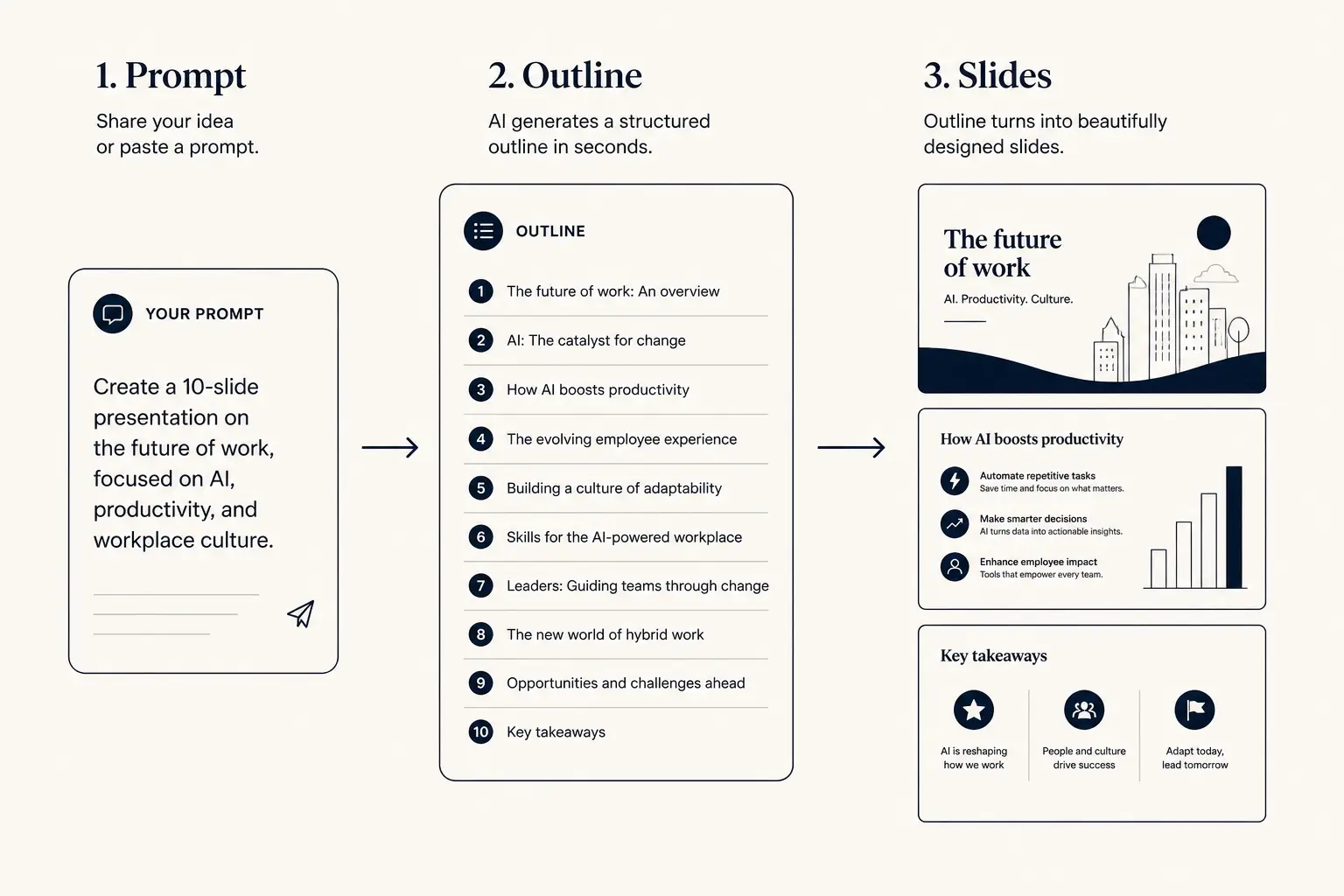
Prompt → outline → slides
1. Prompt
Audience, goal, length, proof you already have.
2. Outline
- • Opening claim
- • Proof beats
- • Ask / next step
3. Slides
Structure
Structure scores whether titles skim as a story toward a decision. Gamma pushes claim spines early. Pitch structure quality depends on whether the product forces narrative discipline or leaves it to operator skill and templates. Re-score Structure after a junior teammate runs your brief, senior storytellers paper over tool gaps and bias bake-offs. Title-only reads remain the cheapest Structure test money cannot replace: if titles could belong to any company in your category, rewrite before you judge design.
Design quality
Design scores hierarchy, density, and consistency, not decoration. Pitch may win visual polish for certain jobs; Gamma aims for strong defaults with room to keep density honest. If your failure mode is ugly slides, weight Design higher. If your failure mode is pretty nonsense, weight Structure and Editability higher and do not let a Design five hide a Structure three. Decoration that only show hero slides hide density failures that appear on proof and risk slides, score the middle of the deck too.
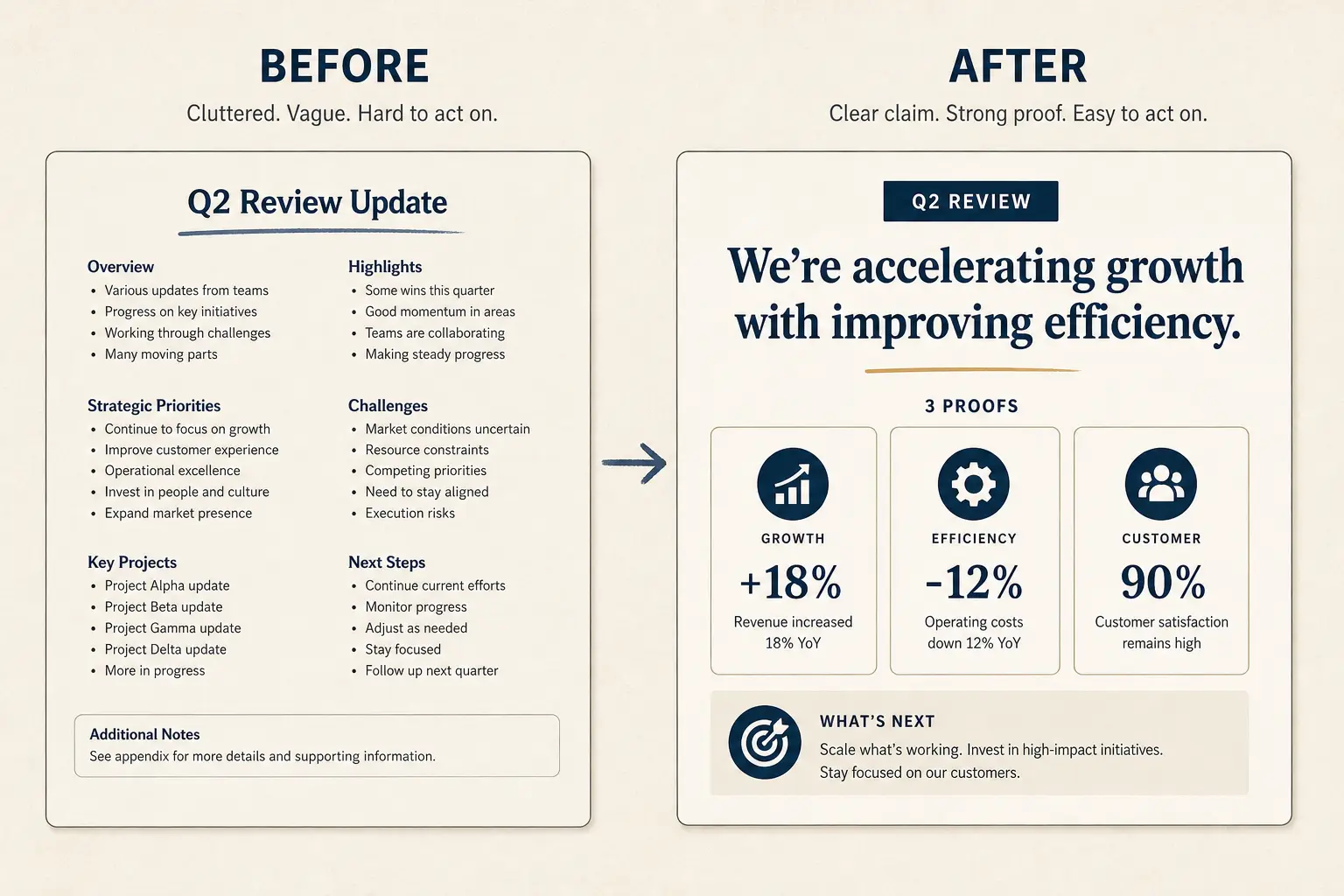
Weak slide → strong slide
Before
- • Overview
- • Features
- • Next steps???
After
- • Cost of status quo
- • Wedge in one claim
- • Proof + decision ask
Editability
Editability scores the forced reorder and metric rewrite under time pressure. Gamma treats outline and slides as one loop. Pitch editability is strong when you live in its native paradigms and weaker when narrative surgery fights the product model. If a metric swap requires a full restart, score Editability a two regardless of brand love. Time the forced edit with a stopwatch; subjective “felt easy” scores are how bake-offs get captured by the best presenter in the room.
Time-to-usable-deck
Blank PPT path
Outline in docs → design fight → rebuild → 3–8 hours
Outline-first AI path
Prompt → edit outline → generate → polish → minutes to first usable draft
Export fidelity
As of Aug 2026, verify on vendor sites for formats and plan gates. Score Export for the artifact you will actually ship this quarter. Gamma present-link is strong; PPTX export expects cleanup on heavy packets. Pitch may win when the deliverable never leaves its native format. See export to PPTX for handoff patterns and billing for plan gates. Plan a cleanup budget in minutes per slide for board packets; zero-budget export expectations are how tools get unfairly failed after a single messy open.
Present link versus file handoff details:export to PPTX. Plan gates:billing.
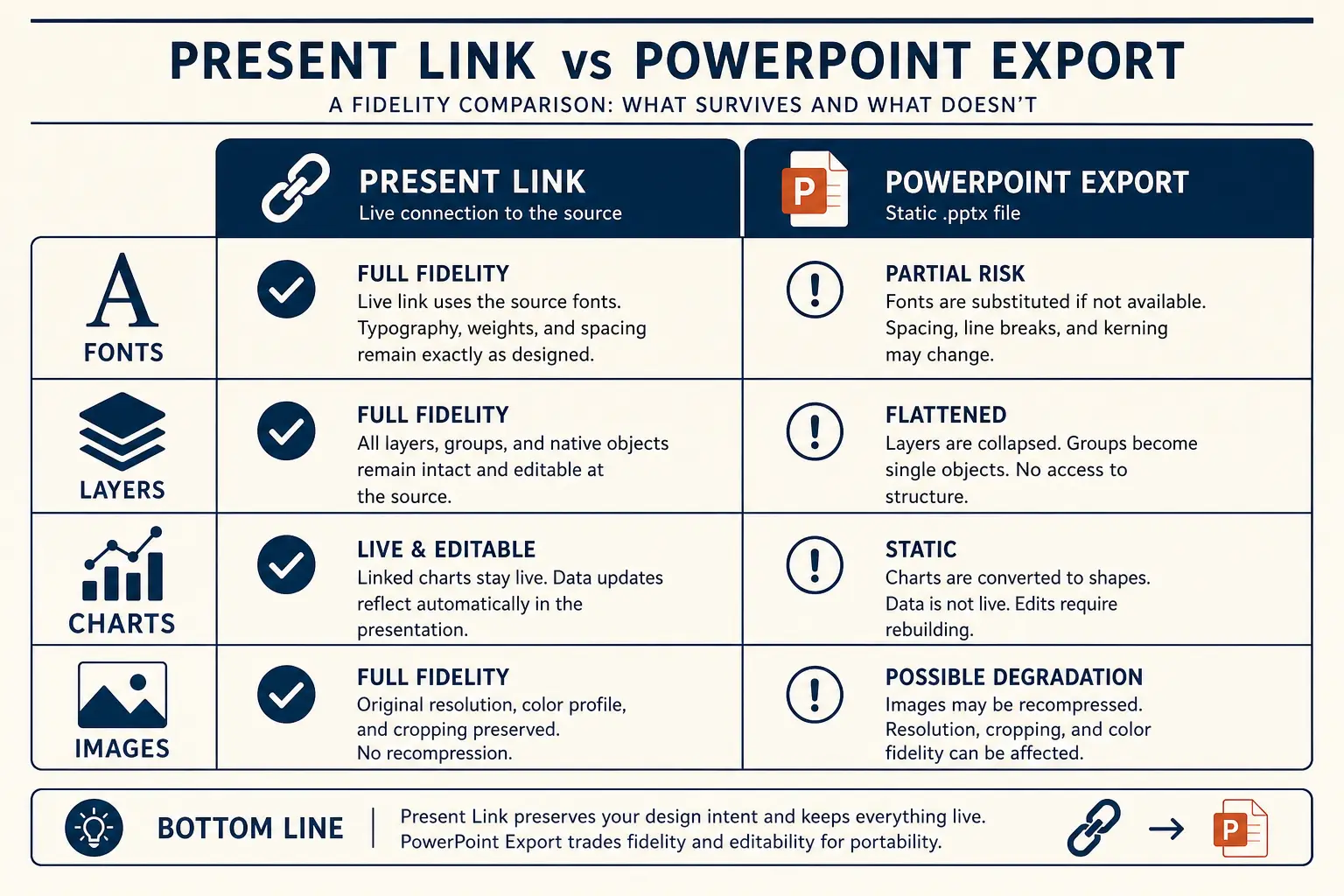
Present link vs PPTX fidelity
Present link
- • Live latest edits
- • Best for your room
- • Analytics-friendly
Export PPTX / PDF
- • Offline / procurement
- • Brand review in PPT
- • Expect cleanup passes
Honesty and transparency
Honesty scores whether marketing matches the seat: dated claims, visible limits, no fake testimonials, no undated pricing. We publish the rubric and admit where Pitch wins. Deduct Honesty when any vendor, including Gamma, oversells export as pixel-perfect or hides SKU fragmentation. Re-read claims after every major launch. Require vendors to date feature claims and to show the exact SKU that unlocks the demo you saw, SKU fragmentation is an Honesty issue.
Worked example
Worked example A: an operator must ship a decision deck tomorrow with metrics that changed twice this week. Gamma outline lock, generate, reorder risks ahead of options, present from link, optimized for argument motion. Pitch path depends on whether the story is already settled and whether stakeholders demand that product native. Pick the path that matches the binding constraint, not the prettier homepage. Write down which constraint actually bound the decision, file, brand, analytics, or argument motion, so the next purchase reuses the same logic.
Worked example B: a team with existing Pitch muscle memory and light AI needs. Staying put can be rational even if Gamma drafts faster, switching tax is real and often larger than founders admit. Worked example C: dual-running by job class, Gamma for messy narrative drafts, Pitch where sales collaboration and engagement analytics already wins, with a written handoff so two sources of truth do not fight before the meeting.
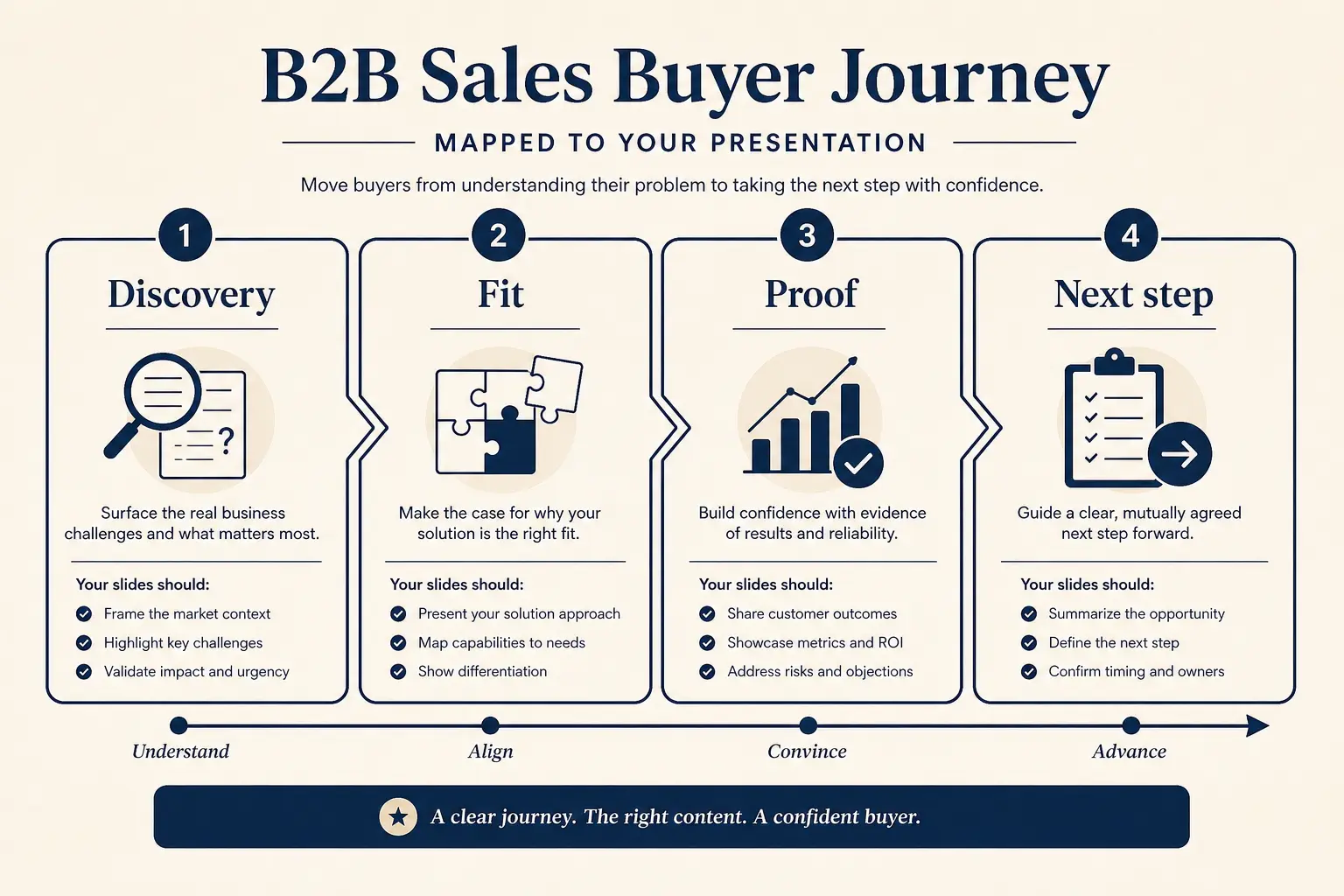
Buyer journey → slide map
Discovery
Pain + stakes
Fit
Why you win
Proof
ROI / risk
Next step
Clear ask
Failure modes and what to cut
Failure modes: aesthetic bake-offs without forced edits; undated pricing tables; assuming one tool must own every deck type; ignoring file gravity or brand vetoes; scoring Design before Structure; migrating everything in one weekend. Cut vanity demos that never touch your real brief, real metrics, and real stakeholder constraints for Pitch versus Gamma. The fastest way to waste a quarter is migrating every template at once instead of moving one job class, measuring, then expanding.
- Cut aesthetic-only bake-offs that never force a narrative reorder in both Gamma and Pitch.
- Cut undated pricing tables from third-party roundups before finance approves seats.
- Cut winner-take-all migrations; split jobs by constraint instead of ideology.
- Cut assuming Pitch equals brand control, analytics, or file fidelity without testing your tenant or plan.
Not for you if…
Gamma is not for you if your organization will never accept a non-Pitch home for presentations and links are forbidden. Pitch is not for you if your weekly pain is rewriting arguments inside a product model that fights section surgery. Both are wrong if you have not defined the job of the deck. Define the job first. If you recognize yourself in the not-for paragraph, stop the bake-off and fix the constraint or the job definition first.
Pricing note (August 2026)
Pricing note dated August 2026, verify on vendor sites before purchase. Pitch and Gamma pricing tiers, seat definitions, and export gates change. Screenshot the pages you used for procurement. Ignore aggregator dollar amounts. Include adjacent costs (Microsoft 365, Google Workspace, design suite seats) in total cost of ownership when relevant to Pitch. Finance reviews go smoother when you attach dated screenshots and note whether export, brand kits, or AI credits sit behind a higher tier.
Related decisions
Continue with the compare hub for sibling matchups, Best AI presentation makers for job-based ranking, examples for annotated decks, and the method page for scoring definitions. Product entry points include the AI presentation maker page and login for a live draft test against the same brief you used to score Pitch.
Concrete next step
Keep a one-page scorecard in your wiki with dates, brief, and winner by job class. Concrete next step: run your next real brief in Gamma, lock claim titles, generate, force a section reorder, rewrite one metric, present from the link, export only if required. In parallel, run the same brief in Pitch if you have access. Keep the tool that survives the forced edit for that job class. Re-score quarterly as vendors ship. Save the outline and the forced-edit notes beside the scores so a future teammate can reproduce the evaluation without starting from marketing pages.
Frequently asked questions
Run the same brief against Pitch
Generate in Gamma, force an edit, present, then keep Gamma or Pitch based on what survives.