Templates
AI pitch deck template with an investor-ready spine
Start from a Gamma pitch deck template that follows a fundraising arc investors recognize—then paste real traction and sharpen the ask. Outline first, edit ruthlessly, present or export when the room requires a file. Templates accelerate structure; they do not invent proof.
Who this pitch deck template is for
Use this template when you are preparing pre-seed, seed, or Series A conversations and want a familiar spine without starting from a blank canvas. It fits founders, operators helping portfolio companies, and advisors tightening ask slides. If you are reporting monthly rather than raising, use the investor update workflow instead.
- Founders drafting a partner-meeting deck under time pressure.
- Teams rewriting a bloated thirty-slide pitch into a timed live path.
- Advisors who need a shared spine for coaching multiple companies.
- Operators converting a memo into a visual raise narrative.
Not for you if…
Skip this template for sales evaluations, classroom talks, or board governance packets. Skip if you hope AI will invent traction. Skip if you need locked brand masters as the primary constraint—finish packaging in a kit tool after the story is solid. And skip if you refuse to edit the outline; unedited templates still ship hollow raises.
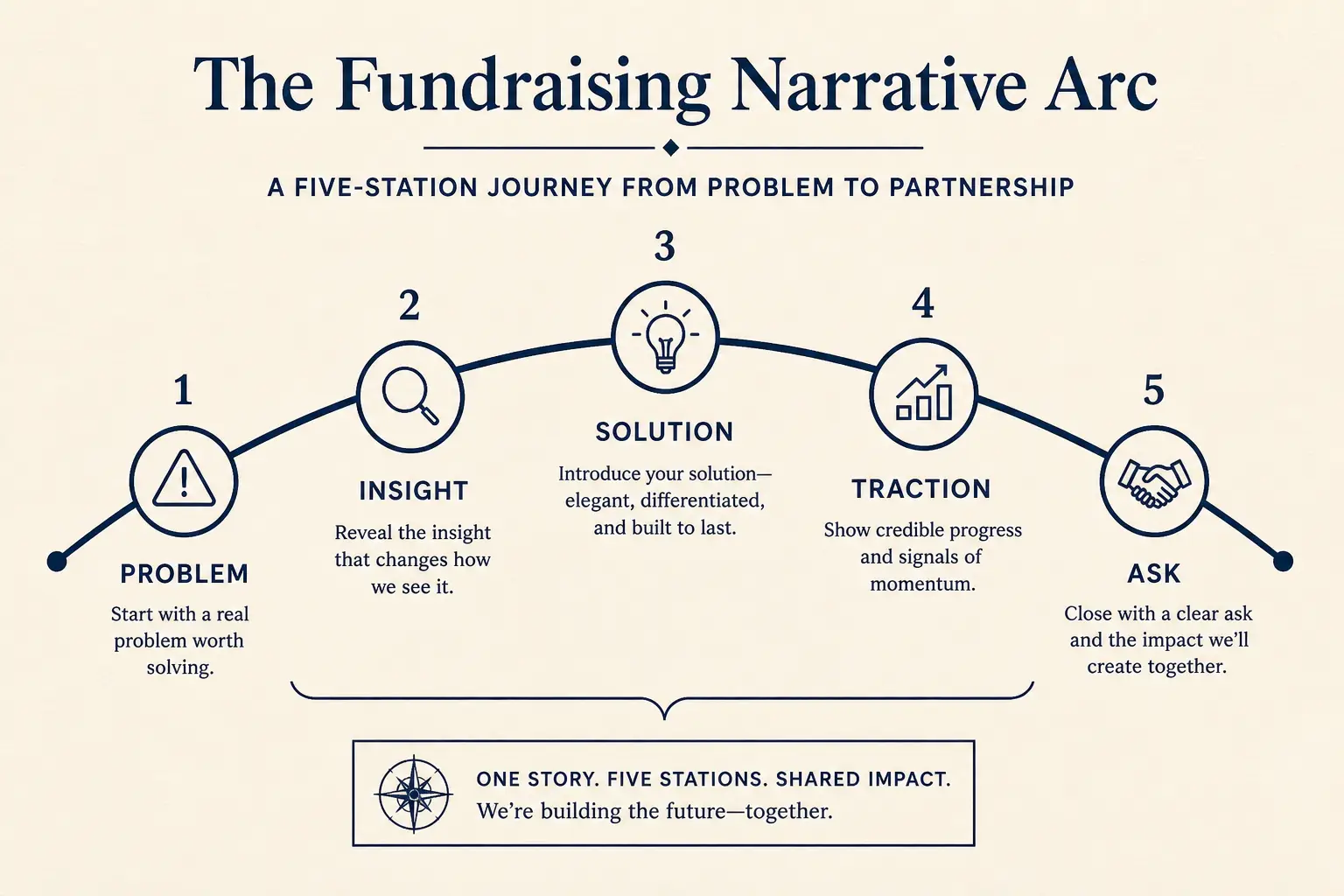
Fundraising narrative arc
Tension early. Proof before the ask. Titles should skim as a story.
Template spine mapped to RAISE
The template encodes RAISE: Reality of the problem, Advantage wedge, Insight why now, Scoreboard traction, Exact ask. Before you generate, write five sentences that fill those letters. Titles in the outline should still work if body copy never loads. If market is pure TAM without beachhead, rewrite before slides exist.
- Reality, buyer cost in hours, dollars, or risk.
- Advantage, one wedge sentence rivals cannot copy this quarter.
- Insight, why this year changes the stack or buying motion.
- Scoreboard, three live metrics max; appendix for the rest.
- Exact ask, amount, runway, use of funds buckets totaling 100 percent.
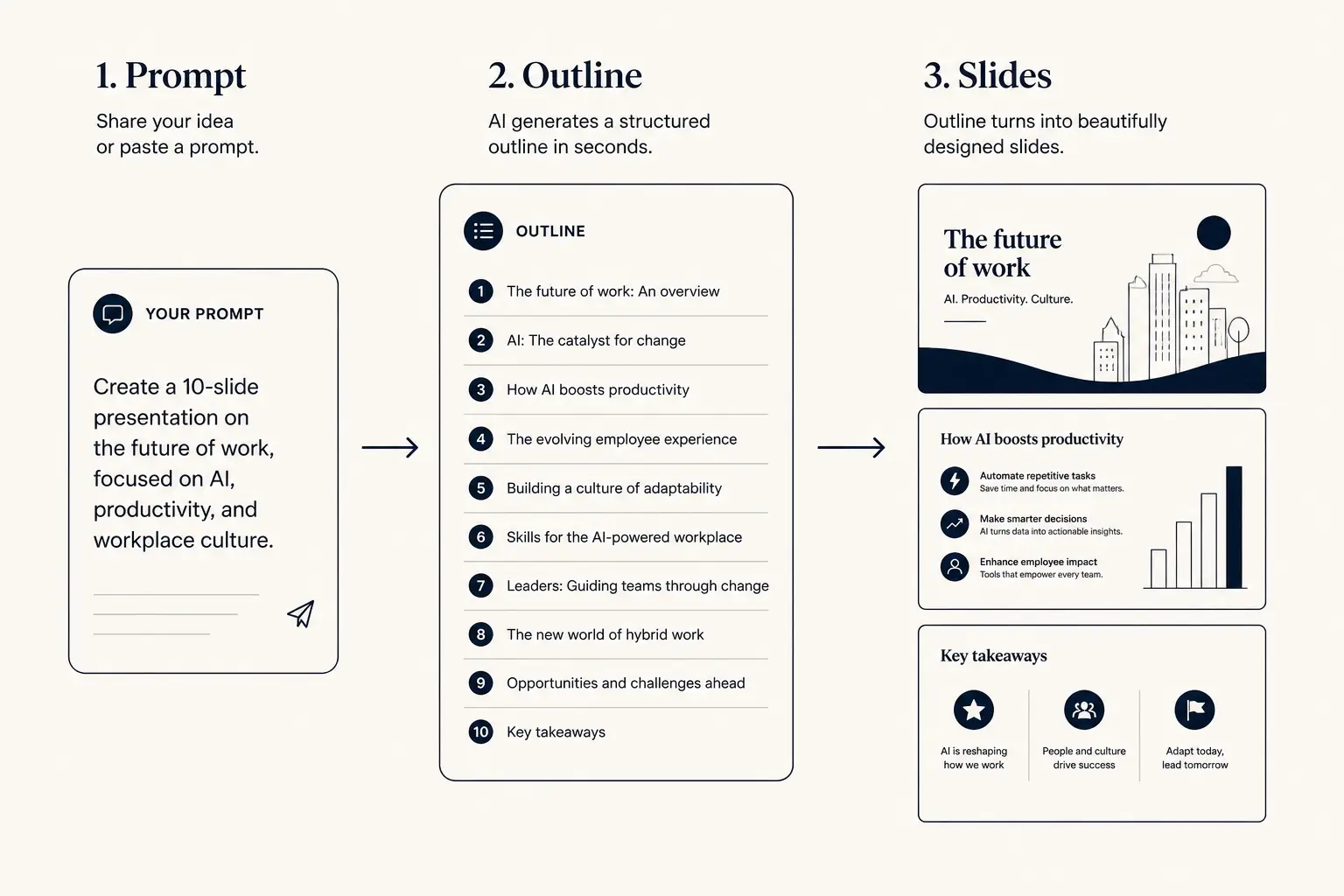
Prompt → outline → slides
1. Prompt
Audience, goal, length, proof you already have.
2. Outline
- • Opening claim
- • Proof beats
- • Ask / next step
3. Slides
Outline preview
- Narrative, open with Fill a pitch deck template for
- Body, 3–5 slides that carry the argument
- Close, summary, risks, and the ask
Preview only, Gamma expands this into editable slides.
Slide budget for the raise meeting
High-stakes short meetings need tighter live paths. Set minutes and stakes, then cut template sections that do not fit.
Slide budget calculator
Get a realistic slide count from meeting length and stakes, then open a matching prompt in Gamma.
16
Total slides
11
Core narrative
5
Appendix
Create a 16-slide deck for executives who skim. Meeting length: 12 minutes. Stakes: high. Use an outline-first structure with 11 core narrative slides and 5 appendix slides. Every slide needs one claim and proof.
Open this budget in GammaWorked example: filling the seed template
Product: workflow tool for mid-market ops. Ask: $2.5M for eighteen months. Metrics: $420k ARR, 11 percent MoM, 118 percent NRR, eight paying logos. Meeting: fourteen minutes with two partners. Fill Reality with the six- hour weekly cost from interviews. Fill Advantage with the wedge versus spreadsheet glue. Fill Scoreboard with ARR, MoM, NRR on one slide. Fill Exact ask with three spend buckets. Delete the origin-story montage the template might suggest. Move competitive detail to appendix if time is tight.
| Template section | What you paste | Cut if… |
|---|---|---|
| Market | Beachhead count, buyer, expansion path | It is only TAM poetry without a wedge |
| Traction | ARR, growth, retention, logo context | Logos appear without retention or growth |
| Ask | Amount, runway, use of funds percentages | Never cut the ask—rewrite until specific |
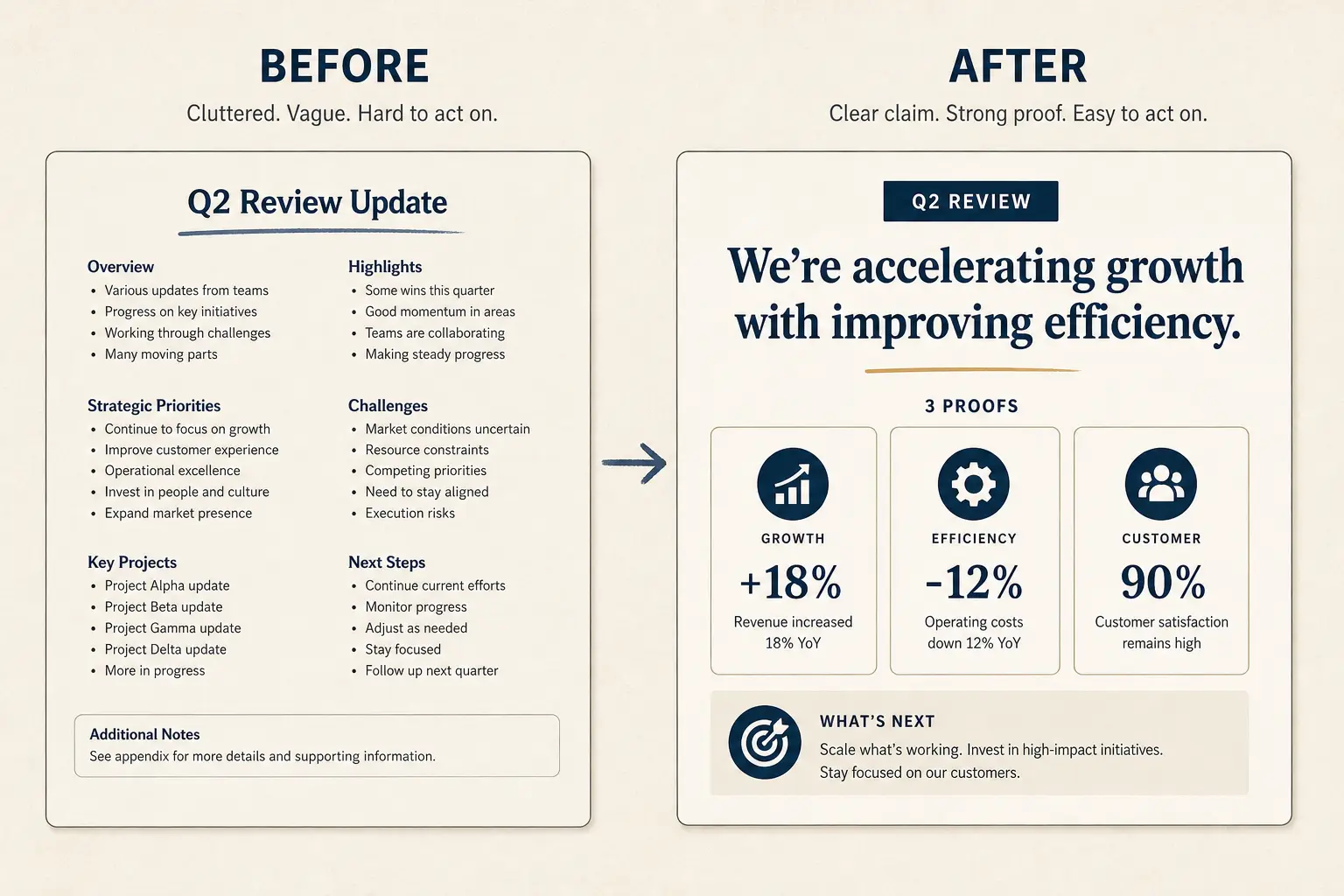
Anatomy of a claim slide
Claim headline (one idea)
Supporting line that states the so-what for this audience.
Source / footnote
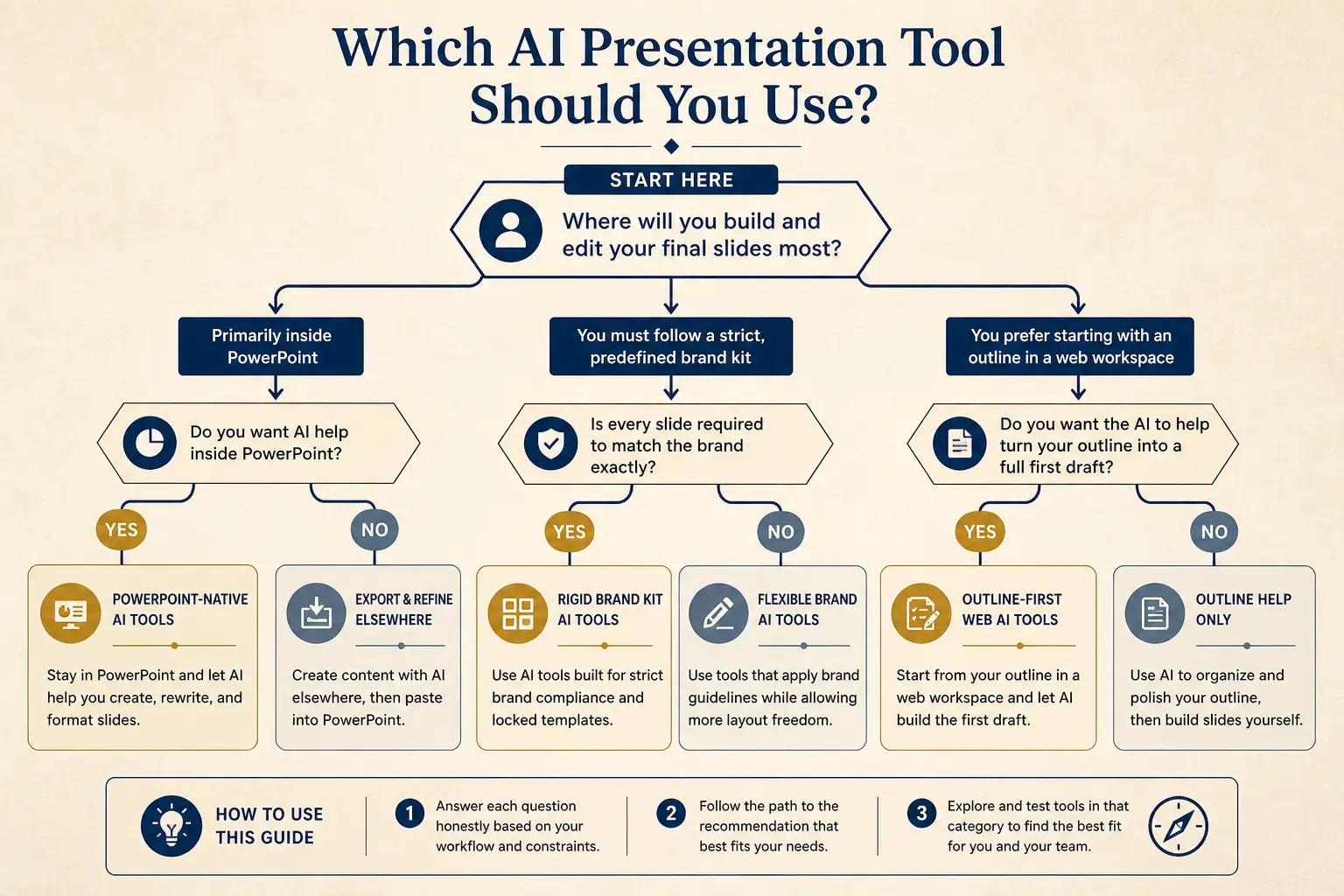
Which tool for which job
Need native PowerPoint editing every day?
Yes → Plus AI / Copilot · No → continue
Need rigid brand kits across a large team?
Yes → Beautiful.ai / enterprise kits · No → continue
Need outline-first AI drafting + present link?
Yes → Gamma
Stage notes inside the same template
Pre-seed overweight insight, prototype path, and founder edge. Seed must show a repeatable wedge with early revenue or strong usage. Series A must show unit economics and a scalable motion. Put the stage in the first sentence of your prompt so the template densifies correctly. Associate- heavy processes need thicker appendix packs even when the live path stays short.
Evaluation rubric axes
Present and export
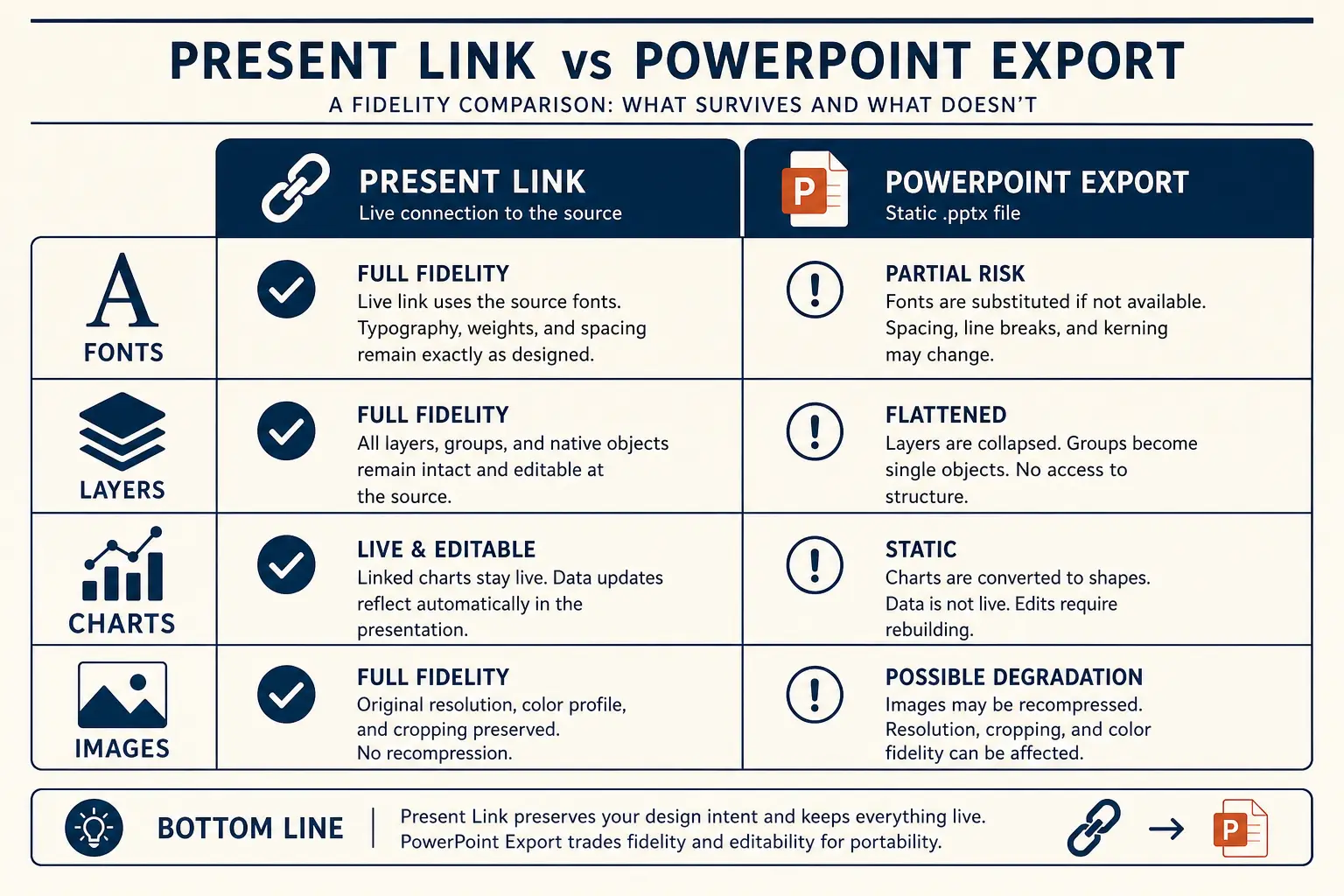
Present from Gamma for most partner meetings. Export when files are required—see export to PPTX. Keep data rooms separate from the live pitch. For the full generator craft, use the AI pitch deck generator page. For monthly reporting, use AI investor update. Browse the templates hub if you picked the wrong spine.
Present link vs PPTX fidelity
Present link
- • Live latest edits
- • Best for your room
- • Analytics-friendly
Export PPTX / PDF
- • Offline / procurement
- • Brand review in PPT
- • Expect cleanup passes
Slide density spectrum
Sparse
Live stage
1 claim, huge type
Balanced
Default
Claim + 3 proofs
Dense
Leave-behind
Detail for async read
Failure modes when filling the template
- Leaving AI-invented traction because placeholders looked real.
- Keeping every template section for a twelve-minute meeting.
- Ask slide missing amount, runway, or use of funds.
- Market as TAM without beachhead or buyer.
- Using the pitch template for a sales evaluation.
- Polishing fonts before the title-only read passes.
- Merging data room depth into the live path until pacing dies.
- Stage mismatch: Series A economics forced into a pre-seed story.
Continue with pitch guides under Learn, annotated examples, and the AI pitch deck generator. Compare tools with Method when software choice is still open. Return to the templates hub to switch spines if the job changed.
Coach notes for filling the pitch template well
Advisors coaching multiple founders should keep a shared critique checklist beside this template. First, title-only read. Second, traction honesty. Third, ask completeness. Fourth, stage fit. Fifth, timed rehearsal. AI pitch deck templates make first drafts fast; coaching still decides whether the raise narrative can survive interruption. Do not confuse a filled template with a ready partner meeting.
Founders often over-invest in market slides because templates include them. Beachhead math beats TAM theater. If you cannot name the first hundred customers and why they buy now, cut or rewrite market before you polish icons. Partners have seen every global market chart. They have not seen your wedge stated sharply.
Run a red-team pass on competitive claims. Insulting rivals without a wedge sentence trains partners to distrust the rest of the deck. The template may include a competition section; fill it with differentiation you can defend in diligence, or move detail to appendix and keep the live path focused on wedge and traction.
Use of funds should map to milestones across the runway you claim. Percentages that do not add to one hundred, or buckets disconnected from hiring and product plans, are immediate trust hits. AI may draft neat pie language; you must reconcile it with the model you own. Bring summary charts from the spreadsheet rather than asking the template to invent financial truth.
For warm angel conversations, you may shorten the template into a hybrid update-plus-soft-ask. Label that choice explicitly so you do not accidentally run a full raise narrative when you wanted advice and intros. Artifact clarity prevents awkward rooms. If the meeting becomes a real raise conversation, switch back to the full spine and the AI pitch deck generator craft pages.
Store appendix packs as linked sections rather than dumping everything into the live path. Cohort charts, detailed competitive matrices, and product roadmaps support diligence without destroying pacing. Practice jumping to appendix without apology. Partners respect navigation more than they respect eighteen narrative slides spoken at double speed.
After each partner meeting, note which slides drew questions and which were skipped. Feed that learning into the next outline edit. Templates should evolve with your raise, not remain museum pieces. Deleting a section you once loved is a sign of progress when the story tightened.
Practice the twelve-minute timed rehearsal before any partner meeting. If you cannot finish without rushing traction, the template fill is still too long. Cut live path slides rather than speaking faster. Appendix exists so diligence depth and narrative pace can coexist. AI will not enforce pacing unless you put the minute budget in the brief and honor it during edits.
When multiple founders present, assign slide ownership in rehearsal. The template can look coherent while delivery is chaotic. Title-only reads help shared storytelling. Each founder should be able to speak the spine without reading body copy. That is a higher bar than generating pretty layouts, and it is the bar investors actually experience.
If your raise includes unusual instrument terms, put a plain-language note on the ask slide. Surprises in term sheets after a polished narrative damage trust. The template’s ask section is the right place for clarity, not a buried appendix footnote nobody sees during the live meeting.
Warm intro hygiene before you send the deck
Before you paste this template into a warm intro thread, write a three-sentence email that states the wedge, one traction proof with a date, and the exact ask. Partners skim the email before they open the file. If the email cannot stand alone, the deck will not save you. Keep the live spine short enough that a partner can finish it on a phone between meetings, and put cohort tables or competitive matrices in linked appendix sections they can open later.
When two partners ask different questions in the same week, do not regenerate two whole decks. Fork only the slides that changed, usually traction, competition, or ask, and keep the RAISE spine stable so your story does not drift. Version the outline in one place, then regenerate presentation polish. That habit is what makes an AI pitch deck template useful beyond the first flashy draft.
Frequently asked questions
Fill the spine with numbers you can defend
Open Gamma’s pitch template with RAISE sentences and real metrics. Cut tourism, sharpen the ask, then present.