Templates
Product review deck template that forces a decision
Start from a Gamma product review template built for scorecards, evidence, risks, and ship/hold asks—not launch glitter. Paste real adoption and reliability numbers, edit the outline, then run the room toward a dated decision.
Who this product review template is for
Use this template when eng and design leadership must decide ship, hold, kill, or sequencing—and you already have metrics or clear gaps. It fits PMs, product leaders, and chiefs of staff assembling exec product reviews. If the audience is the full board with fiduciary scope, use the AI board deck path and adapt.
- PMs running recurring feature reviews with a binary ask.
- Product leaders sequencing roadmap bets under capacity constraints.
- Eng managers who need risk registers with owners, not vibes.
- Operators converting PRDs into decision decks via document workflows.
Not for you if…
Skip if you only want applause for a launch. Skip if you will hide misses under vanity charts. Skip for customer sales decks or investor pitches. Skip if the better artifact is a one-page decision memo and slides would add theater without clarity.
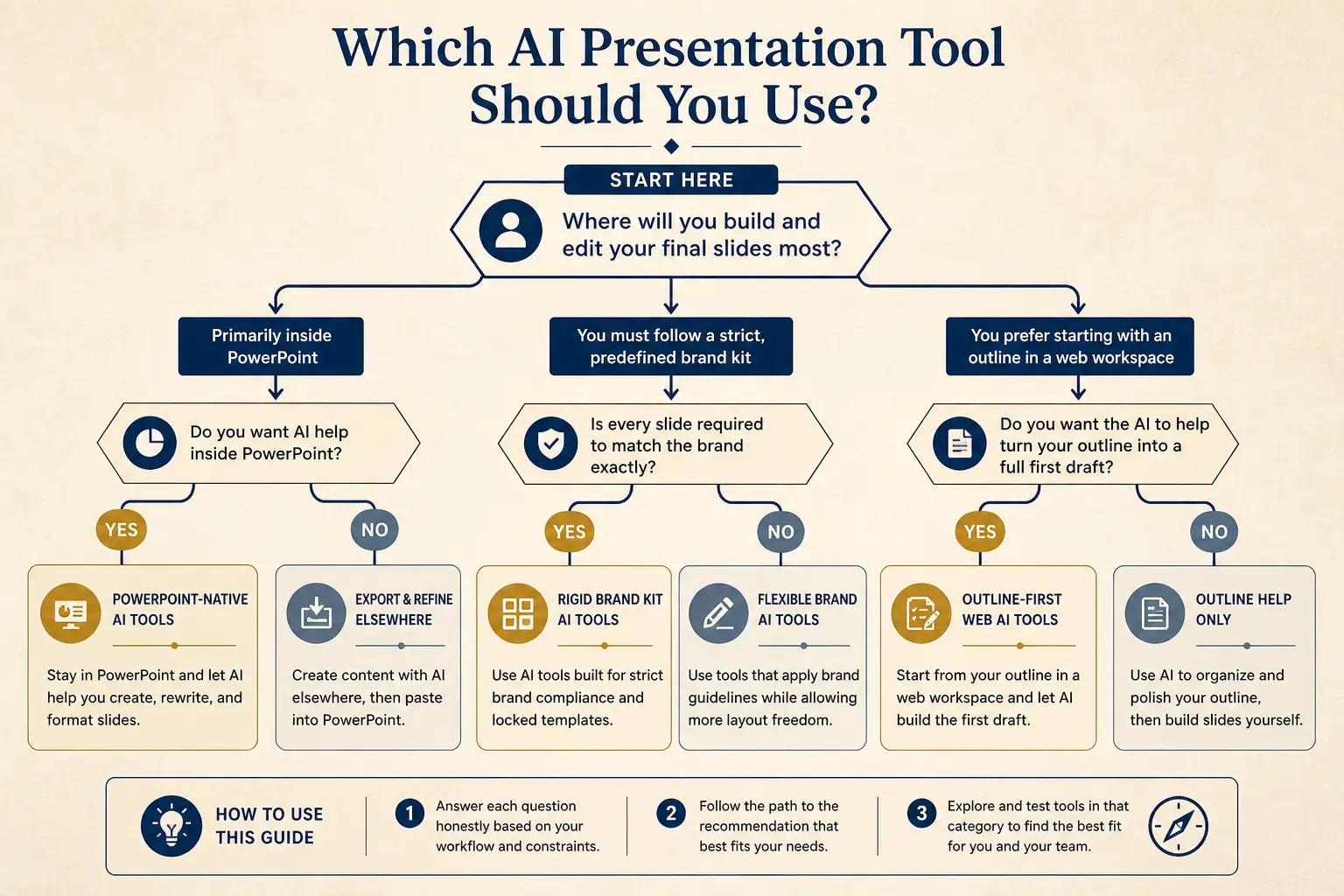
Which tool for which job
Need native PowerPoint editing every day?
Yes → Plus AI / Copilot · No → continue
Need rigid brand kits across a large team?
Yes → Beautiful.ai / enterprise kits · No → continue
Need outline-first AI drafting + present link?
Yes → Gamma
Template spine mapped to SCORE
The template encodes SCORE: Scorecard versus plan or success criteria, Context that changed, Options on the table, Risks with owners, Exact asks. Write SCORE before generating. If Options are missing, you built a status tour. If Risks lack owners, you built fiction.
- Scorecard, adoption, quality, support, and goal variance in titles.
- Context, what changed in user behavior or constraints since last review.
- Options, ship, hold, kill, or sequencing choices with tradeoffs.
- Risks, severity, owner, mitigation date.
- Exact asks, approvals needed today with implications if deferred.
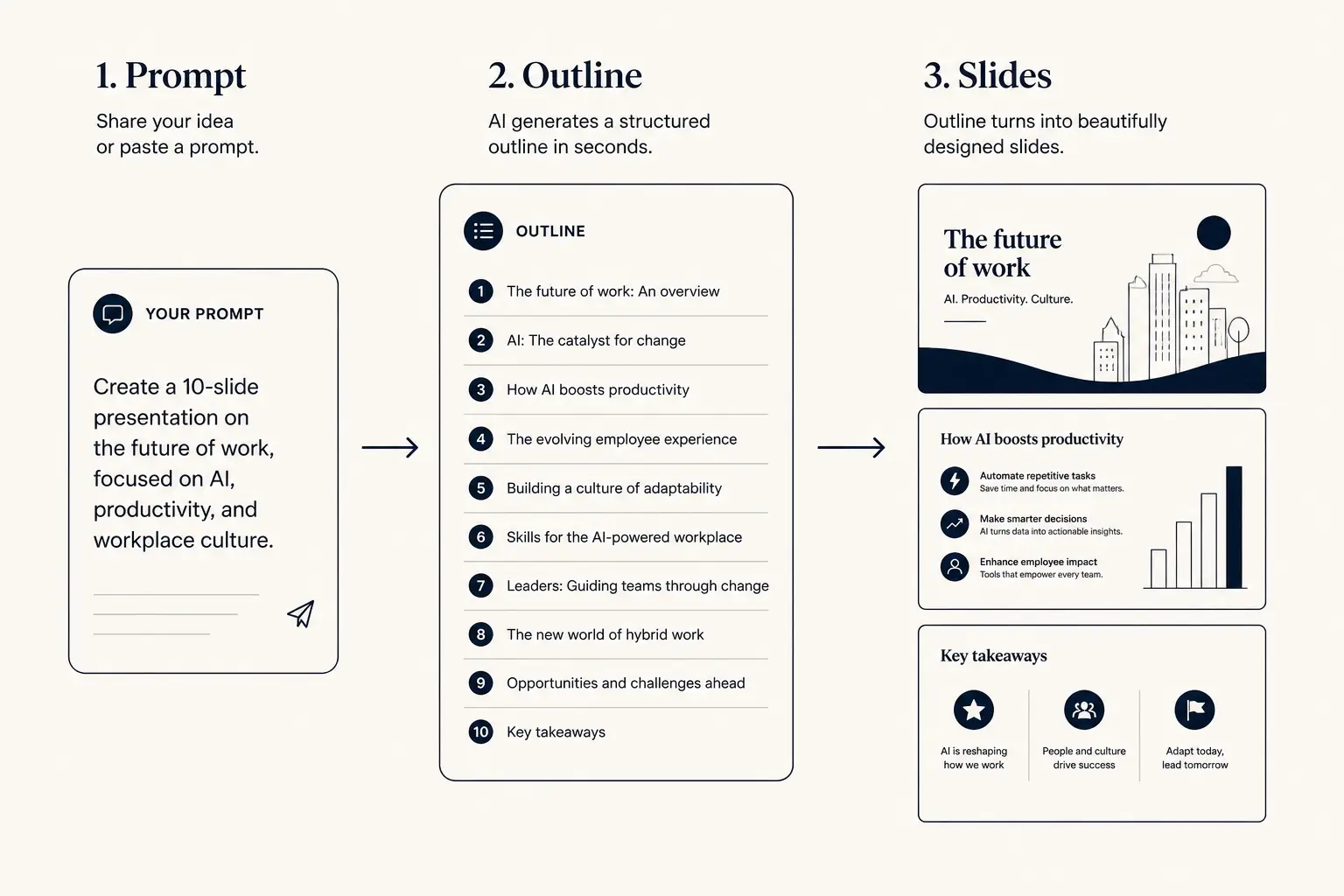
Prompt → outline → slides
1. Prompt
Audience, goal, length, proof you already have.
2. Outline
- • Opening claim
- • Proof beats
- • Ask / next step
3. Slides
Outline preview
- Narrative, open with Fill a product review template for
- Body, 3–5 slides that carry the argument
- Close, summary, risks, and the ask
Preview only, Gamma expands this into editable slides.
Time-box the review
Eighteen-minute ship reviews need fewer slides than sixty-minute roadmap forums. Set minutes and stakes so the template does not expand into a tour.
Slide budget calculator
Get a realistic slide count from meeting length and stakes, then open a matching prompt in Gamma.
18
Total slides
13
Core narrative
5
Appendix
Create a 18-slide deck for executives who skim. Meeting length: 18 minutes. Stakes: high. Use an outline-first structure with 13 core narrative slides and 5 appendix slides. Every slide needs one claim and proof.
Open this budget in GammaWorked example: Feature X ship review
Meeting: eighteen minutes with eng and design leadership. Feature X adoption is 22 percent of weekly actives over thirty days. Support tickets up 18 percent on onboarding step three. Two reliability risks have owners and dates. Decision needed: hold fourteen days versus ship now. Fill Scorecard with adoption and support variance in the title. Fill Risks before the ask. Fill Options with tradeoffs. Cut history-of-the-project. Closing slide names owner and re-review date—not Thanks.
| Template slide | Claim to show | Proof pasted |
|---|---|---|
| Scorecard | Adoption real; support load rising with it | 22 percent WAU; tickets up 18 percent on step three |
| Risks | Two reliability risks block a clean ship call | Owner, severity, mitigation date per row |
| Ask | Approve fourteen-day hold with named re-review | Options table ship/hold/kill with tradeoffs |
Anatomy of a claim slide
Claim headline (one idea)
Supporting line that states the so-what for this audience.
Source / footnote
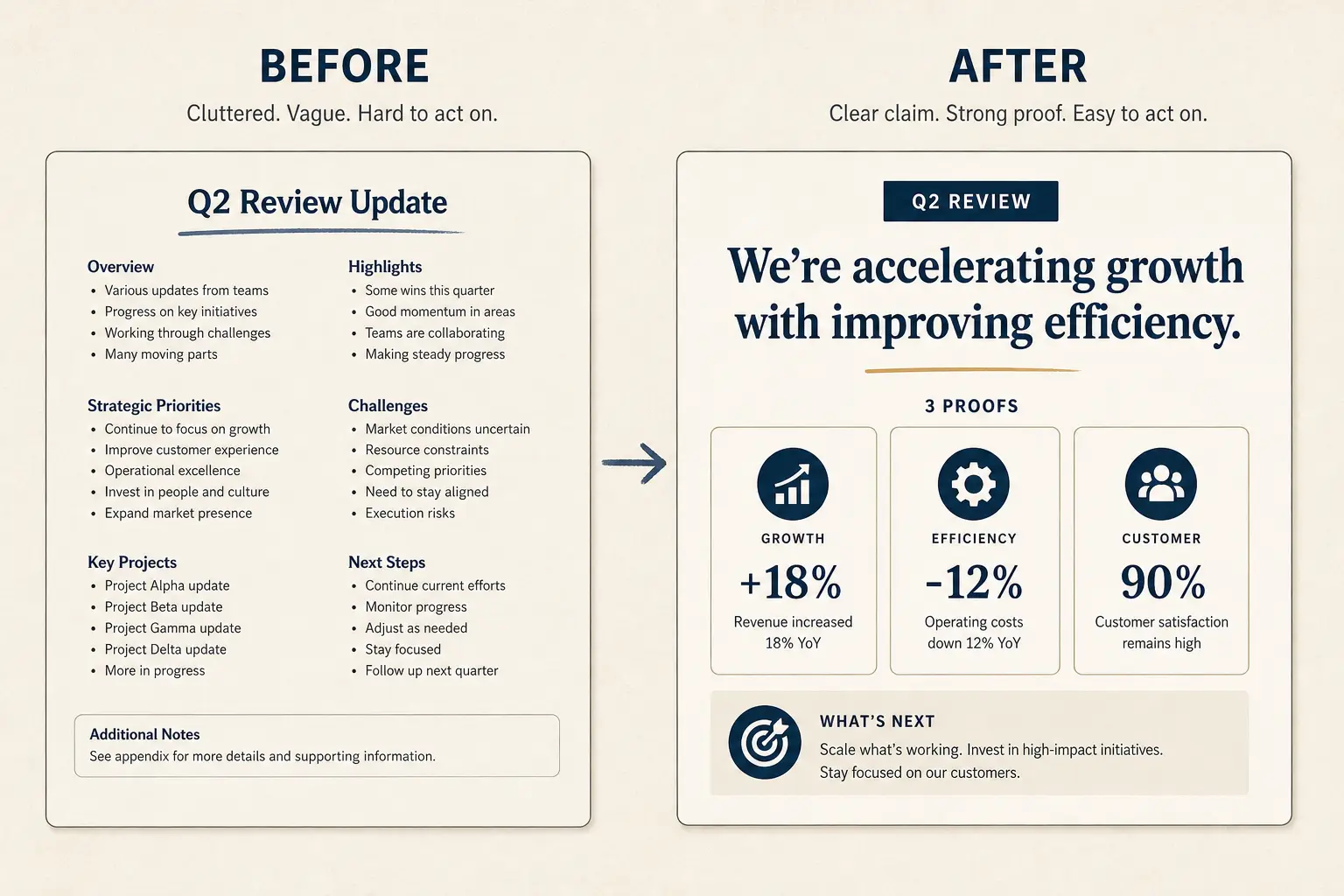
Rewrite status tourism
Weak bullets → claim/proof/ask
Paste a bad slide. Get a rewrite pattern you can drop into Gamma, not vibes, a structure.
- Claim: Agenda (make the cost of inaction obvious)
- Proof: Highlights (add a number, name, or constraint)
- Proof: Metrics (add a number, name, or constraint)
- Proof: Next steps (add a number, name, or constraint)
- Ask: Thanks (one decision, one owner, one date)
Roadmap mode versus ship mode
Ship mode emphasizes a single feature decision. Roadmap mode emphasizes bets, capacity, and sequencing asks. Duplicate the template and retitle Options accordingly. Do not mix a six-bet roadmap into an eighteen-minute ship review without parking bets in appendix. Capacity math belongs on a slide leaders can challenge, not in speaker notes.
Evaluation rubric axes
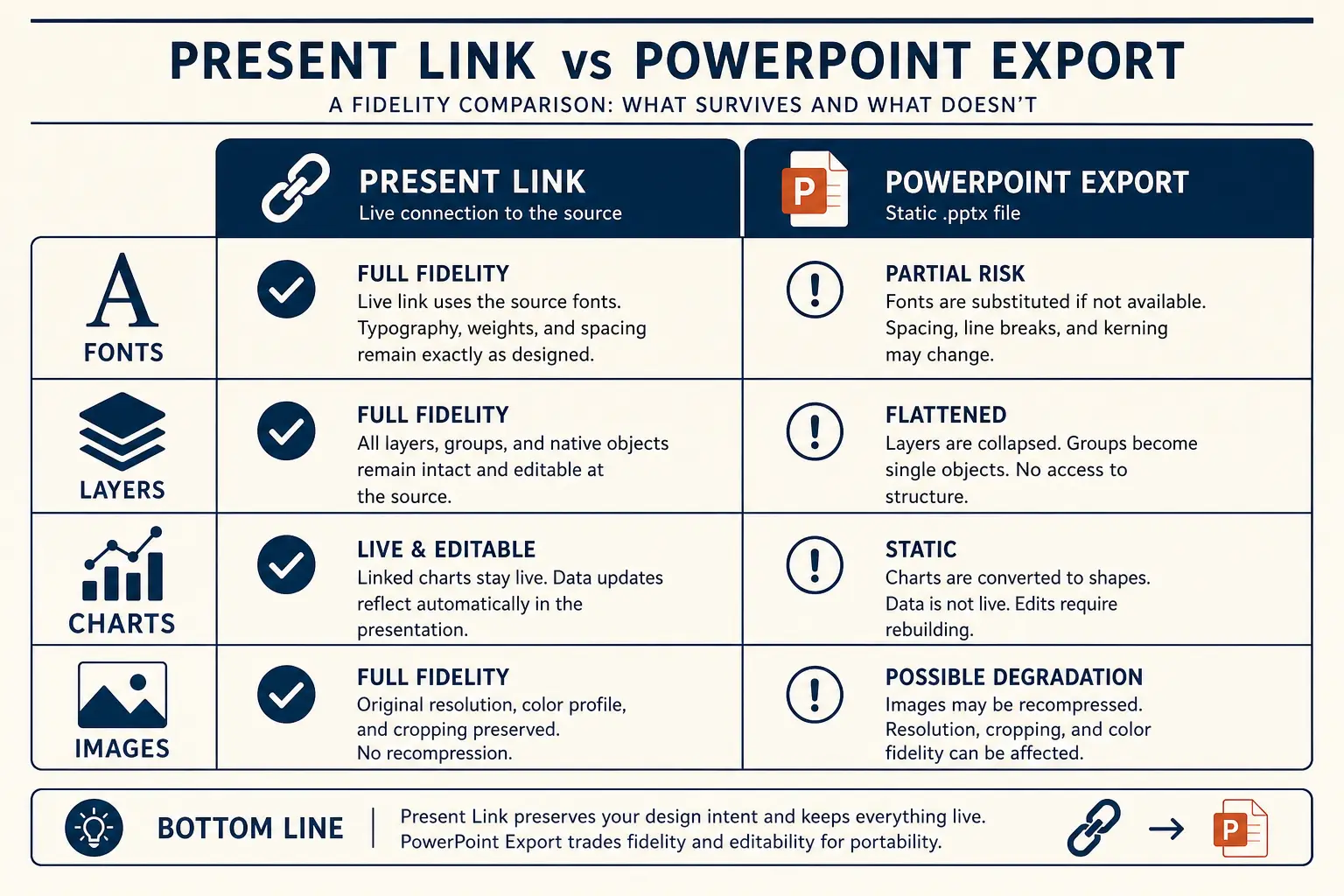
Present link vs PPTX fidelity
Present link
- • Live latest edits
- • Best for your room
- • Analytics-friendly
Export PPTX / PDF
- • Offline / procurement
- • Brand review in PPT
- • Expect cleanup passes
Slide density spectrum
Sparse
Live stage
1 claim, huge type
Balanced
Default
Claim + 3 proofs
Dense
Leave-behind
Detail for async read
From PRD to review deck
If your source is a PRD or Notion brief, run document to presentation with CUTS, then drop the result into this template spine. Do not paste the entire PRD as slides. Underline must-keep claims: user problem, success metrics, options, risks, ask. Omit backlog trivia. The template gives the decision shape; the document workflow supplies the cuts.
Failure modes
- Status tours with zero options and zero asks.
- Hiding adoption or quality misses under vanity charts.
- Risks without owners or dates.
- AI-invented quotes or metrics the team cannot source.
- Using a sales or pitch template for an internal ship decision.
- Ending on Thanks instead of owner, date, and recommendation.
- Packing six roadmap bets into a short ship review without appendix.
- Decorating before the title-only read shows variance clearly.
Continue in product reviews under Learn, use the AI board deck page for director-level packets, and browse examples for annotated decision decks. Return to the templates hub to switch spines. Method scores tools when software choice—not the feature decision—is the open question.
Rituals that keep product reviews decision-ready
Product organizations should schedule review rituals around decisions, not around slide production. If there is no ship, hold, kill, or sequencing ask, cancel the deck and send a short status note. The product review template exists to force options and owners into the open. Using it for applause tours trains leaders to skim and disengage.
Define success criteria at kickoff and reuse them on the scorecard. Reviews fail when success criteria mutate to match whatever improved. AI will not catch that dishonesty unless you paste the original criteria beside actuals. Put both on one slide so variance is undeniable.
Require risk rows to include owner and date before the meeting starts. A risk without an owner is a story. A risk with an owner and no date is a wish. The template’s risk section should be rejected in outline form if those fields are empty. This single habit improves reliability conversations more than any visual redesign.
For roadmap reviews, show capacity math explicitly. Leaders cannot sequence bets without knowing what does not get done. AI can draft bet descriptions; humans must supply capacity constraints and opportunity costs. Put the sequencing ask on a slide with clear recommendation and fallback.
Separate customer marketing narratives from internal decision narratives. Launch glitter belongs elsewhere. Internal reviews need adoption, quality, support themes, and tradeoffs. If a PM pastes launch copy into the template, rewrite titles until they sound like decision memos. The before-after rewriter on this page exists for that cleanup.
When reviews repeatedly overflow, shrink the template defaults. Teams normalize eighteen slides because the first generate looked complete. Leadership should reward short decision paths. Appendix can hold exploratory detail. Core path should remain discussable inside the minute budget.
Connect PRDs to reviews through document to presentation CUTS rather than pasting entire specs. Underline must-keep claims, trim backlog trivia, and shape channel. Then drop into this template. That pipeline keeps engineering truth intact without turning the room into a reading group.
After each decision, record the outcome and re-review date in the next packet’s context. Closed asks should not reappear as open questions. Over time, this creates an institutional memory that AI drafting can support but never replace. Decision-ready templates compound when the organization closes the loop.
Invite dissenting evidence into the template on purpose. If support themes conflict with survey delight, show both. AI tends to smooth contradiction into a bland narrative. Product leaders need the contradiction to decide. Put conflicting evidence on adjacent slides rather than averaging them into meaningless green metrics.
For platform teams, include dependency risks and cross-team asks explicitly. Ship decisions often fail because another team’s constraint was invisible. The Exact asks section can include non-product approvals such as staffing or migration windows. Name owners outside the immediate squad when needed.
Keep a library of strong and weak review fills for PM onboarding. Weak fills usually share traits: tourism titles, missing options, risks without owners, and thank-you closings. Strong fills show variance in titles and end on decisions. Studying those pairs teaches SCORE faster than abstract framework lectures.
If leadership repeatedly asks for more detail, resist by improving appendix navigation rather than lengthening the core path. Decision rooms die when every curiosity becomes a live slide. The product review template should protect focus. Teach stakeholders that appendix jumps are available without turning the meeting into a scavenger hunt through twenty status frames.
Keep the re-review date visible whenever you choose hold, and put the success criteria that will unlock ship on the same slide so the next meeting does not renegotiate the definition of done from scratch under time pressure with new vanity metrics.
Pre-read packets versus live review rooms
Some leadership teams want a pre-read twenty-four hours ahead; others insist on live debate only. Adapt the SCORE template to the room: denser scorecards and risk tables for pre-read, sparer titles and a sharper recommendation for live discussion. Never change the recommendation between modes. If the pre-read and the live deck disagree, trust collapses and the review becomes theater about which file is real.
When a review spans multiple squads, nominate a single deck owner who merges inputs before the meeting. Parallel AI drafts that never reconcile produce duplicate option slides and conflicting asks. The owner should run a ten-minute title-only pass with each contributor the day before, then lock the core path. Appendix can absorb unresolved detail without hijacking the decision clock.
Frequently asked questions
Fill the review spine with a real decision
Open Gamma’s product review template with SCORE sentences and actuals. Put options and asks on slides leaders can debate.