Learn · Product
Product & executive review decks
Product reviews, roadmaps, QBRs, and exec updates fail for the same reason: they optimize for completeness instead of decisions. Leadership needs the recommendation, the evidence, the options considered, and the owners, not a tour of every ticket closed last sprint.
This hub is about decision-ready slides for internal rooms. Browse product review and QBR examples, draft from the AI board deck path, or start in the AI presentation maker.
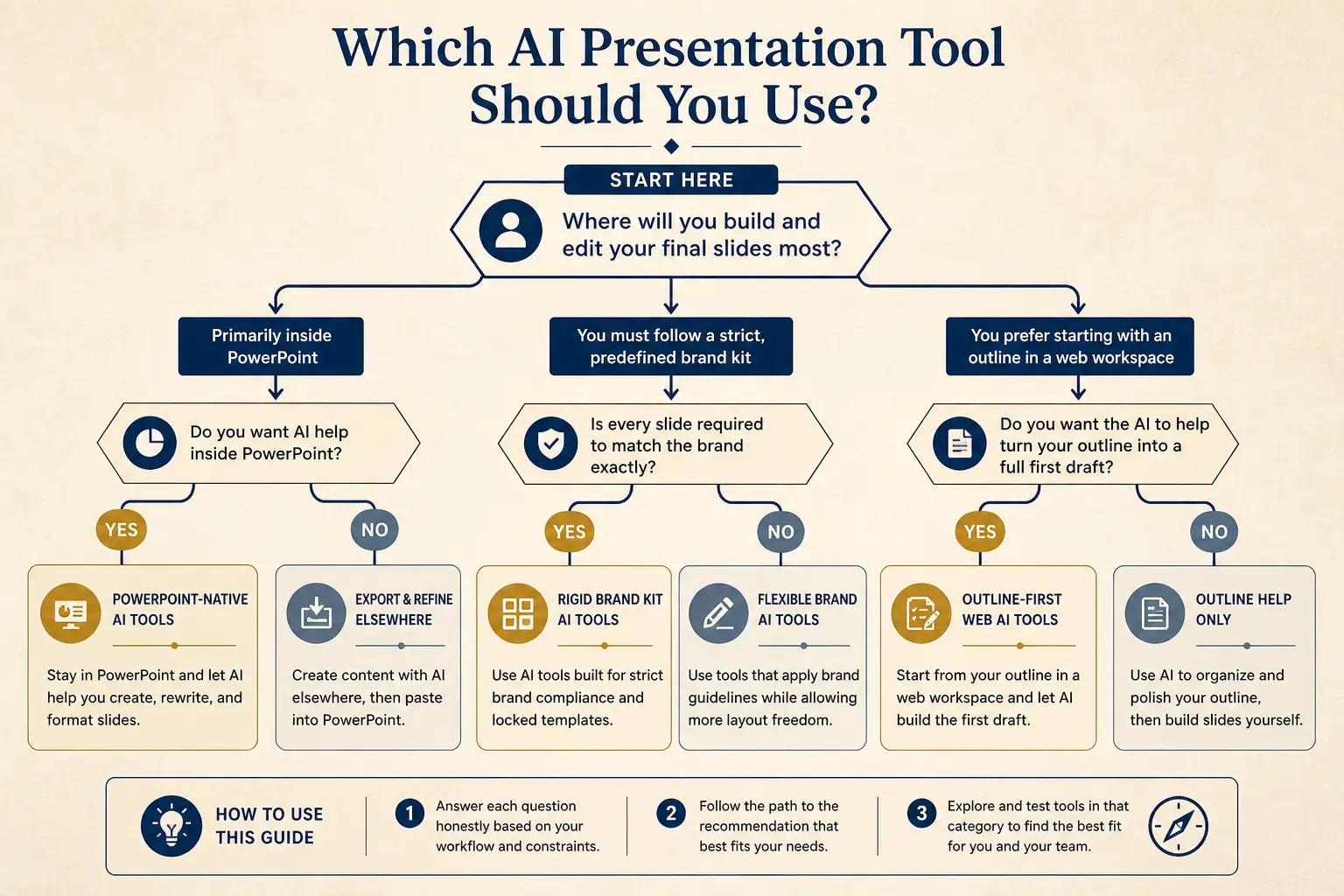
Which tool for which job
Need native PowerPoint editing every day?
Yes → Plus AI / Copilot · No → continue
Need rigid brand kits across a large team?
Yes → Beautiful.ai / enterprise kits · No → continue
Need outline-first AI drafting + present link?
Yes → Gamma
Product review anatomy
A useful PR deck states the goal in one sentence, shows the evidence that matters, presents options with tradeoffs, and ends with a recommendation plus owners and dates. Metrics without decisions are status theater. Decisions without metrics are opinions with formatting.
- Context: why this review exists now
- Scorecard: the few metrics that govern the decision
- Insight: what changed, not everything that happened
- Options: at least one alternative you are not choosing
- Ask: approval, resources, or policy change
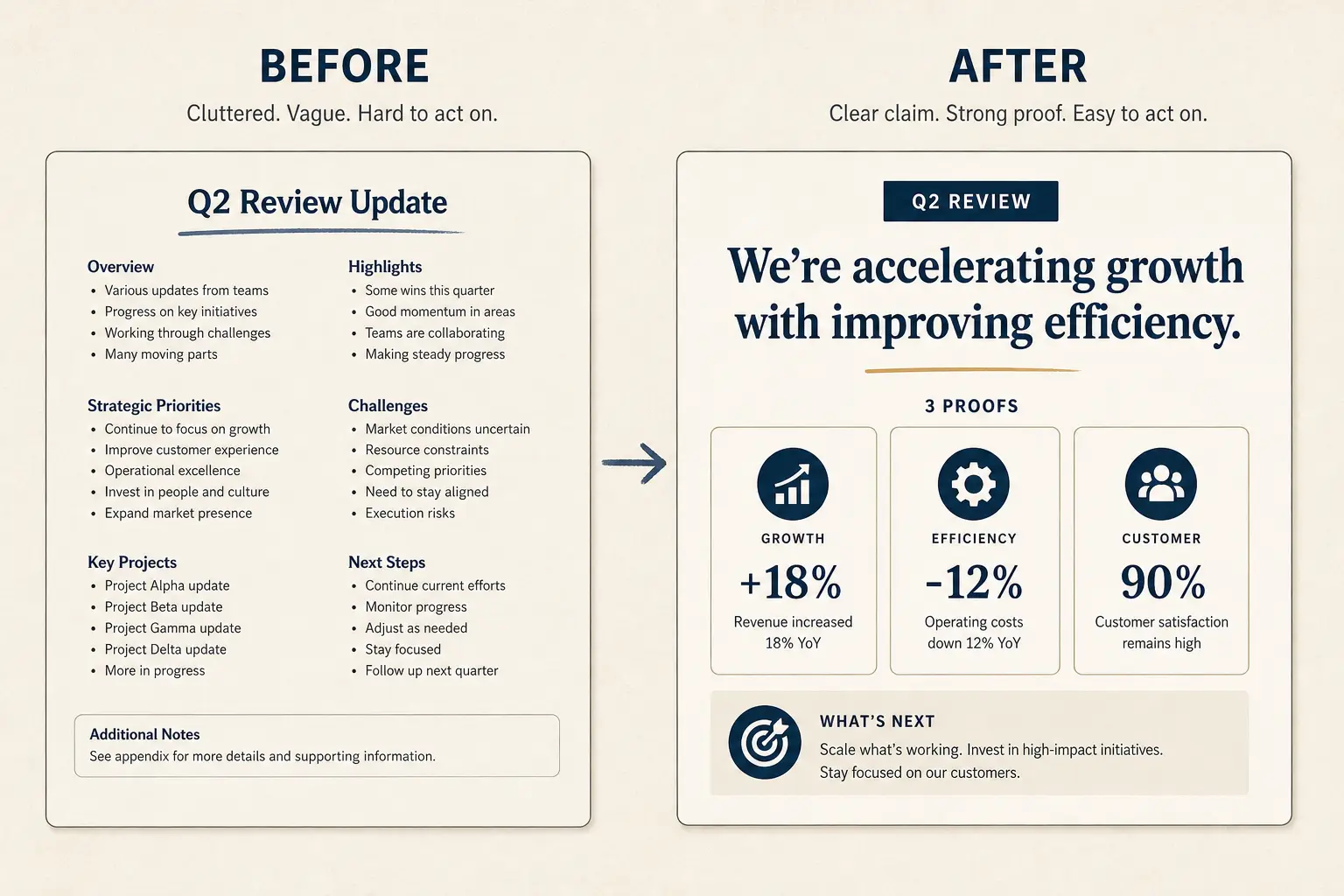
Anatomy of a claim slide
Claim headline (one idea)
Supporting line that states the so-what for this audience.
Source / footnote
Roadmaps that survive the room
Executives do not need your Jira hierarchy. They need themes, customer outcomes, sequencing rationale, and what you are explicitly not doing. Time horizons beat feature laundry lists. Risks and dependencies belong next to the plan, not in a separate “risks” graveyard at the end. When AI drafts a roadmap deck, force a “not doing” slide, models avoid negation unless asked.
QBRs without template soup
Quarterly business reviews work when every team uses the same scorecard spine and customizes the narrative. Wins and misses should map to causes and next-quarter actions. If churn is up, show cohort truth and the intervention, do not hide it under a green ARR arrow. See QBR structure and the long-tail churn in a QBR.
Slide density spectrum
Sparse
Live stage
1 claim, huge type
Balanced
Default
Claim + 3 proofs
Dense
Leave-behind
Detail for async read
Exec updates and all-hands
Shorter is harder. An exec update should fit the calendar: highlights, one risk, one ask. All-hands decks need a story employees can retell — strategy in plain language, progress against it, and what changes for them next. Avoid packing both audiences into one artifact.
Framework: decision-first outline
Before generation, write four lines: (1) decision needed, (2) recommendation, (3) top three evidences, (4) ask with owner and date. Generate only after those lines are human-owned. AI may invent causality if you skip this — that fails both Structure and Honesty on /method.
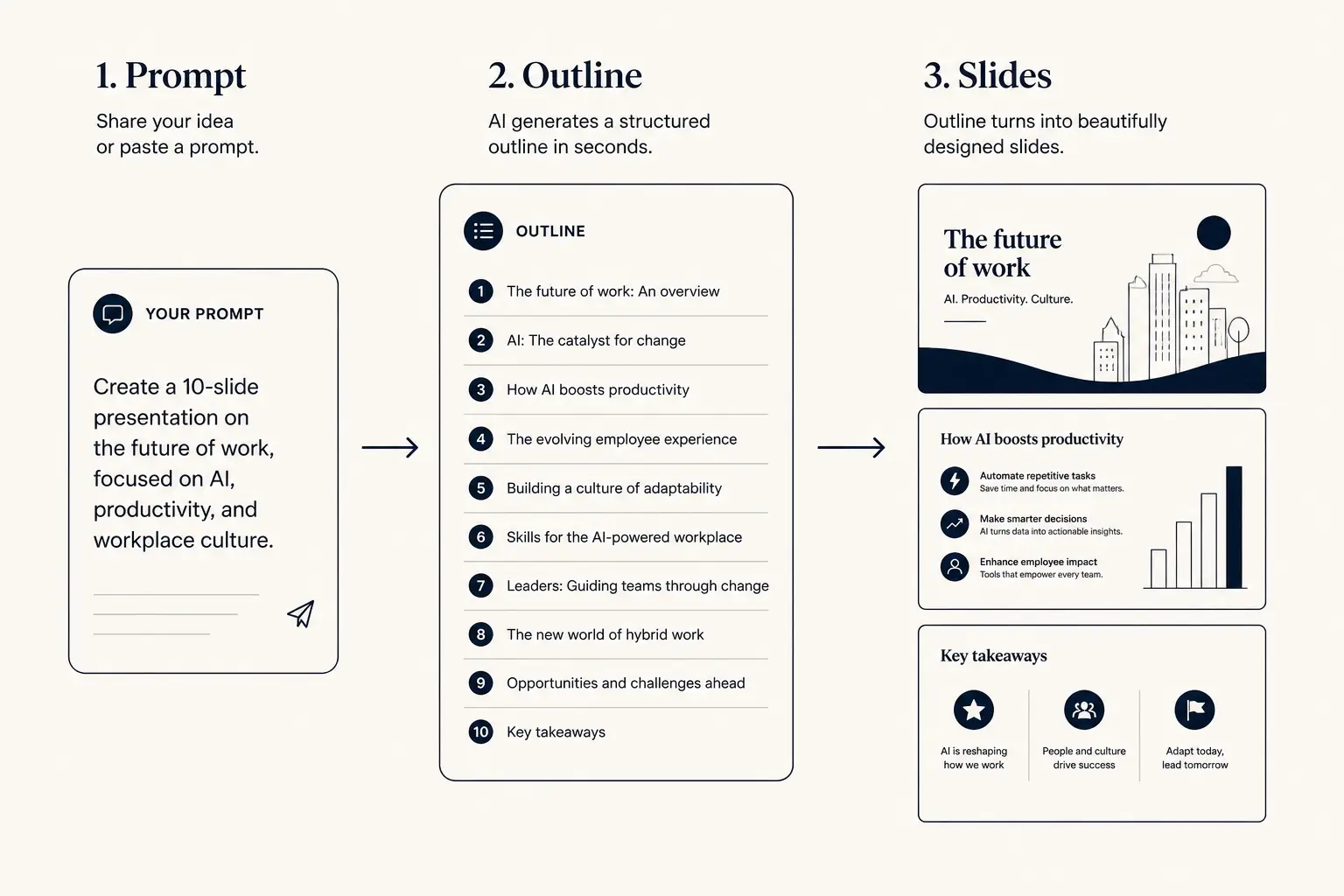
Prompt → outline → slides
1. Prompt
Audience, goal, length, proof you already have.
2. Outline
- • Opening claim
- • Proof beats
- • Ask / next step
3. Slides
Worked example: 30-minute reliability review
Goal: approve delaying Feature X to fund reliability. Scorecard shows incident rate up 30% QoQ. Options: ship X anyway, delay X one quarter, hire contractors. Recommendation: delay X; fund two SRE hires; owners named. Live deck is 10 slides; appendix holds incident timelines. Pre-read PDF is denser. Forced edit: move decision to slide two.
Time-to-usable-deck
Blank PPT path
Outline in docs → design fight → rebuild → 3–8 hours
Outline-first AI path
Prompt → edit outline → generate → polish → minutes to first usable draft
Failure modes
- Status tours with no recommendation
- Different scorecards per team in the same QBR
- Roadmaps that never say what you are not doing
- AI-invented root causes presented as fact
- Twelve optional analyses inside a 30-minute slot
Not for you if…
You need a living roadmap tool, not a meeting artifact. You are pitching investors, use the pitch hub. You want AI to own the decision, stop; ownership stays human.
Frameworks, worked rules, and cuts
Product and exec decks fail when they optimize for completeness instead of decisions. Leadership needs the recommendation, the evidence, the options considered, and the owners. Ticket tours are status theater. Metrics without decisions are theater too. Decisions without metrics are opinions with formatting.
Original framework: Decision-First Outline. Before generation, write four lines you own as a human: decision needed, recommendation, top three evidences, ask with owner and date. Generate only after those lines exist. AI may invent causality if you skip this step, which fails Structure and Honesty on the public rubric.
Worked example: a thirty-minute reliability review recommending delay of Feature X to fund reliability. Scorecard shows incident rate up thirty percent quarter over quarter. Options include ship anyway, delay one quarter, or hire contractors. Recommendation delays X, funds two SRE hires, names owners. Live deck is ten slides; appendix holds incident timelines. Forced edit moves the decision to slide two.
Roadmaps survive when they show themes, customer outcomes, sequencing rationale, and what you are explicitly not doing. Jira hierarchy invites feature bargaining. Outcomes invite prioritization. Force a not-doing slide because models avoid negation unless asked. Risks belong next to the plan, not in a graveyard section at the end.
QBRs work with a shared scorecard spine and customized narrative. Wins and misses map to causes and next-quarter actions. If churn is up, show cohort truth and the intervention. Do not hide misses under a green ARR arrow. Pre-read PDFs can be denser; live decks should open on contention when pre-read actually happened.
Failure modes include status tours with no recommendation, different scorecards per team, roadmaps that never say no, AI-invented root causes, and twelve optional analyses inside a thirty-minute slot. Park deep dives behind a single appendix index so the room can choose where to dig without derailing the decision path.
Not for you if you need a living roadmap tool rather than a meeting artifact, if you are pitching investors, or if you want AI to own the decision. Ownership stays human. Use the pitch hub for fundraising narrative. Use product hubs for internal decision rooms with named owners and dates.
Concrete next step in Gamma: write the four decision-first lines, paste the scorecard metrics, generate an outline that leads with the recommendation, cut status slides into an appendix index, and present from a link with a denser PDF only if stakeholders truly pre-read. Confirm pre-read happened before you open on contention.
All-hands decks are a different density problem than product reviews. They need a short narrative arc employees can retell, not option matrices. Keep company-level outcomes, one honest miss, and a clear ask for how teams should prioritize. Save tradeoff tables for the exec review room.
Strategy offsites fail when every function pastes a different template. Agree on decision questions before slide generation: what bets continue, what stops, what resources move. AI can draft section scaffolds; humans must supply the bets and the stops or you get fluent vagueness.
Exec updates should surface exceptions, not restate the operating plan. Lead with what changed since the last update, what you need from the room, and which metrics moved with definitions intact. If nothing needs a decision, say so and keep the packet short instead of inventing theater.
Churn and reliability misses deserve cohort or incident truth on the same slide as the intervention. Separating bad news from the plan invites distrust. When AI suggests a soft landing phrase, replace it with the cause you can defend and the owner of the corrective action.
Roadmap not-doing lists should name the customer outcome you are delaying and the risk of saying yes anyway. Vague not-now language invites renegotiation in the meeting. Specific negation is a design choice that keeps the hour decision-shaped.
QBR appendix indexes should be one slide with named deep dives, owners, and whether pre-read is required. Without an index, every chart becomes a rabbit hole. With an index, leadership can choose digs without abandoning the recommendation path.
Product review rituals improve when the room agrees on three checks before taste feedback: Is the recommendation clear? Are options visible? Can we cut twenty percent of status slides? Apply those checks before arguing about chart colors. Pixel taste is optional until the decision path is clear.
Draft a decision-ready review
Start from the recommendation and evidence, Gamma helps you structure the room.