Learn · Sales
Sales deck structure that maps to discovery
A sales deck structure is a buyer conversation in slide form—not a product tour with a logo on every page. The order that works is stubbornly consistent across B2B: their situation, the cost of staying put, the capability that removes that cost, proof from people like them, commercial logic, implementation reality, and a mutual next step. If a slide does not advance that path, cut it before you debate fonts.
This guide is the spine for the sales presentations hub. Browse examples for annotated shapes. How we score structure is public on Method.
The eight-block spine
Treat these as blocks, not a rigid slide count. A twenty-minute call may merge blocks; a procurement committee may expand proof and risk. The sequence stays the same because buyers decide in this order whether you admit it or not. Skipping the cost-of-status-quo block is the most common reason rooms tune out during feature tours.
- Context mirror, Restate their world in their words: industry pressure, internal initiative, trigger event. One slide. If they nod, you earned the next ten minutes.
- Cost of status quo — Quantify broken: hours, error rate, lost deals, compliance exposure. Prefer their discovery metrics over industry averages.
- Capability, not catalog — Three capabilities max, each tied to a pain. Headlines read like outcomes, not module names.
- How it works, One diagram or three-step operating model. Demo timing lives here if you present live.
- Proof, Pair one metric case, one peer story, and one risk reducer. Logo strips alone are weak.
- Commercial framing — Packaging logic, cost drivers, ROI shape. Deep math on ROI slide that closes.
- Implementation reality — Timeline, owners, what you need from them, what “live” means. Rollout fear kills more deals than missing features.
- Mutual plan, Named next step, owners, date. Not “happy to answer questions.”
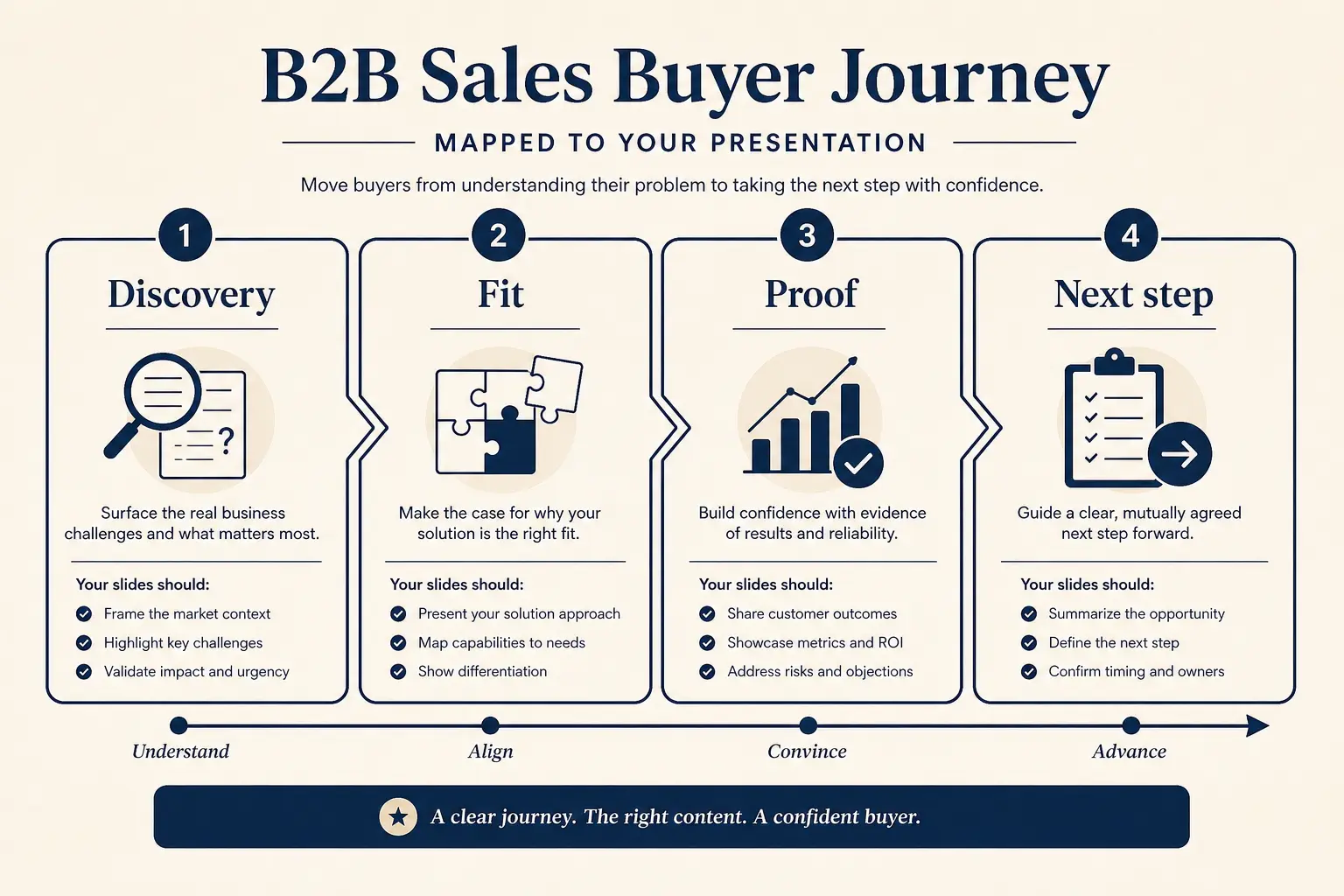
Buyer journey → slide map
Discovery
Pain + stakes
Fit
Why you win
Proof
ROI / risk
Next step
Clear ask
Discovery-mapped, not website-mapped
Most failed sales decks are homepage transplants. Marketing sites organize by product; buyers organize by jobs and risks. After every discovery call, tag notes into four buckets: pains with verbatim phrases, success criteria, stakeholders and objections, and commercial constraints. Those tags become slide titles. If a feature cannot map to a tagged pain, it does not belong in the live deck—full stop.
Run the title-only test: read only the headlines aloud. You should hear a story the buyer recognizes—you are drowning in ticket backlog, that backlog costs X, here is the workflow that clears it, peers saw Y, here is rollout and commercial, here is what we do Thursday. If titles say Overview, Features, Benefits, About us, you still have a brochure. Same-day conversion from call notes is covered in the discovery-to-deck guide.
Deep dive: discovery call to presentation.
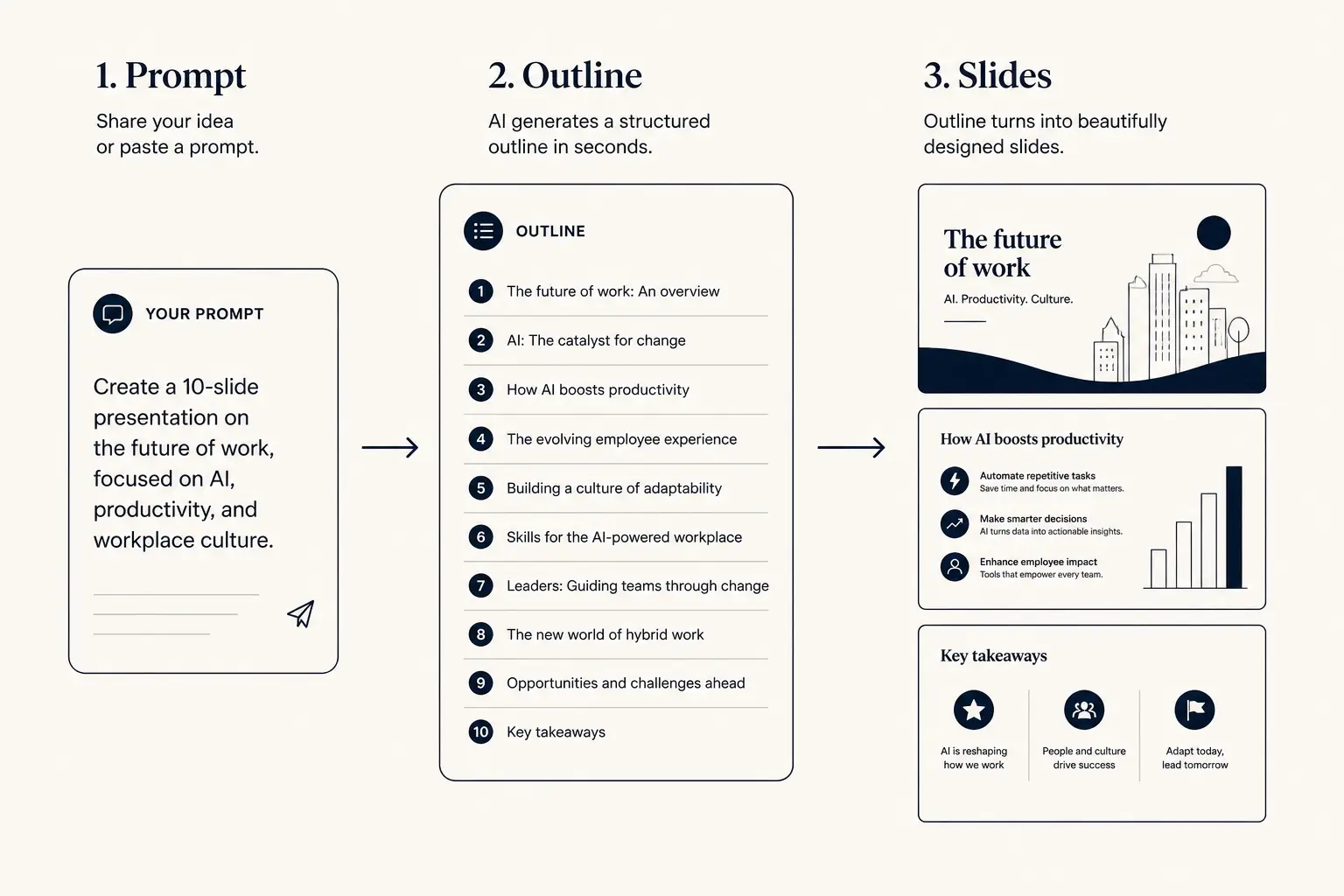
Prompt → outline → slides
1. Prompt
Audience, goal, length, proof you already have.
2. Outline
- • Opening claim
- • Proof beats
- • Ask / next step
3. Slides
Slide budget by meeting type
Budget slides from meeting minutes and stakes, not from how many screenshots marketing approved last quarter. A discovery follow-up at thirty-five minutes with medium stakes usually wants eight to ten live slides. An exec demo wants six to eight plus product time. A proposal review wants ten to fourteen with risk and commercial weight. Committee rooms want twelve plus appendix for security and legal depth.
Slide budget calculator
Get a realistic slide count from meeting length and stakes, then open a matching prompt in Gamma.
18
Total slides
13
Core narrative
5
Appendix
Create a 18-slide deck for executives who skim. Meeting length: 35 minutes. Stakes: medium. Use an outline-first structure with 13 core narrative slides and 5 appendix slides. Every slide needs one claim and proof.
Open this budget in Gamma| Meeting | Live slides | Emphasis |
|---|---|---|
| Discovery follow-up | 8–10 | Context mirror + capability + mutual plan |
| Demo with exec | 6–8 + live product | Sparse spine; see demo vs leave-behind |
| Proposal review | 10–14 | Scope, risk, ROI — proposal presentation |
| Multi-stakeholder | 12 + appendix | Proof and risk reducers first |
Slide density spectrum
Sparse
Live stage
1 claim, huge type
Balanced
Default
Claim + 3 proofs
Dense
Leave-behind
Detail for async read
Worked example: mid-market ops follow-up
Discovery notes from a forty-two-minute call: the VP of Ops described weekend overtime on returns processing; success means thirty percent faster cycle time before Q4 peak; IT worried about Shopify to NetSuite sync; the CFO wants payback under nine months; the next step agreed is a ninety-minute technical workshop next Tuesday with two engineers and the RevOps lead.
Spine application: context mirror uses the overtime quote verbatim. Cost of status quo estimates eighteen overtime hours per week times sixty-five dollars loaded cost, about sixty thousand dollars per year, labeled as an estimate pending their numbers. Capability shows returns workflow automation with three outcome headlines, not a product menu. How-it-works is a three-step sync diagram as a workshop teaser. Proof picks one retail ops case with a cycle-time metric. Commercial frames a sixty-day pilot package and what drives price. Implementation shows the first thirty days and named owners on both sides. Mutual plan lists Tuesday attendees and the decision the workshop should unlock. Feature grids, founding story, and generic retail-is-changing slides never appear.
Stakeholder beliefs map onto slides
A single sales deck rarely serves every stakeholder equally. After discovery, list attendees for the next meeting. For each person, write the one belief they must leave with, then ensure a slide exists that creates that belief with proof. Orphan beliefs—needed but unsupported—are homework before you generate slides. If a stakeholder will only attend for fifteen minutes, give them a three-slide path through the spine, not a promise that everything is buried somewhere in the appendix.
- CFO belief: payback plausible under nine months → status-quo cost plus ROI with editable inputs.
- IT belief: integration will not become a six-month science project → how-it-works plus risk reducer with ownership.
- Champion belief: I will not look foolish sponsoring this → peer proof plus implementation reality with clear roles.
- End-user leader belief: this reduces my team’s pain this quarter → capability outcomes in their language.
Anatomy of a claim slide
Claim headline (one idea)
Supporting line that states the so-what for this audience.
Source / footnote
Objection placement without derailing
Do not front-load every objection. Place risk reducers after capability and before commercial: security posture, data residency, implementation ownership, integration path. If an objection dominated discovery, promote it earlier—right after the cost-of-status-quo block—so the buyer stops waiting to spring it. Never hide known deal-killers in the appendix; committees assume silence means weakness.
A practical timing rule for a thirty-five-minute follow-up: minutes zero to five for context and cost; five to fifteen for capability and how-it-works or demo; fifteen to twenty-two for proof and risk; twenty-two to thirty for commercial and implementation; thirty to thirty-five for mutual plan and questions. If proof runs long, cut a second case study—not the mutual plan. Rooms that run out of time before next steps are structure failures, not calendar failures.
What to cut ruthlessly
If removing the slide would not change the buyer’s next decision, it was decoration. Teams that cut roughly thirty percent of slides usually shorten cycle time because the room stays on the argument. Cut founding stories longer than two sentences unless founder credibility is the proof. Cut feature grids that do not map to discovery pains. Cut generic industry trend slides every vendor uses. Cut thank-you closers that replace a mutual plan. Cut duplicate proof slides that say the same case three ways. Cut security questionnaires from the live narrative—appendix or data room only.
Weak slide → strong slide
Before
- • Overview
- • Features
- • Next steps???
After
- • Cost of status quo
- • Wedge in one claim
- • Proof + decision ask
Failure modes and the fix
- Feature dump after logo — Skipped shared pain. Fix: context mirror and cost before capability.
- Proof before problem — Cases feel like bragging. Fix: status quo cost first, then one peer metric.
- No commercial until proposal , Surprises create stalls. Fix: packaging logic and cost drivers before the ask.
- Vague close, “We’ll send materials” is not a plan. Fix: owner, date, and decision on the last slide.
- One deck for every stage — Discovery and proposal need different density. Fix: live and leave-behind twins from one outline.
Master deck versus account deck
Maintain one master spine with modular proof and commercial blocks. Account decks swap variables: company name, pains in their language, peer logos in their industry, ROI inputs, and the named next step. Do not fork twenty incompatible decks; fork variables. Appendices hold security questionnaires, architecture diagrams, full feature matrices, and extended cases. In the live narrative, reference the appendix once instead of touring twenty hidden slides. Keep Account_Motion_Live and Account_Motion_LB twins from the same outline so proof stays synchronized.
Variable map: personalize decks at scale.
Building the master in one week
Day one: pull five recent call notes and extract phrase clusters for pain, success criteria, and risk without polishing. High-frequency phrases become default titles in the master. Day two: draft eight claim titles only and run a title-only read with a manager who was not on the calls; if they cannot retell the buyer story, rewrite titles before any layout work. Day three: attach proof modules and commercial options from an approved library, labeling each proof metric with commitment level—customer-approved, anonymized, or directional. Day four: generate in Gamma, force a twenty percent cut, and produce live and leave-behind density twins from the same outline. Day five: enablement dry-run where one rep presents titles only and another plays skeptic CFO.
Version hygiene matters once the master exists. Name files by motion and density, such as ICP_Motion_Live_v3, not by rep name. Personalization forks variables, not spines—otherwise every AE invents a new narrative and forecasting becomes fiction.
Enablement scorecard
Managers should score structure, not aesthetics. Five binary checks before customer send: buyer language on slide one; status quo cost before product; proof with a metric not only logos; commercial framing present; mutual plan dated with owners. Fail two and the deck returns for rewrite. In deal reviews, ask reps to present only titles before opening body copy. Require the mutual plan slide to match CRM next-step fields exactly, including date and buyer-side owners when known. Celebrate cuts publicly so brevity becomes status instead of fear.
Evaluation rubric axes
Not for you if…
This spine is wrong for consumer flash sales, one-call transactional SMB where a pricing page closes the deal, or investor fundraising—use the pitch decks cluster instead. It is also wrong if you refuse to capture discovery notes. Without buyer language, every personalized deck is still a brochure with a mail-merge field on the title slide. If your motion is pure inbound product-led growth with no human discovery, invest in in-app education rather than forcing an eight-block enterprise narrative onto a self-serve checkout.
Concrete next step in Gamma: paste four discovery tags—pain phrases, success criteria, top objection, and the dated next step—into an outline-first prompt. Lock the eight-block order. Generate, run the title-only test, cut twenty percent, then create the leave-behind twin only after the live spine survives a skeptical manager read. If the title-only story still sounds like your homepage, delete the draft and retag the discovery notes before you touch any design polish at all on the draft.
Checklist before you send or present
- Every headline uses buyer language from discovery or known ICP.
- Cost of status quo appears before product capability.
- Proof includes at least one peer-relevant metric, not only logos.
- Commercial framing answers what drives price even if numbers are ranges.
- Implementation names owners and a realistic first milestone.
- Last slide has a dated mutual plan—not Questions.
- Appendix holds security, legal, and feature depth—not the live narrative.
- You can delete twenty percent of slides and the story still stands.
- Live and leave-behind twins share the same outline version number.
- Every attending stakeholder has at least one slide that creates their required belief.
Draft in AI sales presentation or AI presentation maker: paste discovery tags, name the next step, reject weak outline sections before polish. Design craft after structure: presentation design.
Frequently asked questions
Rebuild your sales spine today
Paste discovery notes into Gamma, keep the eight-block outline, and cut every slide that does not move the buyer toward a dated next step.